
Estimating a Logistic Regression Model on the Impact of Geopolitical Risk on Financial Development
Wilbert Kudakwashe Chidaushe* 
1Faculty of Business and Accounting (FBA), Botho University, Gaborone, Botswana .
wilbert.chidaushe@bothouniversity.ac.bw
http://dx.doi.org/10.12944/JBSFM.07.01.06
The study aimed to uncover the impact of geopolitical risk on financial development. The study applied logistic regression model on the data gathered from the year 2010 to the year 2024 for fifty-three countries chosen at random around the globe. The study used simple random sampling in selecting the countries to the study. The theoretical framework for the study was based on the functional and securitization perspective. The study tested the hypothesis that geopolitical risk is significantly and positively associated with financial development, as measured by financial stability (computed by volatility of stock prices), financial depth (computed by financial systems deposit to GDP), financial access (computed by number of bank branches per 100,000 adults) and financial efficiency (computed by bank net interest margin). The results of hypothesis testing revealed that geopolitical risk is significantly and negatively associated with financial stability (as measured by stock price volatility), financial access (as measured by bank branches per 100,000 adults) and financial efficiency (as measured by bank interest margin). Further testing of the hypothesis revealed that geopolitical risk is significantly and positively correlated with financial depth (as measured by financial systems deposit to GDP). Banking institutions, investors and non-banking financial institutions located in areas of moderate, elevated and heightened geopolitical threats and acts should rethink and repatriate funds and investments to safe havens around the globe. Intercountry and regional as well as international cooperation and collaborations are crucial for mitigating geopolitical risk of any form. The relationship between geopolitical risk and financial development is both symmetrical and asymmetrical as it is at times based on the non-traditional, known, unknown and the unknown.
Copy the following to cite this article:
Chidaushe W. K. "Estimating a Logistic Regression Model on the Impact of Geopolitical Risk on Financial Development".Journal of Business Strategy Finance and Management, 7(1).
DOI:http://dx.doi.org/10.12944/JBSFM.07.01.06Copy the following to cite this URL:
Chidaushe W. K. "Estimating a Logistic Regression Model on the Impact of Geopolitical Risk on Financial Development".Journal of Business Strategy Finance and Management, 7(1). Available here:https://bit.ly/4i6JRVf
Download article (pdf) Citation Manager Publish History



Introduction
Cihák et al. (2012) defined financial development as characterised by financial depth, financial access, financial efficiency and financial stability of financial systems. The Global Financial Development Report (2020) captured the measures of these characteristics for both financial institutions and financial markets.
Diekelmann et al. (2024) defined geopolitical risks as attributable to actors and countries that cause threats and escalate adverse events that cause tensions, terrorism and wars. Diekelmann et al. (2022) advised that a firm's level of sensitivity to geopolitical risk varies depending on its geographic location and trade connections, as well as the various industrial sectors.
Financial stability report (2024) referred to geopolitical risk as the potential for bad events stemming from conflicts, international tensions, cyber-attacks and trade restrictions. It is highlighted that geopolitical risk is communicated across channels notably generating interruptions to supply chains and limited access to export markets. It has also been noted that the financial market channel transmits geopolitical risk, which results in reduced asset prices and tighter funding conditions. According to the Financial Stability Report (2024), financial institutions are impacted by geopolitical risk in the form of higher funding costs, default rates, and market costs. Figure 1 summarizes the devastating effects of geopolitical risks on the global economies.
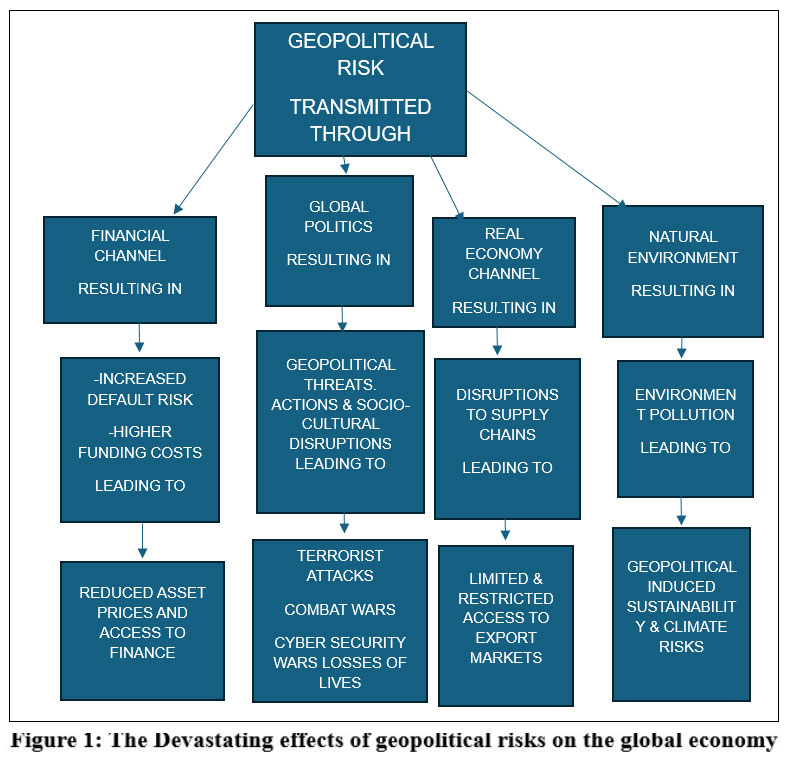 | Figure 1: The Devastating effects of geopolitical risks on the global economy |
Source: Author, 2024
It is further elaborated that most types of manufacturing and technological based industries are affected intermediately whilst those in the mining and consumer goods are the least affected. Additionally, it has been noted that the defense, natural gas, and fossil fuel businesses benefit from stress associated with geopolitical risk (ibid).
Maijoor (2024) argued that the Netherlands and Europe have not been able to take international relations for granted. De Nederlandsche Bank (DNB) (2024) noted that increased international relations had an effect on financial institutions, so Majoor (2024) advised financial institutions, especially banks, insurance companies, and pension funds, to improve their operational resilience by being proactive in identifying geopolitical risk.
Buck (2024) urged on financial institutions to be ready for a very lengthy period of global tensions characterized by increased volatility and high uncertainty, emphasizing that elevated geopolitical risk is unlikely to subside in the near future. Buck (2024) defined geopolitical risks as addressing both the unknown and the known, rather than only the former. Financial institutions are advised to provide adequate operational and financial resilience in order to counteract geopolitical threats. Furthermore, it is proposed that in order to address geopolitical risks, close coordination between macroprudential and microprudential supervision is necessary. Finally, Buck (2024) hinted at the need for strong international cooperation to address the negative effects on banks and non-banks as well as the global nature of geopolitical concerns.
Measuring Geopolitical Risk
To measure negative geopolitical events and associated risks, Dario and Iacoviello (2022) created the geopolitical index by classifying automated text-search results from ten newspapers' electronic archives. The percentage of news stories about negative geopolitical developments in each of the ten newspapers for each month was represented by this index.
Dario and Iacoviello (2022) developed two subindices, specifically the Geopolitical Acts (GPRA) and the Geopolitical Threats (GPRT). Texts that fall under the headings of war threats, military buildups, nuclear threats, terror threats, and the start of conflict are included in the geopolitical threats. Texts that support the spread of war and acts of terror are covered by the geopolitical acts.
The Impact of Geopolitical Risk
Special Eurasia (2024) identified two geopolitical risk impact spectrums comprising of moderate geopolitical tensions and geopolitical crises. It is claimed that the impact of moderate geopolitical tensions resulted in subdued market response with discerning investors speculating in sectors poised to benefit such as the defence industries. It is further stressed that elevated geopolitical risk provoke market volatilities prompting investors to transfer capital from vulnerable emerging markets to safe havens in developed economies. It is also proclaimed that geopolitical crises resulted in disturbances in global supply chains, currency devaluations and precipitating sharp decline in equity values. The following were identified as key transmission channels of geopolitical risks notably, commodity price volatility, investor sentiments, economic uncertainty and currency fluctuations. The following were the recommended as strategies in a geopolitical world, scenario planning, diversification, focus on long term fundamentals and tactical asset allocation (Special Eurasia, 2024).
Hentov et al. (2018) observed that the impact of geopolitical risk differs across countries regarding equity and foreign exchange markets. In addition, the study observed that equity markets responded to geopolitical risk asymmetrically as compared to currency spot markets that react instantly to negative events. It was also revealed that markets treat geopolitical risks as a beta driver and is more pronounced for negative than for positive events. The study covered those countries that met certain levels of efficiency and liquidity and was based on 71 geopolitical events that occurred from 1986 to 2018. The study examined the effect of geopolitical risk on volatility and returns of equity and currency markets.
Statement of the problem
Geopolitical risk is further recognised as a contemporary issue that threaten financial stability. The ongoing Russia, Nort Korea invasion of Ukraine, increased wars in the Middle East and fear escalation of tension of US and China over Taiwan have increased anxiety about geopolitical stability (Dieklmann et al., 2024). Increased conflict in the Middle East, the battles between Russia and Ukraine, Hamas and Israel, and the US's growing tensions with China over Taiwan have all had a major effect on global financial development. Thus, this study examined how geopolitical risk affects financial development, paying special emphasis to financial depth, financial access, financial stability, and efficiency as measured by a number of metrics.
Research gap
Zhang and Shi (2023) pronounced a significant gap in literature that fully explores how geopolitical risk affects financial development. The study by Zhang and Shi (2023) focused on financial channel and real economy channel through which the effects of geopolitical risk are transmitted and did not focus clearly on the impact of geopolitical risk on the other components of financial development that included financial access, financial depth and financial efficiency. Hence this study aimed to focus its attention on the impact of geopolitical risk on financial access, financial depth and financial efficiency as well as on financial stability to fill this gap in the literature.
Research Questions
What is the impact of geopolitical risk on financial development?
What is the association between geopolitical risk and financial development?
Objectives of the research
The objectives of the research were;
To investigate how financial development is affected by geopolitical risk
To assess how financial development and geopolitical risk are related.
The conceptual and operational hypotheses for the present study had been formulated as follows:
Conceptual hypothesis for the research
H0: Geopolitical risk is not profoundly and positively associated with financial development
H1: Geopolitical risk is profoundly and positively associated with financial development
Operational hypothesis for the study
H1a: Geopolitical risk is significantly and positively associated with financial access.
H1b: Geopolitical risk is significantly and positively associated with financial depth.
H1c: Geopolitical risk is significantly and positively associated with financial efficiency.
H1d: Geopolitical risk is significantly and positively associated with financial stability
Literature review
The empirical review is displayed in terms of theoretical, conceptual framework and discussed the impact of financial development.
Theoretical framework
The theoretical framework for the study is based on both functional perspective (Merton, 1993) and the differentiated securitization theory emphasizing on securitization (Buzan & Albert, 2011). The rationale for adoption of the functional perspective is that the study emphasized an examination of the impact of geopolitical risk on financial development which can be seen as an analysis of the impact of geopolitical risk on the role of banking and non-banking financial institutions providing functions of intermediaries. Buzan and Albert (2011) described securitization as an extreme version of politicization, leading to existential threats to sovereignty and above politics. Hence the present study adopted both the securitization and functional perspective theoretical frameworks as depicted in Figure 3 and Figure 4 below.
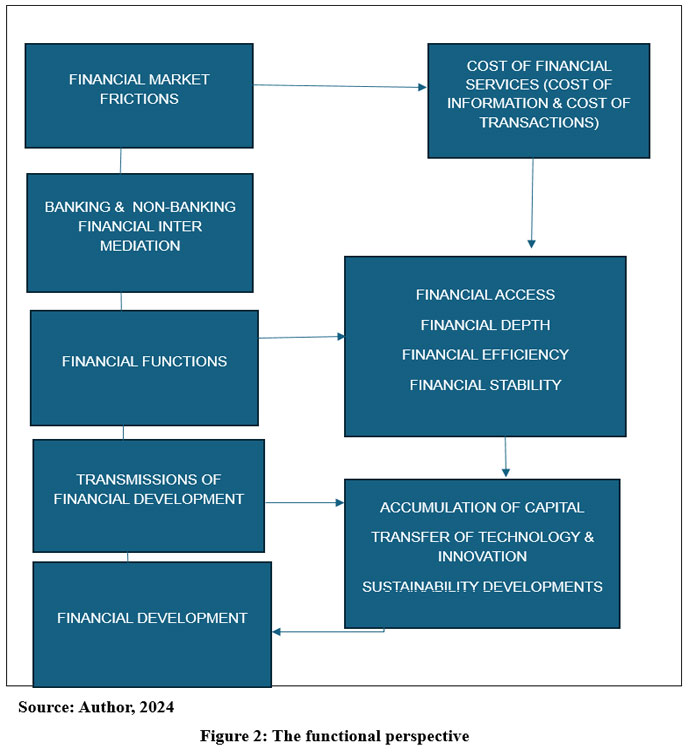 | Figure 2: The functional perspective |
Source: Author, 2024
 | Figure 3: The differentiated securitization theory |
Source: Author, 2024
Conceptual framework
The conceptual framework for the study was based on the impact of geopolitical risk on the characteristics of individual financial institutions and financial markets as designed by the World Bank in the Global Financial Development database (Cihák et al., 2012).
 | Figure 4: Conceptual framework for the study |
Source: Author, 2024
Materials and Methods
Impact of geopolitical risk on financial development
Geopolitical risk has a mixed effect on asset returns, with both positive and negative relationships found, according to Teplova et al. (2022). Additionally, the study found that during typical times, market returns changed as a result of geopolitical risk. The study also showed that market type and condition affected the direction and effect of geopolitical risk on asset returns. The evaluation of the geopolitical risk posed by the conflict between Russia and Ukraine on the returns on Russian and European assets and commodities markets served as the foundation for the study. The research methodology used in the study was quantile-on-quantile (ibid). The present study focused on the extensive examination of the impact of geopolitical risk on financial access, financial depth, financial efficiency and financial stability whilst the study by Teplova et al. (2022) is only centred on the effect of geopolitical risk on asset returns which is an aspect of financial stability. Therefore, the present study purported to fill the differences between the two studies.
Soltani et al. (2021) observed that the Middle East and North Africa was more vulnerable as a result of rising geopolitical risk. The study also found that higher geopolitical risk deterred foreign investment and slowed the economic growth of particular economies. A panel of Middle Eastern and North African nations was subjected to the panel vector auto regression
model in this study. The present study explored the impact of geopolitical on the itemized components of financial development whilst the study by Soltani et al. (2021) examined the impact of geopolitical risk on foreign investment and economic growth. Hence the present study was intended to fill the wider and distinct gap between the studies.
Diekelmann et al. (2024) observed geopolitical risk as a threat to financial stability and global economy. The study further stressed that geopolitical risk adversely affect economies and caused negative consequences on asset quality, solvency, lending, funding and profitability for banks and non-banking financial institutions. The study recommended financial institutions to a combination of business diversification and prudent financial risk management in managing geopolitical risk. The study further stressed that geopolitical risk could affect global economies on the real economy side and the financial side. It is stressed that geopolitical risk affect the real economy side by adversely affecting the real GDP growth rate, investment, savings, consumption, inflation and trade. On the financial side, it is also emphasized that geopolitical risk negatively affects asset prices and capital flows. Geopolitical risk is observed to result in volatilities in credit spreads, interest rates, commodities markets, exchange rates and stock prices (ibid). The study by Diekelmann et al. (2024) is centred on the examination of the impact of geopolitical risk on the global economy and financial stability whilst the present study is focused on the effects of geopolitical risk on financial development of global economies. The present study is purported to fill this gap.
Geopolitical risk has a major impact on the Indian financial sector, according to Kumar and Rao (2024), with varying shock propagation under various market conditions. The study found that during times of greater uncertainty, the banking and currency sectors were more vulnerable to geopolitical risk. The study evaluated shock transmissions under various market situations using the Quantile Vector Auto Regression (QVAR) technique. Strong risk management techniques and comprehensive geopolitical risk monitoring were suggested by the study. The study Kumar and Rao (2024) explored the impact of geopolitical risk on the financial markets focusing on the identification of shocks under various market conditions and the present study sought to examine the impact of geopolitical risk on financial development clearly focusing on geopolitical risk effect on the characteristics of financial development that included financial access, financial depth, financial efficiency and financial stability.
The financial markets' reactions to geopolitical risk are not consistent, and the impact of geopolitical risk on financial asset returns varies, according to Nam et al. (2023). The study, which covered the years 2012–2022, investigated the connection between the geopolitical index and the returns on the Vietnamese stock market. Stochastic volatility was used in the Time Varying Parameter (TVP) VAR model (ibid). The study by Nam et al. (2023) looked at the impact of geopolitical risk on financial asset returns focusing on assessing the resilience of stock returns to geopolitical risk and the present study purported to assess the impact of geopolitical risk on financial access, financial stability, financial depth and financial stability focusing on financial development.
Lu et al. (2020) ascertained geopolitical risk as having a negative relationship with financial development as measured by domestic credit to private sector. The results from the robustness checks revealed geopolitical risk as having a significant statistically and economic negative relationship with domestic lending (ibid). The study based on a panel data set covered 18 emerging markets from 1985 to 2018. The study applied the fixed effects panel data model. The present study explored the impact of geopolitical risk on all the components of financial development that included financial stability, depth, efficiency and financial access whilst the study by Lu et al. (2020) ascertained the effects of geopolitical risk on financial depth as measured by domestic credit to private sector. Credit.
It was observed that over four months, there was no significant correlation between African stock market returns and global economic policy uncertainty, geopolitical risk, or financial stress; but, over a longer time frame, there was a significant correlation (Korsa et al., 2024). Using a cross-sectional basis, the study investigated the stability and strength relationships using the wavelet coherence technique. The present study examined the impact of geopolitical risk on financial development whilst the study by Korsa et al. (2024) assessed the impact of geopolitical risk, financial stress and economic policy uncertainty over African stock returns.
Bajaj et al. (2022) stressed that financial conditions are significantly and negatively impacted by geopolitical risk. The survey also found that one of the main factors influencing financial development is geopolitical risk. The study applied a fixed effect panel data model of specific emerging economies using monthly data from January 1999 to September 2016. The present study looked at the impact of geopolitical risk on financial access, depth, efficiency and financial stability whilst the study by Bajaj et al. (2022) focused on assessing the effect of geopolitical risk on different economic scenarios.
Hodula et al. (2024) determined how geopolitical risk impacted macroeconomic financial stability through the financial and real economy channels. It is emphasized once more that geopolitical risk increased uncertainty and risk aversion through the financial channel, which led to changes in portfolio allocation reallocation and cross-border capital flows. It is also emphasized that supply chains, commodity markets, and international trade were all impacted by geopolitical risk through the real economy channel.
The integrity of the financial system in emerging countries is seriously threatened by geopolitical concerns, according to Nguyen et al. (2022). The study found that the banking, debt, and foreign exchange markets in emerging nations are more severely impacted by geopolitical risks than the stock market. However, the analysis found that geopolitical concerns had a greater negative impact on the stock market in the Group of Seven economies than they did on the debt, foreign exchange, and banking sectors. From 1985 to 2019, the panel quartile estimate approach was used in emerging economies. The study by Nguyen et al. (2022) looked at examining the impact of geopolitical risk on financial stability by focusing the assessment on geopolitical risk on debt and foreign exchange markets whilst the present study extensively looked a the impact of geopolitical risk on all the components of geopolitical risk that included financial access, financial depth, financial efficiency as well as on financial stability.
Tan et al. (2022) remarked that geopolitical risks hurt corporate investments in Turkey. It was further observed that financially constrained small firms are adversely affected than financially viable firms. The study applied the Generalized Method of Moments (GMM) estimator based on 164 Turkish manufacturing firms listed on Borsa Instabul covering the period from 2005 to 2019. The study by Tan et al. (2022) assessed the impact of geopolitical risk on financial access with regard to corporate investments and small firms in Turkey whilst the present study evaluated the impact of geopolitical risk on all the elements of financial development that included financial access, financial stability, financial efficiency and as well as on financial depth.
Zhe and Ying (2023) stressed that financial development and geopolitical risk have a small but positive relationship. Several reliable econometric methods were employed in the study. From 1989 to 2021, the study concentrated on the connection between China's natural resources and financial development. The analysis was expanded to include geopolitical risk as an additional element influencing financial development. The study by Zhe and Ying (2023) focused on assessing the relationship between financial development (particularly natural resources) and geopolitical risk whilst the present study examined the impact of geopolitical risk on all the elements of geopolitical risk that included financial access, financial development, financial depth and financial stability.
Zhang and Shi (2023) asserted that geopolitical risk decreases financial development in the BRICS economies. The study was based on the BRICS economies covering the period from 1990 to 2022. The study used panel data and moment’s quartile regression. The study by Zhang and Shi (2023) examined the impact of geopolitical risk on financial development focusing on the extraction of resources without assessing the impact of geopolitical risk on the individual components of financial access, depth, efficiency and stability that compose financial development as was done in the present study.
Adel and Naili (2024) acclaimed that Middle Eastern banks are extremely vulnerable to geopolitical risk, while the effect of this risk on African banks' profitability is unclear and statistically minor. The study emphasized the need for sophisticated risk management and policy responses tailored to the particular difficulties presented by geopolitical risk in developing nations. The two-step Generalized Method of Moments (GMM) was used in the study, which covered the years 2009–2019 and involved 125 of 13 rising nations. The study by Adel and Naili (2024) examined the impact of geopolitical risk on the profitability of banks in the Middle East and on African banks whilst the present study explored the impact of geopolitical risk on all the characteristics of financial development that included financial depth, efficiency, stability and access.
Ugurlu-Yildirim and Ordu-Akkaya (2022) argued that market-based structures, as opposed to bank-based systems, lessen the detrimental effects of geopolitical risk on economic growth and consumption. Furthermore, it was found that bank-based systems lessen the long-term detrimental effects of geopolitical risk on consumption. Autoregressive distributed lags were used in the study for the years 1985–2021. The study's sample size was determined using 15 emerging markets' geopolitical risk indices. The study by Ugurlu-Yildirim and Ordu-Akkaya (2022) examined the detrimental effects of geopolitical risk on market based structures and bank based structures focusing on the impact of geopolitical risk on economic growth and consumption whilst the present study assessed the impact of geopolitical risk on all the elements of financial development that included financial access, depth, efficiency and financial stability.
Alsagr and Hemmen (2021) revealed that the use of renewable energy was positively impacted by geopolitical risk. Furthermore, it is noted that with time, the benefits of both financial development and geopolitical risk on the use of renewable energy become increasingly apparent. Testing a two-step GMM using data from emerging nations between 1996 and 2015 served as the foundation for the study. The study by Alsagr and Hemmen (2021) assessed the impact of geopolitical risk on the use of renewable energy whilst the present study explored the effect of geopolitical risk on the elements of financial development that comprise financial access, financial depth, financial stability and financial efficiency.
Cottrell et al. (2024) uncovered that geopolitical risk had a significant impact on financial institutions' default risk and has distinct repercussions for globally systemic banks (G-SIBs) and non-GSIBs.Additionally, it was shown that credit default swaps for G-SIBs were significantly and negatively correlated with geopolitical risks. Additionally, the analysis's findings showed that default risk for non-G-SIBs was negatively correlated with geopolitical risk. Ordinary least squares statistical cross-sectional analysis served as the foundation for the investigation. The study by Cottrell et al. (2024) examined the impact of geopolitical risk on the credit default swaps for G-SIBs and non-GSIBs whilst the present study is centred on the impact of geopolitical risk on financial access, depth, efficiency and financial stability.
According to Jung et al. (2021), increased geopolitical risk lowers stock returns, and this decline is more pronounced for larger companies with a larger percentage of domestic investors and for companies with a higher fixed assets to total assets ratio. By creating a monthly geopolitical risk index (GPRNK) of North Korean geopolitical risk, the firm was based on firm-level data. The study by Jung et al. (2021) evaluated the impact of geopolitical risk on larger companies and domestic investors whilst the present study assessed the impact of geopolitical risk on financial development as measured by financial access, depth, efficiency and stability.
Economic uncertainty and geopolitical risk decreased bank stability, according to Olalere and Peterson (2023). The panel VAR and the two-step System GMM estimate method were used in the investigation. The study examined bank-level data from 2009 to 2021 and was based on a sample of 105 commercial banks. The study by Olalere and Peterson (2023) assessed the impact of geopolitical risk and economic uncertainty on bank stability whilst the present study was more comprehensive in that it looked at the impact of geopolitical risk on all the measures of financial development that included financial access, depth, efficiency and as well as on financial stability.
Methodology and data
The research relied on quantitative research based on logit regression approach. Vetter and Schober (2018) affirmed that logistic regression is used to estimate the association of one or more independent variables with a binary dependent variable. Guleria and Sood (2022) proclaimed that logistic regression model models a binary dependent variable with an outcome variable of 0 or 1 by applying a logistic function. In order to forecast the impact of geopolitical risk acts on financial development based on the characteristics of the financial development, as indicated in equation 1 below, this study employed the logistic regression equation. Hence this study used logistic regression model as the outcome of geopolitical events can be represented by 1 for occurrence and a zero for no occurrence. Cross sectional data obtained from the Global Financial Development database covering the period from 2010 to 2024 of fifty-three countries were processed and analysed through logit regression represented in Equation 1 below. The study used simple random sampling in selecting the countries to the study. The simple random sampling provided an unbiased equal opportunity of selecting countries to the study. Noor et al. (2022) pronounced that all units had an equal probability of taking part in the study based on using simple random sampling. Furthermore, it is emphasized that simple random sampling is advantageous in populations that are homogeneous and uniformly selected. Thus, simple random sampling was used on selecting the countries to study based on the homogenous measures of financial development.
Equation 1: Geopolitical risk Logit regression equation
GPRit = ?i + ?1 Stock price volatilityit + ?2 Financial systems deposits to GDPit+ ?3 Bank branches per 100,000 adultsit + ?4 Bank net interest marginit (1) + ?(error term)it.
The subscript for the country financial development measure i in year t of the Global Financial Development Annual Report (2010–2024) is it; the GPRit for the country geopolitical risk i in year t is equal to zero unless there was a geopolitical risk act or threat in the world that year; and the coefficient of stock price volatility, or ?1, is the average of the national stock market index's 360-day volatility; demand, time, and savings deposits in deposit money banks and other financial institutions as a percentage of GDP is represented by the ?2-coefficient; the ?3-coefficient indicates how many branches there are for every 100,000 adults; The error term is ?it, and ?4 is the coefficient of the bank's accounting value of interest revenue as a percentage of its average interest-bearing assets (total earnings).
Results
Table 1 and Table 2 below illustrate results respectively of descriptive statistics and the outcome of logit regression. Due to the ongoing conflict between Russia and Ukraine, Ukraine had the fewest bank branches per 100,000 adults in 2024 (0.42), while the calm Seychelles had the most (56). United States had a maximum stock price volatility of 35% in 2018/19 whilst Burkina Faso had a notable least stock price volatility of zero percent in 2010. Tajistan had the highest bank interest margin of 56% in 2019 whilst Myanmar had the lowest bank interest margin of 0.069% in 2013. Lebanon scored the highest financial system deposit to GDP percentage of 251% in 2016 and whilst Niger scored the least score of 8.1% in 2012. Highlights extracts for different measures of financial for the year 2021 are depicted in Table 2 below.
Table 1: Descriptive statistics
Item | Mean | Median | SD (?) | Max | Min |
Stock price volatility | 14.65137 | 14.25460 | 7.191805 | 35.09380 | 0.000000 |
Financial systems deposit to GDP | 53.85598 | 44.51315 | 41.19743 | 251.2358 | 8.158960 |
Bank Branches per 100,000 adults | 13.41047 | 9.766791 | 11.32774 | 56.22545 | 0.420796 |
Bank net interest margin | 4.655374 | 4.046025 | 3.184376 | 56.10839 | 0.068784 |
Source: Author, 2024
Table 2: Detailed extracts of the results of the impact of geopolitical risk on financial development for the year 2021.
Country/Index | Log Odds of GPRA | Stock Price Volatility | Financial System deposits to GDP | Bank Branches per 100,000 adults | Bank Interest Margin |
United States | 1 | 5.26 | 53.43 | 30.46 | 30.28 |
Seychelles | 1 | 5.45 | 119.70 | 55.07 | 22.58 |
Niger | 1 | 4.14 | 11.90 | 1.63 | 14.38 |
Russia | 1 | 3.15 | 58.64 | 25.64 | 8.18 |
Ukraine | 1 | 5.62 | 31.74 | 0.42 | 6.16 |
Burkina Faso | 1 | 2.58 | 37.90 | 3.08 | 10.98 |
Tajistan | 1 | 9.39 | 9.37 | 22.89 | 1.91 |
Myanmar | 1 | 2.77 | 53.87 | 5.61 | 8.27 |
Lebanon | 1 | 4.40 | 251.24 | 21.66 | 19.25 |
Source: Author, 2024
Table 3: Estimation of Logistic Regression Model on the Impact of Geopolitical risk and related measures
Model | June 2010-July 2024 results | June 2010-July 2024 results | June 2010-July 2024 results | June 2010-July 2024 results |
Variable/ Constant | Coefficient | Std. Error | z-Statistic | Probability |
Constant | -0.418749 | 0.265883 | -1.574937 | 0.1153 |
Stock price volatility (?1) | -0.010636 | 0.011556 | -0.920374 | 0.3574 |
Financial systems deposit to GDP (?2) | 0.004278 | 0.002088 | 2.049210 | 0.0404 |
Bank Branches per 100,000 adults (?3) | -0.015654 | 0.007378 | -2.121558 | 0.0339 |
Bank net interest margin (?4) | -0.021747 | 0.029038 | -0.748903 | 0.4539 |
Cross-section | 53 | |||
Number of observations | 791 | |||
McFadden R-Squared | 0.009552 | |||
Likelihood ratio (LR) | 9.725491 | |||
Source: Author, 2024
53 nations were chosen at random to participate in the study. Table 3 above displays the logit regression model's results. The coefficients ?1, ?2, ?3, and ?4 of the panel logistic regression equation (1) that were run through e Views are displayed in the table above. The dependent variable, geopolitical risk, had a value of 1 if there were geopolitical risk acts or threats occurring globally in that given year, and vice versa.
The study uncovered that geopolitical risk is insignificantly and positively correlated with financial depth as measured by financial systems deposits to GDP. This result is in agreement with the study of Zhe and Ying (2023). The research further revealed that geopolitical risk is significantly and negatively correlated with stock price volatility. The result of this research concurs with the study of Nam et al. (2023), Hentov et al. (2018) and Hodula et al. (2024), but in contrast with findings of Olatere and Peterson (2023), Cottrel et al. (2024), Adel and Naili (2024), Nguyen et al. (2022) and Hodula et al. (2024). Further, the number of bank branches per 100,000 adults indicated a substantial and negative correlation between geopolitical risk and financial access.
Discussions
It can be stressed that geopolitical risk adversely affect financial development in almost all the countries in the world, but with varying degrees of impact, with the most affected countries being those that are directly involved in the conflict and vice versa (Adel and Naili (2024); Cottrell et al. (2024); Bajaj, 2022; Lu et al.. 2020 and Nguyen et al, 2022). The study revealed that geopolitical risk is insignificantly and negatively correlated with stock price volatility (Nam et al., 2023). This is in contrast to the findings of Jung et al. (2021). Hence the reasoning behind this could be that investment in stocks are preferably more stable to holding cash or real estate investments during periods of elevated and aggravated geopolitical acts and geopolitical threats.
According to this study, financial development as shown by financial access and financial efficiency is significantly and negatively correlated with geopolitical risk. This is partly in agreement with the study of Tan et al. (2022) with regard to financial access. Conversely, as indicated in Table 2 above financial systems deposits to GDP showed a strong and positive association between geopolitical risk and financial depth (Hentov et al., 2018). The reason behind this could be that investors shy away from holding large sums of cash during periods of geopolitical crisis and hence tend to deposit the cash with reputable international financial institutions for safe keeping. Inconclusive findings of the insignificant association between geopolitical risk and financial stability as measured by stock price volatility was revealed by the study. This in in agreement with the study of Hodula et al. (2024). Therefore, it can be reiterated that a combination of symmetrical and asymmetrical correlations influences the impact of geopolitical risk on financial development, as Table 2 above illustrates.
Lastly GraphPad (2025) stressed that if the intercept only model more closely fits the data, McFadden’s R squared will be closer to zero. Hence the regression model applied in the present study fits the data that was used for the research as shown in Table 3. Gskpro (2025) noted that likelihood ratios help in assessing the effect of a diagnostic test on the probability of associaton of the dependent variable with the dependent variable and further, likelihood ratios >1 proved that an association of independent variable with dependent variable exist. For the present study, therefore, the likelihood ratio was close to 10 >1 as shown in Table 10, as a result it can be confirmed that the subsequent likelihood of a large increase change in the association between geopolitical risk and financial development measures is inevitable, if additional tests are conducted.
Conclusion
It is concluded that geopolitical risk is significantly and negatively associated with financial access and efficiency. This concurs with study of Zhang and Shi (2023). Furthermore, geopolitical risk is profoundly and positively correlated with financial depth (as measured by financial systems deposits). Moreso, geopolitical risk had an inconclusive insignificant and negative association with financial stability as measured by stock price volatility.
It is recommended that countries that are directly involved or threatened by geopolitical events and hazards should harness the use of artificial intelligence on innovative seamless banking devices in their banking systems and avoid the creation of physical banking branch structures. It is also recommended that financial institutions and investors should consider placing their funds in offshore investments in safe havens away from the moderate, elevated geopolitical tensions and geopolitical crises (Special Eurasia, 2024). Thus, it can be reaffirmed that, as previously mentioned, geopolitical risk has a mixed effect on financial development, resulting in both positive and negative relationships as well as small inconclusive associations (Teplova et al., 2022; Zhe & Ying., 2023 and Nam et al., 2023).
Lastly banks and non banking financial institutions are urged to implore sustainability linked finance directing finance to ESG and green investments which offer resilience to the devasting effects of geopolitical risks.
Further banks should rethink and proactively assess the impact of geopolitical risk on their stability, efficiency, accessibility, the breadth and depth of their operations and offer solutions that are specifically accustomized to the geopolitical event. Moreso, unbiased institutional partnership and collaborative dialogue with relevant stakeholders, governments, unions, United Nations and other non governmental associations will illuminate and provide inevitable insights, capital buffers and solutions to geopolitical risks.
Acknowledgement
The author would like to thank Professor Tavonga Njaya of Zimbabwe Open University for providing me with research mentorship. No materials were reproduced but the figures and tables produced were a direct output of the data that was processed through E views Logit regression model.
Funding Sources
The author received no financial support for the research, authorship, and/or publication of this article.
Conflicts of Interest
The author declares no conflict of interest.
Data Availability Statement
The data used in this work can be obtained upon request from the corresponding author. The data are not publicly available due to constraints.
Ethics Statement
This research did not involve human participants, animal subjects, or any material that requires ethical approval.
Informed Consent Statement
This paper is entirely empirical research, and informed consent was not required.
Author Contributions
The sole author was responsible for the conceptualization, methodology, data collection, analysis, writing, and final approval of the manuscript
References
- Adel, N. and Naili, M. (2024). Geopolitical risk and banking performance: evidence from emerging economies. Journal of Risk Finance. Vol. 25 No. 4, pp. 646-663. https://doi.org/10.1108/JRF-10-2023-0243
CrossRef - Alsagr, N. and Hemmen, S.V. (2021). The impact of financial development and geopolitical risk on renewable energy consumption: evidence from emerging markets. Environmental Science and Pollution Research. Vol (28) pp.25906–25919. https://doi.org/10.1007/s11356-021-12447-2.
CrossRef - Bajaj, N., Siyal, T. and Kumari, S. (2022). The Impact of Geopolitical Risk on Financial Conditions of Emerging Economies. Journal of Asian Finance Economics and Business Vol 10(1).DOI:10.13106/jafeb.2023.vol10.no1.0133 https://www.researchgate.net/publication/ 374697381_The_Impact_of_Geopolitical_Risk_on
- Buck, C. (2024). Global rifts and financial shifts: supervising banks in an era of geopolitical instability. Accessed on 28 December 2024. https://www.bankingsupervision.europa.eu/press/speeches/date/ 2024/html/ssm.sp240926_1~ebf2 df6685.en.html
- Buzan, B., and Albert, M. (2011). Securitization, sectors and functional differentiation. Sage Publications, Ltd, Vol. 42, No. 4/5, Special issue on The Politics of Securitization , pp. 413-425 (13 pages). https://www.jstor.org/stable/26301798.
- Cihák, M., Demirgüç-Kunt, A., Feyen, E. and Levine, R. (2012). “Benchmarking Financial Systems around the World.” Policy Research Working Paper 6175, https://www.worldbank.org/en/publication/gfdr/data/global-financial-development-database
- Cottrel, S., Imtiaz, F.M., Krishnamurti, C., Zhou, H. (2024). Geopolitical Risk and Default Risk of Global Systemically Important Banks. Date accessed 28 December 2024. https://internationalbanker.com/banking/geopolitical-risk-and-default-risk-of-global-systemically-important-banks/
- Dario, C. and Iacoviello, M. (2022). Measuring Geopolitical Risk. American Economic Review. 112(4), pp.1194-1225. https://www.matteoiacoviello. com/gpr. htm. Special Eurasia (2024). Financial Markets and the geopolitical Risk. Accessed on 12 October 2024. ISSN 1073-2500 (Print) ISSN 2767-4509 (Online) https://www.specialeurasia.com/2024/04/15/geopolitics-financial-markets/.
- De Nederlandsche Bank (DNB).(2024). Growing geopolitical risks impact financial sector. Date accessed 28 December 2024. https://www.dnb.nl/en/general-news/press-release-2024/growing-geopolitical-risks-impact-financial-sector/
- Diekelmann, D., Kaufmann, C., Larkon, C., Mcquade, P., Negri, C., Pancaro, C. and Rößler, D. (2024). Turbulent times: geopolitical risk and its impact on euro area financial stability. Date accessed 4 December 2024 https://www.ecb.europa.eu /press /financial-stability-publications/ fsr/special/ html/ecb.fsrart202405 _01~4e4e30f01f.en.html
- Financial Stability Report. (2024). Impacts of geopolitical risk on financial stability. Accessed on 28 December 2024. https://www.rbnz.govt.nz/hub/ publications/financial-stability-report/2024/nov-2024/impacts-of-geopolitical-risk-on-financial-stability
- Global Financial Development Report (2020). Bank Regulation and Supervision a Decade after the Global Financial Crisis. Date accessed 29 December 2024. https://www.worldbank.org/en/publication/gfdr/data/global-financial-development-database
- Graphpad(2025).https://www.graphpad.com/guides/prism /latest/curve-fitting/reg_multiple_logistic_pseudo_r_squared.htm. Date Accessed 08 January 2025.
- Gskpro(2025).https://gskpro.com/content/cf-pharma/health-likelihood ratio. Date Accessed 08 January 2025.
- Guleria, P and Sood, M. (2022). Artificial intelligence and machine learning for health care sector- performing predictions and metrics evaluation of ML classifiers on a diabetic diseases data set, pp.1-28. https://doi.org/10.1016/B978-0-323-85751-2.00007-4
CrossRef - Hentov, E., Petrov, A., and Zumbo, F. (2018). How does Geopolitics affect Financial Markets. Accessed on 03 December 2024. https://www.ssga.com/ library-content/ pdfs/ official-institutions-/how-does-geopolitics-affect-financial-markets.pdf
- Hodula, M., Janku, J.. Malovaná, S. and Ngo, N.A. (2024). Geopolitical Risks and Their Impact on Global Macro-Financial Stability: Literature and Measurements. Accessed on 28 December 2024.https://www.cnb.cz/export/ sites/cnb/en/economic-research/.galleries/research_ publications /cnb_wp/ cnbwp_2024_08.pdf
- Jung, S., Lee, J., and Lee, S. (2021). The Impact of Geopolitical Risk on Stock Returns: Evidence from Inter-Korea Geopolitics. Vol 2021(251) https://doi.org/10.5089/9781557759672.001
CrossRef - Korsa, D., Amewu, G., Achampong, K. O. (2024). The impact of geopolitical risks, financial stress, economic policy uncertainty on African stock markets returns and volatilities: wavelet coherence analysis. Journal of Humanities and Applied Social Sciences. DOI: 10.1108/JHASS-12-2023-0172. https://www.emerald.com/insight/content/doi/10.1108/JHASS-2023-0172/full/html
CrossRef - Kumar, S. and Rao, A. (2024). Assessing and Mitigating the Impact of Geopolitical uncertainty on the Indian Financial Sector: A policy perspective. Bulletin of Monetary Economics and Banking, Vol. 27 No. 3, 2024, pp. 483 – 526.DOI: https://doi.org/10.59091/2460-9196.2278https://bulletin.bmeb-bi.org/cgi/viewcontent.cgi?article=2278&context=bmeb
CrossRef - Lu, Z., Gozgor, G., Huang, M., & Lau, C. K. M. (2020). The Impact of Geopolitical Risks on Financial Development: Evidence from Emerging Markets. Journal of Competitiveness, 12(1), 93–107. https://doi.org/ 10.7441/joc.2020.01.06.
CrossRef - Maijoor, S. (2024). Growing geopolitical risks impact financial sector.Date accessed 28 December 2024. https://www.dnb.nl/en/general-news/press-release-2024/growing-geopolitical-risks-impact-financial-sector/
- Merton, R.C. (1993). “Operation and Regulation in Financial Intermediation: A Functional Perspective.” In: P. Englund (ed.), Operation and Regulation of Financial Markets. Stockholm: The Economic Council.
- Nam, H.N., Dinh, D.D., Yen, N.T., Vinh, D. Q., and Tung, N. T. (2023). The Impact of Geopolitical Risk on Financial Assets: Evidence from Time-Varying Parameter Var. Journal of Economics and Business, Vol. 3, No. 4 (2023) 33-43.DOI: https://doi.org/10.57110/vnujeb.v3i4.202 https://jeb.ueb.edu.vn.
CrossRef - Nguyen T., Denis, H. and Örsal, K. (2022). Geopolitical Risks and Financial Stress in Emerging Economies. International Network for Economic Research, Working Paper No. 9. Accessed on 29 November 2024. https://infer-research.eu/wp-content/uploads/2022/10/WP2022.09.pdf
- Noor, S., Tajik, O., and Golzar, J. (2022). Simple random sampling. International journal of education and language studies. Vol 1(2), pp.78-82. https://doi.org/10.22034/ijels.2022.162982
- Olalere, O.E. and Peterson, J.M. (2023). Geopolitical risk, economic policy uncertainty, and bank stability in BRICS countries. https://doi.org/10.1080/ 23322039.2023.2290368.
CrossRef - Soltani, H.,Triki, M. B., Ghandri, M., and Abderzag, F.T. (2021). Does geopolitical risk and financial development matter for economic growth in MENA countries? Vol 14 (1).DOI: 10.14254/2071-8330.2021/14-1/7 https://www.jois.eu/?672,en_does-geopolitical-risk-and-financial-development-matter-for-economic-growth-in-mena-countries-
CrossRef - Tan, O.F., Cavlak, H., Cebeci, Y., and Gunes, N. (2022). The Impact of Geopolitical Risks on Corporate Investments: Evidence from Turkish Firms. Indonesia Capital Market Review. Vol 14 (1).DOI: 10.21002/icmr.v14i1.1138 https://scholarhub.ui.ac.id/ icmr/vol14/iss1/2/
CrossRef - Teplova, T., Choi, SY., Bossman, A., and Umar, Z. (2022). Does geopolitical risk matter for global asset returns? Evidence from quantile-on-quantile regression. Vol 48 (C). DOI: 10.1016/j.frl.2022.102991 https://doi.org/10.1016/j.frl.2022.102991
CrossRef - Ugurlu-Yildirim, E., & Ordu-Akkaya, B. M. (2022). Does the impact of geopolitical risk reduce with the financial structure of an economy? A perspective from market vs. bank-based emerging economies. Eurasian Economic Review, Springer; Eurasia Business and Economics Society, vol. 12(4), pages 681-703. https://ideas.repec.org/a/spr/eurase/v12y2022i4d10.1007_s40822-022-00219-3.html
CrossRef - Vetter T.R., Schober P. (2018). Regression: the apple does not fall far from the tree. Anesth Analg. Vol127, pp.277–283.
CrossRef - Zhe, S & Ying, L. (2023). China’s sustainable development perspective of financial development from the lens of geopolitical risk and resource extraction. Resource Policy, Elsevier, Vol 85(PA). DOI: 10.1016/j.resourpol. 2023.104298 https://ideas.repec.org/a/ eee/jrpoli/v86y2023ipas0301420723010097.html
CrossRef - Zhang, J. and Shi, S. (2023). Extraction of natural resources and geopolitical risk revisited: A novel perspective of research and development with financial development. Vol 85(A). https://doi.org/10.1016/j.resourpol.2023.103799.
CrossRef

This work is licensed under a Creative Commons Attribution 4.0 International License.