
The Paradox of Strategizing: Embracing Managerial Agency without Throttling it
J.-C Spender*  and Jeroen Kraaijenbrink*
1Department of Management in the Network Society, Kozminski University, Warsaw, Poland .
2Faculty of Economics and Business, Section Strategy and International Business University of Amsterdam, Amsterdam, Netherlands .
http://dx.doi.org/10.12944/JBSFM.04.01.03
Copy the following to cite this article:
Spender J. C, Kraaijenbrink J. (2022) "The Paradox of Strategizing: Embracing Managerial Agency without Throttling it". Journal of Business Strategy Finance and Management, 4(1). DOI:http://dx.doi.org/10.12944/JBSFM.04.01.03
Copy the following to cite this URL:
Spender J. C, Kraaijenbrink J. (2022) "The Paradox of Strategizing: Embracing Managerial Agency without Throttling it". Journal of Business Strategy Finance and Management, 4(1). Available From: https://bit.ly/3JDryWO
Download article (pdf) Citation Manager Publish History



Introduction
Strategy theory is a paradox. On the one hand it implies managers are free to create strategies that differ from their competitors’, absent which strategizing means computing the firm’s objectively determined or choice-less response to its environment or circumstances. On the other hand, it presumes knowledge of the causal structures that determine the outcomes of the manager’s strategic choices, absent which strategizing is empty and beyond theory, for analysis presupposes structure. Thus strategy’s paradox is that it works a middle ground between un-analyzable free choice and strategy-denying full determination even as this territory cannot be described by either (Alvarez & Porac, 2020; De Rond & Thietart, 2007: 535).
This paradox is not unique to strategic management - though it is seldom noted in its literature. The tension between determinism (implied by a structured definition of the world) and choice (implied by agency or otherwise defining human beings as proactive) is one of sociology’s oldest and most debated topics (Archer, 1988; Child, 1972; Giddens, 1984; Hobbes, 1651; Parsons, 1951, 1977; Popper, 1950; Sztompka, 1991). It is particularly pertinent to strategic management, for that presumes managers navigating mindfully between the constraints in the firm’s environment and resources, and their freedom to make a difference there (Bracker, 1980; Nag, Hambrick, & Chen, 2007; Thomas & Pruett, 1993). As strategy researchers consider this, they discover their road forked somewhere behind them. Ahead may lie the well-trodden road towards deterministic theories that capture the world’s causal structures with ever-finer nets. Many have been travelling this road for decades; driving mature methodological vehicles, they explain as much of the variance in firm behavior as possible, leaving any unexplained on the wayside, an unsightly nuisance to be cleaned up by later research. Though most in our field consider this the only road there is another, less travelled, that branched off the main highway, where unexplained variance is not an indicator of undiscovered causal structures. Rather, it is a place of opportunity that provides for managers’ attempts to be unique or entrepreneurial, to seek competitive advantage. Researchers moving along this road put the strategic manager’s agency in the front-seat and treat it as at least as important as the causal structures that constrain their choices. Rather than explaining variance completely, they accept it cannot be fully explained and, instead, axiomatize it into a dynamic theory of advantage seeking under uncertain conditions. Not many have travelled this road and their passage is barely visible in today’s literature. Plus the road is uncertain and poorly mapped; it is not clear what methodological obstacles must be overcome or what theoretical outputs might result.
We review the literature of both roads - concluding there is good reason to explore the second and leverage its unexplained variances as a way of relating strategizing to uncertainty resolution and Knight’s notions of profit (Knight, 1921). We propose ‘frameworks’ as an alternative methodology and sketch their characteristics and process. We also reconsider how frameworks and theories are related and, thereby, the relationship between theory and practice. We discuss some rigor versus relevance issues and conclude by outlining a research agenda and some of the resulting methodological challenges.
Review Method
Scholars have tried to understand and capture the relationship between the strategist’s entrepreneurial agency and the firm or industry’s structures since the strategic management field’s inception. To take stock of what has been achieved, we considered all the papers published in Strategic Management Journal, Long Range Planning and Strategic Organization plus all the papers with either ‘strategy’ or ‘strategic management’ in their title published in the other major management journals - a total of 5382 papers. Scanning their titles, we selected those that discussed the field generally or addressed managerial agency specifically. We added general commentaries because many addressed agency implicitly. We also found papers in dialogue with previous papers not in our initial sample - in which case we added them. Our final pool comprised 154 papers (see Table 1).
Table 1: Sample of Reviewed Articles.
|
Journal |
# Articles pooled |
# Articles in the final sample |
|
Principal strategic management journals |
||
|
Strategic Management Journal |
1769 |
60 |
|
Long Range Planning |
3093 |
19 |
|
Strategic Organization |
154 |
19 |
|
General management journals (articles with ‘strategy’ or ‘strategic management’ in title) |
||
|
Journal of Management Studies |
102 |
10 |
|
Academy of Management Review |
81 |
17 |
|
Academy of Management Journal |
61 |
3 |
|
Journal of Management |
52 |
7 |
|
Organization Studies |
30 |
11 |
|
Organization Science |
21 |
6 |
|
Administrative Science Quarterly |
19 |
2 |
|
|
|
|
|
Total number of articles |
5382 |
154 |
A detailed analysis of the 154 papers suggested seven arguments or rhetorical tracks. Five try to reduce the unexplained variance and pull back into mainstream causal analysis by: (a) improving research accuracy, (b) studying strategy process, (c) refining behavioral assumptions, (d) developing an integrative theoretical paradigm, and (e) making strategy research more relevant. They shared an intent to capture the strategist’s agency more precisely and securely thus - ironically - denying or reducing its significance. Two further tracks offered a different approach: one, ontological, gave agency a place in the world and a second, epistemological, led away from positivism. As we shall argue, both move us away from the mainstream toward an agenda that accepts and leverages human agency.
The Five Tracks toward Variance Reduction
Track A: Improving Research Accuracy
The first track’s papers capture agency better by improving the research methods’ accuracy in five ways: (a) tightening the connections between theory and empirics (Camerer, 1985; Montgomery, Wernerfelt, & Balakrishnan, 1989, 1991; Seth & Zinkhan, 1991), or (b) measuring latent concepts better (Boyd, Gove, & Hitt, 2005a, 2005b; Hitt, Boyd, & Li, 2004; Venkatraman & Grant, 1986), or (c) managing the heteroscedasticity between firms better (Bergh & Fairbank, 2002; Bowen & Wiersema, 1999; McKelvey & Andriani, 2005; Shook, Ketchen Jr, Cycyota, & Crockett, 2003), or (d) addressing the endogeneity problem in strategic management better (Bascle, 2008; Hamilton & Nickerson, 2003), or finally (e) proposing larger samples (Ferguson & Ketchen Jr, 1999; Short, Ketchen, & Palmer, 2002).
These papers analyze managerial agency by showing that while there is some heterogeneity among firms they are far from idiosyncratic. Agency lies in the middle ground between uniformity and idiosyncrasy, constrained by structures that appear as regularities in firms’ responses. Finding these helps clarify the impact of management’s strategic actions. The five variants also share the assumption that firms and strategies can be measured and modeled. They concede strategic management is complex and ambiguous but presume, nonetheless, it can be researched successfully with familiar constructs, models, and qualitative and quantitative techniques. Certainty is their methodological goal, to fully predict the consequences of a management’s strategic decisions - even as years of research activity have shown the unlikelihood of explaining more than 30% of the variance (Donald C. Hambrick, 2004). No question our community has lowered its aspirations and now accepts studies finding only small effects (Ferguson & Ketchen Jr, 1999). But by focusing on the regularities and leaving 70% of variance unexplained, this track is clearly not inclined to research management’s agency directly.
Track B: Studying Strategy Process
Studies of strategic process and practice can make for a more precisely targeted research. Whereas Track A focused on capturing the content of strategic management with more accurate models, Track B covers the strategic choice process in more detail. A recent keyword analysis of papers in Long Range Planning shows there has been a steady increase in process studies over the past 40 years (Cummings & Daellenbach, 2009). Strategy process was explicitly put on the research agenda in 1992 by two Special Issues of Strategic Management Journal (Chakravarthy & Doz, 1992; Pettigrew, 1992; Schendel, 1992a, 1992b; Van de Ven, 1992) and this work continues (e.g., Langley, 2007).
There are three main variants. First, those positioned against ‘content research’ that look at the process’s dynamics. They probe the behaviors and interactions of individuals, groups, and/or organizational units within or between firms (Chakravarthy & Doz, 1992). A second variant evokes a ‘practice turn’, ‘micro-strategizing’ or ‘strategy as practice’. Johnson, Jarzabkowski, and Whittington are among the principal advocates (Jarzabkowski, 2004, 2008; Jarzabkowski & Whittington, 2008a; G. Johnson, Melin, & Whittington, 2003; Whittington, 1996, 2003, 2006, 2007; Whittington & Cailluet, 2008). They look deeply at process and question what managers have to do to make a difference, what works for them and what does not (G. Johnson et al., 2003). Although vigorously promoted (now as a new Academy of Management Interest Group) the s-a-p approach has attracted criticism as functionalistic, behaviorist, naïve in its assumptions and more a matter of fresh terminology than theoretical novelty (Carter, Clegg, & Kornberger, 2008; Chia & Holt, 2006; Rasche & Chia, 2009; Seidl, 2007). Yet it is a clear response to the widening interest in micro-level of analysis and the search for strategy theory’s ‘micro-foundations’ (Felin & Foss, 2005; Teece, 2007). A third approach emerges from a different research tradition, studies of the language of strategizing. The focus is on narrative (Barry & Elmes, 1997), discourse (Hardy, Palmer, & Phillips, 2000; Hendry, 2000; P. Shrivastava, 1986), interpretation (Clark, 2004), framing (S. Kaplan, 2008), and talk-based routines (Samra-Fredericks, 2003).
Despite their variety these studies provide a deeper understanding, exposing the detailed processes, practices, and discourses. The limitations of Track B are similar to those of Track A. By describing, explaining, and prescribing strategic actions, they bring managerial agency into a deterministic model - and so deny it. Yet we can note some work within this track, such as that of Shrivastava (1986) or Pettigrew (1992), points towards ways of embracing managerial agency without denying it.
Track C: Refining Behavioral Assumptions
The next track directly challenges mainstream theory’s assumptions. Following Simon, several writers replace the assumption of managers as rational maximizers with them as boundedly rational ‘satisficers’ (Eisenhardt & Zbaracki, 1992; Hesterly & Zenger, 1993; Rumelt, Schendel, & Teece, 1991), even as this has been criticized along with pleas for a more realistic, richer view of human actors (Eisenhardt & Zbaracki, 1992). Note simplifying assumptions are not problematic per se. Freidman famously argued the true test of a theory lies in its predictive power, not in the realism of its assumptions. Along that line, the debate between Tsang (2006) and Lam (2010) showed ‘domain, negligibility, and heuristic assumptions’ can facilitate theory development even when they seem unrealistic (Musgrave, 1981). Even so, there is agreement the behavioral assumptions should be more realistic.
Our review revealed four kinds of comment. First, that the strategy field should move away from neoclassical economics and towards economic theories based on more realistic assumptions, such as those of institutional, evolutionary, or Austrian economics (Foss, 1996; Jacobson, 1992). These comments are often made about the resource-based view (Foss & Ishikawa, 2007; Foss, Klein, Kor, & Mahoney, 2008; Kor & Mahoney, 2004; Kraaijenbrink, Spender, & Groen, 2010). Their common thread is the feeling that economics is rich rather than monolithic and brings valuable rigor to the field (Hesterly & Zenger, 1993; Hirsch, Friedman, & Koza, 1990; Rumelt et al., 1991). Second, some comments are critiques of the field’s devotion to the Cartesian idea of Mind - which separates strategic thought from strategic action (Calori, 1998). This has been challenged, especially in Mintzberg’s debates with Ansoff (Ansoff, 1991, 1994; Goold, 1992; Mintzberg, 1990a, 1991, 1994a, 1994b; Mintzberg & McHugh, 1985; Mintzberg & Waters, 1985). The point has been made broadly by those who see thinking as embedded in a context of action, as in ‘adaptive intelligence’ (J. G. March, 2006) or, following Bourdieu or Heidegger, ‘dwelling’ (Chia & Holt, 2006). Others point to the lack of ‘body-awareness’ arguing strategists are not mere ‘talking heads’ and rational deciders but situated real-world actors (Heracleous & Jacobs, 2008; Minocha & Stonehouse, 2007). Following the trend to language and practice in philosophy, the strategy field has likewise shifted its locus from the abstractions of planning and to the examination of situated practice (Andersen, 2000; Cummings & Daellenbach, 2009; Whittington & Cailluet, 2008). A third variant concerns the field’s tendency to focus on utilitarian or instrumental values while ignoring other value types (Ruef, 2003; B. Taylor, 1975). While values are seldom discussed explicitly, Singer (1994) argues neoclassical rationality implies one type of morality while managers may act in accordance with another. Ghoshal and Moran make a similar point, sometimes vehemently, in their critique of transaction cost economics (Ghoshal, 2005; Ghoshal & Moran, 1996; Moran & Ghoshal, 1996; Williamson, 1996). They say transaction cost economics, as well as related theories such as principal-agent theory, fail to acknowledge positive human values such as honesty, integrity and trust or recognize that people have emotions and passions (Calori, 1998; Godet & Roubelat, 1996).
These critiques call for richer, more realistic assumptions about human actors, or at least some effort towards making value assumptions explicit. Yet, as Simon (1998) and Bromiley & Papenhausen (2003) argue, strategic management researchers often leave their behavioral assumptions implicit even when these give their theories more predictive power than do their explicit rationality assumptions. In general these writers argue theories based on realistic behavioral assumptions are more likely to predict how people will react to stimuli. But behavioral assumptions imply people behave in a generalizable manner and the more they are adopted, the less room there is for an individual to act genetically.
Track D: Developing an Integrative Theoretical Paradigm
Researchers on the first three tracks address managerial agency by squeezing it out methodologically, with more accuracy and detail. A fourth track attempts to harmonize divergent research efforts under a new paradigm. Often referring to the parable of the blind men and the elephant (e.g., Ansoff, 1987; Arend, 2003; Thomas & Pruett, 1993), the strategy field is declared fragmented and without the uniform frame of reference researchers can use to communicate, compare, and combine each other’s work (Scherer, 1998; Seidl, 2007). While few justify this assertion, some refer to Kuhn’s (1962) view on paradigm development and argue it follows from the field’s immaturity (D. C. Hambrick & Chen, 2008), an apology evident since the field’s earliest writings (Schendel & Hofer, 1979; Bernard Taylor & Macmillan, 1973). There are several prescriptions. One is that we should adopt economics’ methods, as a discipline high in rigor, rather than those of less-rigorous disciplines. Doing so would enable us to speak a single language and be less confused about basic concepts (Camerer, 1985; Foss, 1996). These authors point out that economics is not limited to neo-classical or IO economics; there are richer varieties, such as evolutionary or Austrian economics that provide insights from which the field can benefit (Hesterly & Zenger, 1993; Hirsch et al., 1990; Kim & Mahoney, 2010; Rumelt et al., 1991). There is pluralism, but a ‘balanced pluralism’ within economics’ rigorous language (Foss, 1996).
A second prescription comes from authors who provide overviews and integrative frameworks. For a field that claims to be integrative, as ours does, proposals like those in two 1981 special issues of Academy of Management Review seem natural (Thomas & Pruett, 1993). In four related papers, Jemison (1981a, 1981b), Biggadike (1981), and Porter (1981), work towards integrating the administrative, marketing, and industrial organization perspectives. Further examples are Mintzberg’s (1990b) overview on ‘schools’ of strategy theory, Hutzschenreuter and Kleindienst’s (2006) inventory of perspectives, Shay and Rothaermel’s (1999) ‘multi-perspective and dynamic competitive strategy analysis model’ and Porter’s (1991) dynamic theory of strategy. Finally, there are papers critiquing scholars’ tendency to announce their presence by inventing new theories (Pfeffer, 1993; Scherer, 1998) or trying to lead the field into new directions (Child, 1997). Hambrick (2004), deplores our field’s ‘fetish for novelty’. Likewise Mahoney (1993; Joseph T. Mahoney & Pandian, 1992) deplores our field’s ad hominen battles and morality plays, urging more conversation about ‘the things that really matter’. Some look to more replication (Hubbard, Vetter, & Little, 1998; Singh, Ang, & Leong, 2003), a core heuristic for ‘normal science’ (Mezias & Regnier, 2007), to distill the field’s variety into a stabilized set of findings.
These comments indicate how hard strategy scholars struggle with the tension between pluralism and coherence. On the one hand we need pluralism enough to grasp the multidimensionality of strategic practice, on the other, homogeneity enough for a coherent body of strategy theory to emerge. That no adequate balance has been found has led some to argue we are stuck in a ‘paradigm prison’ (D. Miller, 2007) or that progress can only follow the emergence of a new paradigm (Prahalad & Hamel, 1994). But where might we look for this?
Child (1997), responding to Burrell & Morgan’s (1979) paradigm analysis, argues ‘strategic choice’ is the process that dissolves the oppositions between subjective and objective or regulation and radical change. Likewise Spender (1998) argues the way to develop a coherent pluralism is to consider practice rather than knowledge per se and to research how we act and change the world rather than merely know about it. Hambrick (2004) concludes we need to recover the human element in the strategic process. All imply a balanced pluralism might embrace the strategic manager’s agency, though there is little guidance in how it would work.
Track E: Making Strategy Research More Relevant
While tracks A through D suggest managerial agency might be captured by better-aligned research methods, a researcher’s view, the final track takes up the practitioners’ view and considers how theorizing might be made more relevant for them. Some writers note there are major events in the world that are too important socially, technologically, or economically to be ignored, and these should be considered by strategy researchers more often (J. T. Mahoney & McGahan, 2007). Curiously, such papers tend to appear at the start of a new decade (e.g., Hahn, 1991; Lyles, 1990; Tolley, 1981).
Other writers though note a tension between the academic pursuit of generic patterns and causal relationships versus the practitioners’ desire for prescriptions (Bettis, 1991; Seth & Zinkhan, 1991). Often the conclusion is that rigor and relevance are not opposites but mutually strengthen each other in the spirit of Lewin’s (1945) ‘nothing is as practical as a good theory’ (Baldridge, Floyd, & Markóczy, 2004; Paul Shrivastava, 1987). At the same time it does not follow every paper should offer compelling prescriptions. Montgomery et al. (1989) note a theory’s usefulness may not be immediately apparent, only emerging later; but, overall, rigor and relevance go hand in hand at the level of research programs (Montgomery et al., 1989, 1991; Seth & Zinkhan, 1991; Paul Shrivastava, 1987).
This approach to our rigor and relevance problems leaves little room for the strategic manager to exercise his/her agency. Obviously, both general laws and prescriptions narrow the manager’s freedom. Laws reduce the unexplained variance just as prescriptions aim to reduce the variance by causing managers to conform to these laws so their behavior becomes predictable. The quest for general laws and prescriptions presumes the researcher objective is variance reduction, and this runs contrary to embracing the strategic managers’ agency. The tension between rigor and relevance derives from thinking of science as a quest for universal laws, to be contrasted with the process of their instantiation. Alternative views appear in papers drawing on James or Dewey, pragmatists who challenged the distinction between knowledge as general and action as specific. For pragmatists truth content lies in the consequences of action (J. Mahoney, 1993); ‘truth’ indicates fruitful paths of human discovery (Thomas C. Powell, 2001). Such non-positivist intertwinings of knowledge and action also appear in Laudan (1977) who argues scientific progress leads to “an increased problem-solving capacity and reduction of the scope of anomalies and conceptual problems … rather than the instrumentalist position of superior predictive ability, the Popperian emphasis on increased corroboration of falsifiable … theories, or the Lakatosian emphasis on ‘novel facts’ and ‘excess content’” (cited in Foss, 1996: 3). So one way out of the rigor-relevance debate is to acknowledge that knowing and doing go together. Strategic research will make better progress when it takes manager’s problem-solving capacity and discovery practices seriously. Researchers might then move beyond merely delivering causal models and general prescriptions and provide strategic managers with concepts (Prewitt, 1981), ‘theoretical considerations’ (P. Shrivastava, 1986), or ‘frameworks’ (Porter, 1981, 1991; Schultz & Hatch, 2005) that help them capture, evaluate and exercise their agency.
Findings on the Five-Track Road toward Variance Reduction
The first five tracks mark out the well-trodden road towards deterministic or probabilistic theory that captures a variety of strategic behaviors. Tracks A - D try to reduce the unexplained variance by using better theories or research methods; Track E reduces the variance by urging practitioners to behave according to the academics’ prescriptions. None of these tracks can embrace managerial agency without throttling or denying it. All consider unexplained variance a nuisance to be pushed into a yet-to-be-explained residual. But while unexplained variance may arise from poorly constructed research, it may also be an indicator of managerial agency, of managers’ attempts to exploit the world’s changeability and thereby make a difference. Along this second road, we propose an alternative approach, believing agency is endemic to the human condition and essential to economic growth. Not many strategy theorists have travelled this way so few traces remain. The next section will discuss two, following which we shall suggest an alternative agenda.
Traces of Variance Acceptance and Leveraging
The Ontological Trace: Giving Agency a Place in the World
We see two intertwined traces, ontological and epistemological. The first moves away from the mainstream’s deterministic and probabilistic thinking by giving managerial agency an explicit place. Bourgeois (1984) argues that in the early days of our field contingency theory, IO economics, and arguments that ‘rational planning is futile’ all found a place, such as in papers on the failure of planning and foresight under conditions of uncertainty and complexity (Edwards & Harris, 1977; Grinyer, 1973; Harrison, 1976; Horwitz, 1979; Moulton, 1971; Stubbart, 1985). As General Moulton summarized: “the defense planner puts a bold front on things, dreams up scenarios, and keeps his fingers crossed. Knowing that, if he has got them wrong, the ships, tanks and aircraft, will come in useful in the conflicts and confrontations ahead” (Moulton, 1971: 50). Likewise complexity theory presumes cyclical causality, with self-organization or destruction through feedback (N. F. Johnson, 2007; Stacey, 1995, 1996). It rejects simple cause-and-effect relationships, proposing that outcomes, even under deterministic conditions, can be highly variable (Levy, 1994). These writers focus on the subtleties of causality, drawing on Aristotle’s ‘final cause’ (De Rond & Thietart, 2007; Van de Ven, 2007). Agency means causal mechanisms can only be part of the story and inasmuch as agency is a ‘cause that has no cause’, identifying the strategic manager’s agency is one way to complete the story. Strategy researchers might see a weaker form of ‘determinism’ that identifies causes that constrain managements choices without determining them fully (De Rond & Thietart, 2007). But how then are we to make sense of strategizing and account for the strategic manager’s agentic input without defining it as a knowable cause? This is the key methodological challenge.
We find several approaches in the literature; first, an analysis of ‘strategic choice’ that takes off from Barnard (1938) and Thompson (1967) that treats it as a situated synthesizing process, the executive’s central task. Child likewise presumes strategic choice is both enabled and constrained by the political power of the dominant coalition of the firm and summarizes: “When incorporating strategic choice in a theory of organization, one is recognizing the operation of an essentially political process in which constraints and opportunities are functions of the power exercised by the decision-makers in the light of ideological values” (Child, 1972). He went on to provide a politically informed view of the relationship between strategic choice and the environment through notions like mutual pervasiveness and enactment (e.g., Child, 1997). Related, managerial discretion theory (S. Finkelstein & Hambrick, 1996; D. C. Hambrick & Finkelstein, 1987) arises from multifarious environmental, organizational and individual sources, each of which can constrain or enable strategic action in organizations. Some have pointed to discretion as perceived by managers (Carpenter & Golden, 1997) or by stakeholders (Phillips, Berman, Elms, & Johnson-Cramer, 2010) and how activities and behaviors might lead to expanded managerial discretion (Bedeian, 1990; Sydney Finkelstein & Peteraf, 2007). Others have scrutinized these relationships empirically (Hrebiniak & Joyce, 1985; Lawless & Finch, 1989; Lawless & Finch Tegarden, 1990; Marlin, Lamont, & Hoffman, 1994; Peteraf & Reed, 2007).
A second possibility is to step back from unique combinations of causes and seek patterns in groups of related independent variables. There are studies of configurations and clusters (Dess, Newport, & Rasheed, 1993; Ketchen & Shook, 1996; Meyer, Tsui, & Hinings, 1993; D. Miller, 1986, 1996; Snow & Thomas, 1994). Well known are strategic groups (McGee & Thomas, 1986; Porter, 1980), strategy types (Miles & Snow, 1978), and types of organizations (Mintzberg, 1989). Rather than single dyadic relationships, configurations imply complex of multiple factors (Meyer et al., 1993). Positioned between determinism (one best way) and free choice (anything goes), configuration and cluster approaches implicitly engage managerial agency (Huff & Huff, 2000).
Finally, there are contributions explicitly theorizing the interaction of structure and agency, the proposal that they mutually construct and maintain one another. Notions such as ‘reciprocal causality’ (Bourgeois, 1984) and ‘enactment’ (Smircich & Stubbart, 1985) are often grounded in Giddens’s (1984) ‘structuration’ theory (Jarzabkowski, 2008; Pozzebon, 2004), Foucault’s (1980) work on knowledge and power (Knights & Morgan, 1991), or Latour’s (2005) actor-network-theory (Law & Hassard, 1999; Steen, Coopmans, & Whyte, 2006).
These contributions engage managerial agency by problematizing direct causation - at the risk of paralyzing the analysis. If everything affects everything else and no direct relationships can be assumed, given they may be mediated by anothers’ agency, how might managers anticipate the consequences of their actions? The issue is that these are attempts to theorize about agency rather than for those being agentic, they are academic moves to capture agency as an element in a more complete deterministic model rather than provide managers with illumination or insight into their own agentic capabilities and process.
The Epistemological Trace: Moving Away from Positivism
Intertwined with the ontological trace is an epistemological trace that moves the analysis away from causal modeling. We find philosophy-based attempts to redefine what we can know about the world and how we can know it, to recover the Kantian distinction between analytic and synthetic statements. Thus track E above draws attention to the epistemological underpinnings of strategic management. There are related papers about developments in the philosophy of science. As we all know, our mainstream research is strongly rooted in logical positivism and the search for laws and universals that presume the observability of the world (Van de Ven, 2007). But as in the other social sciences, alternative philosophies have been considered for strategic management and while differing in many aspects, most urge us to move away from naïve positivism (Godfrey & Hill, 1995; T. C. Powell, 2003).
Some of the discussion is around critical realism and constructivism (Kwan & Tsang, 2001; K. D. Miller & Tsang, 2010; R. Mir & Watson, 2001; Raza Mir & Watson, 2000). Critical realism is close to positivism, also assuming an order of ordered things that is ‘mind-independent (R. Mir & Watson, 2001). Constructivism, in contrast, presumes all order is constructed in our minds. Both assume knowledge of the world is humanly constructed and that empirical observations are contingent on our theories of observation. Another discussion is around pragmatism (Arend, 2003; R. Durand & Vaara, 2009; Rodolphe Durand, 2002; Thomas C. Powell, 2001, 2002). Initially a critique of ‘competitive advantage’, this move compares pragmatism against both positivist and anti-positivist philosophies. Some think pragmatism the same as instrumentalism, ‘practical but nonscientific’ and ‘a dismal science without the science’ (Arend, 2003: 282) and so miss its central point (Carlile, 2003). Pragmatism (emphasizing the relationship between knowledge and action) and constructivism (emphasizing the constructed nature of knowledge) both key off practice as a way of bringing in the uniqueness of individuals and their agency; a move towards a ‘humanist’ position (Sztompka, 1991). Positivism’s pursuit of generality and objectivity does the opposite; people are only admitted as invariants - in their most extreme characterization, as social atoms of perfect rationality, fully dehumanized, all precisely alike. But treating people as highly variant and idiosyncratic proactive actors, pragmatism and constructivism seems to make conventional explanation and theorizing impossible.
Without getting into the philosophical niceties, we can see agency suggests strategy theory’s fundamental challenges are methodological. If strategy implies a question that can be answered by rigorously mapping the complementary worlds inside and outside the firm - scientifically identifying and measuring the firm’s resources and its environment - then one or more optimal paths of action towards its goals is waiting to be discovered. The analysis is like finding the quickest or least costly route from New York to Chicago. The answer exists before we search for it, and is more or less independent of the person travelling. Given a coherent set of ground-rules the answer gets progressively closer to optimal as mapping and calculation methods improve. But once it admits agency, strategy may be very different. The actor’s world may be beyond being perfectly mapped, so positivist methods cannot yield an answer. To explain why this world cannot be adequately comprehended we throw up terms like ‘uncertainty’ and ‘bounded rationality’, which would be laughable were they not handy descriptions of how we actually experience the world as problematic rather than certain; for these terms are not explanations at all, but mere ‘switcheroos’ replacing one unknown (the world) with another (the strategist’s bounded rationality). But the switch has the important effect of bringing the defects, if we want to label them thus, from ‘out there in the world’ to within us; we humanize them by treating them as personal, aspects of our own incomplete understanding.
Ultimately humanism is about moving away from homo economicus’s objectivity and its presumption of both complete information and the capacity to compute it. Positivism, as homo economicus’s favored epistemology, presumes the world is nothing to do with us. Rather, it is rationally constructed (by Mother Nature perhaps) and thus knowable through the universality of human reason. It follows that the burden of moving away from positivism ultimately falls on our research methodologies - which are a reflection of the ways in which we humans deal with not knowing, for if the world was self-evident and immediately available we would have no need of such methodologies. When approaching human agency we have to find a form of explanation that does not depend on ‘rational man’. Treating the variances between managers’ strategic choices as the phenomena of interest forces us to work very differently. We need to leverage the variance with our research methods, not expunge it. For those who fell they were born into positivism this makes no sense. Fortunately the social and economic sciences are richer.
Note our agenda here is methodological rather than philosophical, though they are mutually implicated. Thus the five tracks considered earlier share a hugely important characteristic; ex assumptio they lead to the same destination - certainty and predictability. In contrast progress along the road of variation acceptance, with positivism abandoned, is hindered by the lack of clear destination. Its literature does not tell where this road leads us or even whether it is worth stepping onto. As we consider strategic agency and try to leverage it, it seems we must lose sight of theory as the desired academic product. In the remainder of this paper we explore ‘frameworks’ as a contrasting research methodology and indicate how their use may suggest an alternative destination and thereby help practicing strategists engage their natural agentic capabilities, even as it may disappoint journal editors committed to the positivist program.
Frameworks as a Methodology of Practice
In this section we propose a methodology for researching managerial agency more directly and thereby resolve the paradox in strategic theorizing via an unfamiliar line of research. But first we must be clear about the agency being considered and its relation to practice.
Practice as Locus of Agency
Like imagination, human agency is unobservable; we capture it via its effects. We can use the term ‘imagination’ to point towards our own experiences of reasoning that seem unexplainable as logical, thereby contrasting the imagination’s subjectivity against the logic’s objectivity rather than identifying it directly or scientifically. Our agency is revealed in those aspects of our practice that lie beyond causal logic; it is what we recognize as the appearance of our imagination in our world.
As academics we prioritize theory over practice whenever we think of practice as the mere application of a theory, reflecting a separation of thought and action that marks mainstream research. ‘Right’ practice is measured against the perfection of a validated theory. Ideally, practice follows the dictates of the theory perfectly - when it will not be agentic because it does not call on the actor’s imagination. In practice all practice is agentic to some degree because we humans are ‘boundedly rational’, so the circumstances of our actions are never fully proscribed and our knowledge is never complete. We ‘fill in the gaps’ as we act, coping with the differences between abstraction and instantiation that practice reveals. Whenever practice seems effective or skillful, we can say the actor found and negotiated the distinction between what theory dictated in the abstract and what they experienced as their present, and associate the gap with ‘bounded rationality’ or Knightian uncertainty. Agency then is the human capacity to come up with skillful practice in such under-structured or under-determined situations (Archer, 2003; Emirbayer & Mische, 1998; Sztompka, 1991).
The agency here has little to do with principal-agent theory (Fama, 1980; Fama & Jensen, 1983; Jensen & Meckling, 1976; Ross, 1973; Spender, 2011), often mislabeled ‘agency theory’ (e.g., Nyberg, Fulmer, Gerhart, & Carpenter, 2010). Principal-agent theory is about a principal’s relationship with an agent who acts on the principal’s behalf. When the situation is under-structured the agent may have opportunities to apply her/his agency and act in ways that do not reflect the principal’s interest. Principal-agent theory’s problematic is the principal’s less-than-complete knowledge and control of the agent’s practice. It is about limiting, even denying, the agent’s agency via various monitoring, bonding, or incentive measures. The agent’s agency is framed as a source of economic loss. Here we adopt the diametrically opposite view and identify the agent’s agency precisely because it is valuable, even crucial, to economic gain, as Knight (1921) suggested. Thus the point of bringing agency into strategic research is to explore how managers might (a) manage their own agentic capabilities better as they address their firm’s strategic choices and engage its strategic opportunities and (b) make the firm’s relationships with its stakeholders more productive, for we presume all are agents to the firm as a principal.
Being in the present and not an abstraction like theory, practice is an epistemological puzzle and researching it presents us with many methodological challenges (Bourdieu, 1990; Carlile, 2004; Turner, 1994; Walsh, Tushman, Kimberly, Starbuck, & Ashford, 2007; Weick, 2003). But these are of our own making, for practice is the most familiar of all human activities. Often we prioritize theory over practice because practice seems self-evident - X scores a goal, Y buys the ABC Corp, and so forth. But there are many complexities. First, being about particular instances, practice is not readily generalized. Even repeated practice-events are each located in a different time-space context. Being embedded in a present, practice is not in the realm of reflection wherein we generalize and find the language we need to describe the practice. So as we write or speak about practice we deny its essential immediacy and uniqueness (Tsoukas & Mylonopoulos, 2004). Second, the information content in the description of a practice is tied up with the possibility that the practice could have been otherwise - X could have missed the goal; Y’s deal could have fallen through. Thus a successful description requires the hearer’s knowing about the alternative outcomes, so drawing on some knowledge beyond the practice observed and described. Practice presumes the background against which it stands out as an event, without which it cannot be located. Often we describe a practice in terms of the change that results, requiring us to describe the background situation’s initial and final conditions. A further difficulty is that any statement that describes a practice implies the situation is changeable, even though the limits here cannot be described. In short, practice is anything but self-evident and may be beyond being described and theorized directly.
On Theories and Frameworks
Given practice is a slippery concept and that agency is only revealed through those practices that are not proscribed by causal theory, the methodological challenge is to find ways to surface agentic practice and prioritize it over theory. Then research is about exploring and engaging an under-structured world and embracing a puzzle-solving process in which actors open themselves to learning-by-doing. They expose themselves to failure rather than subjugate their world with their considered-certain knowledge of it. So we disregard robotic rule following and focus on the cornucopia of ‘work-arounds’ or imaginative shortcuts that characterize purposive action.
The positivist approach reflected in Tracks A-E presumes all ‘correct’ reasoned action can be subsumed under theories that are themselves components of the potentially complete unitary theory of the universe. Given positivism’s commitment to a universe that is both coherent and knowable through our rationality, its theories are arranged hierarchically (see Figure 1). All knowable practice then lies within the compass of the analytic statements that can be derived from the relevant theory. Parts A, B and C might be, say, different disciplines - distinguished by various as-yet-unresolved anomalies (in the Kuhnian sense). Within the positivist approach heuristics, hunches, etc. must be defined as experience-based proto-theories (products of induction) that do not differ from theories in any fundamental way, just that they have not yet been absorbed into the accepted body of knowledge we regard as science. They have not yet been subjected to assessment with science’s methods; they have not crossed the bridge from metaphor to model. They are still somewhat ‘subjective’ and not fully ‘objective’ - objectification being about the rigorous elimination of ‘subjective’ factors in order to produce ‘knowledge’ that is less contingent and more universal.
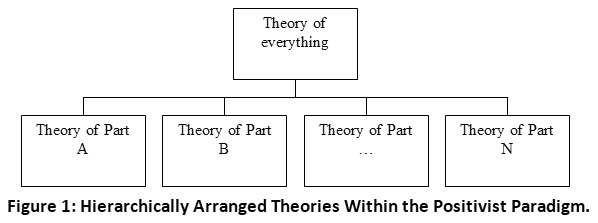 |
Figure 1: Hierarchically Arranged Theories Within the Positivist Paradigm. Click here to view Figure |
The positivist approach implies practice can falsify theory in an experimental test and that the resulting truth lies in the unfalsified theory, not in the practice. In this way we lose sight of the fundamental tenet of empiricism, the axiom that all knowledge derives from experience, that it comes to us only through our practice and is inseparable from it, that practical efficacy is the only way to evaluate its ‘truth-content’. So how are we to speak of practice except in terms of the theory it enacts? Falsification introduces observation and only seems uncontroversial because we take the experimental evidence - contingent on the theory of observation adopted - as certain. However, if we, like Popper (1969), regard all theory as tentative, this must apply to the observation theory as well. In which case falsification is not what we might think it to be - a point sometimes labeled the Duhem-Quine thesis (Ariew, 1984; Boylan & O'Gorman, 2003; Cross, 1982; Gillies, 1998). Rather than being a rigorous test of hypothesis (H), a falsification experiment merely contrasts our relative degree of confidence in a chosen theory of observation (O) versus our commitment to H on experience-based inductive grounds. The point is not to debate the many complexities in the philosophy of science but to note how a practice-event might be ‘caught’ in a simple net constructed from two theories, in this case O and H. These theories must be mutually incommensurate; O must not entail H and vice versa for then the evidence’s empirical content would be crushed by the tautology. Thus practice (especially experimental practice) is defined as synthetic rather than analytic. Noting the Duhem-Quine thesis we see the strategic manager’s agency as the instantiation of his/her judgment ‘captured’ between two or more incommensurate theories (see Figure 2).
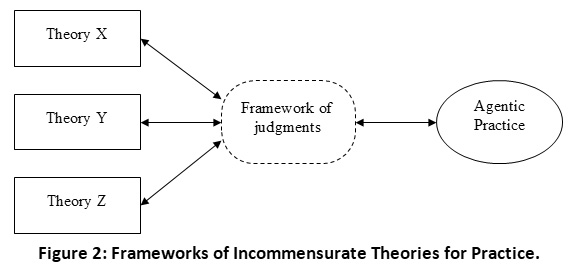 |
Figure 2: Frameworks of Incommensurate Theories for Practice. Click here to view Figure |
Thus, by practice we do not mean the theory-bound analytic processes observed and objectified as in the strategy process (Pettigrew, 1992; Van de Ven, 1992) or strategy-as-practice (Jarzabkowski & Whittington, 2008b; Whittington, 2007) traditions. These define practice as analytic, an application of the strategy theory being presumed or sought. But absent certainty, practice can never be seen as the instantiation of a single theory. In contrast, strategizing as a synthesizing agentic practice connects with the unexplained variance considered earlier and, lying outside what can be grasped by any single ‘theory of strategy’, must be ‘framed’ within a discourse or ‘space of possibilities’ that engages multiple incommensurate theories. These are not ‘theories of strategy’ but theories of the situated constraints in the lived-in present into which the strategist projects her/his agency as an instantiation. Given the Duhem-Quine thesis, these constraints must be incommensurate with and not reducible to each other - the very opposite of arranged in a hierarchy of subcomponents of the positivist theory of everything. If A and B are not incommensurate they must be in a hierarchical relationship, one ‘enveloping’ the other, as do Russian dolls. Action is thereby fully determined and there would be no place for agentic practice.
'Framework’ implies an imagined option-space for the instantiation of human agency. Reasoned practice means choosing the particular incommensurate bundle of theories, heuristics and proto-theories that bound the option-space. Frameworks delineate that domain of practice in which managers might act agentically. In simpler terms, they suggest but do not insist on the factors that might be taken into account. They also suggest which constraints might be influenced were the manager to deploy the firm’s power and resources to increase or ‘manage’ the option-space itself, just as ‘innovation’ might be a way to transform cash into products that create a new market. Framing surfaces and shapes the manager’s strategic choices (e.g. Kahneman & Tversky, 1984; Tversky & Kahneman, 1981), thus the initial choice of framework will be strategically fundamental to the practice that results.
The meaning of the term ‘theory’ is necessarily captive to the particular epistemology adopted. Positivism teaches us to think of theory as a tenable (un-falsified) representation of reality. Here we make no such claim; rather, we consider theory as ‘term of art’, an economical way of grasping and summarizing our experience of practice within the world. We do not suggest theory reveals anything about reality beyond our experience of it; for instance, that we failed to achieve a goal as we experienced the world as limiting our imagined practice. Likewise we cannot generalize on the basis of one instance (James G. March, Sproull, & Tamuz, 1991). But from several instances we might generalize and distill our experience ‘inductively’. Since the resulting generalization is not present in the experiences themselves, it is likewise an act of our agency, of our imagination appearing now in the world of our discourse about the phenomena in question. We can imagine generalizations ranging from the highly tentative to those manifesting high confidence, from intuitive hunches and heuristics to what we label ‘scientific theory’. The point here is that the interplay of practice and theory leads the imaginative person towards an option-space of empirical questioning lying in the middle ground between incommensurate notions. This is where human agency is thrown into the world as a practice that leads to the creation of new world-situations; it is not a decision, a purely mental act. Such practice can, of course, be anticipated and thus abstracted, but the anticipation will always differ from what actually happens. So ‘imaginative’ here means someone engaged in the lived world and acting creatively within it (Joas, 1997). The sequence is less from thought to action, the customary positivist position, than an experience-generating interplay between thought and practice as two different ways in which human beings ‘know’ their world. All generalization requires language, so a corollary to capturing experience is developing a language entwined into and reflecting the context experienced. People use this to communicate with the others that share that context, asking others about their experiences and getting comprehensible answers.
At first sight focusing on the ‘local language’ of the context of practice does no more than bring the interpretive method to our research, redefining strategizing as ‘sense making’ in the face of incomplete theory. There is little new here e.g. (Gerry Johnson, 1987; Silverman, 1993; Spender, 1989; Weick, 2001). Plus, once strategic managers are granted the liberty to construct their own views rather than follow our prescriptions, what can we say or do to help them further? Absent certain knowledge, one view is as good as any other. What such relativism misses is that we are in a world in which every individual’s agentic capabilities are limited in the way Simon suggested our rational capabilities are limited. Some negative generalizations are possible, as in ‘all people are boundedly rational’, because we can never step outside our context of experience-and-language. The development of a context-specific language allows similarly bounded people to collaborate agentically and engage the option-space outlined by the framework.
The economic and strategic importance of such collaboration is evident in the increasing research interest in notions like ‘tacit knowledge’ (Nonaka & Takeuchi, 1995; Polanyi, 1967), ‘thick knowing’ (Geertz, 1983), ‘flow’ (Czikszentmihalyi, 1988), or ‘bricolage’ (Harper, 1987). Polanyi’s ‘knowing more than we can say’ also means ‘more than we can theorize’. We experience being beyond the bounds of theory whenever our everyday practice is not theory-dictated but calls forth those forms of human knowing that lie beyond what can be considered conscious reasoning, cognition or ‘sense making’. We move closer to the philosophizing of, say, Heidegger (Chia & Holt, 2006), or Bourdieu (Bourdieu, 1990; Hurtado, 2010), ultimately seeing practice as the mutual construction of the strategist and her/his world and language.
This may take us perilously close to the bleeding edge of contemporary philosophy and far beyond this paper’s purpose. Our objective is more modest, to explore how the method of frameworks might usefully capture and analyze strategic practice in the business milieu. As we see, frameworks characterize the domains of possible agentic practice that lie in the middle ground between theoretical determination and unconstrained imagination. Many have explored this, though few within our discipline. Again, the paradox noted at the start of the paper is actually of our own creation; a reflection of our discipline’s methodological priggishness and determination to hang onto positivist thinking even when it does not serve us, or managers, well. Thus we argue strategy makes no sense within a positivist epistemology; strategy is a notion that ex definitio demands a conceptual option-space for its application. Strategizing is no more and no less than being agentic in the under-structured situations that alone makes profit possible, Knight’s central argument (Knight, 1921). Analyzing this requires a shift away from positivist idea of theories as hierarchically ordered and decomposable representations of reality and towards the idea of frameworks as synthetically integrated bundles of incommensurate theories. Or, in other words, we might do well to move from theorizing about managerial agency and towards theorizing for managerial agents.
Frameworks are Familiar after all
From the point of view of empirical science, frameworks are not new; they have been its essence since Bacon. Nor are they new in economic theorizing (Cantillon, 2010; Commons, 1931). Business strategy is a special milieu for there the objective is to create economic advantage rather than produce knowledge. Barnard addressed the task of creating an organization with strategic advantage directly. His analysis of the business executive’s strategizing proposed a framework hung between four incommensurate ‘sub-economies’; (a) material, (b) social, (c) individual, and (d) organizational (Barnard, 1938: 242). It is only our unfamiliarity with multi-dimensional frameworks that make this seem opaque and difficult. Nor are frameworks new in strategic management. On the contrary, the Learned, Christensen, Andrews and Guth (LCAG) framework played a central pedagogical role for decades (Learned, Christensen, Andrews, & Guth, 1965). It presumed strategizing should be hung between what management thought it (a) might do, (b) can do, (c) wanted to do, and (d) should do (1965:20), a framework drawn directly from Commons’s frameworking (1924:6). The LCAG framework set generations of strategy students to seeking ‘sweet spots’ between its four constraints.
Porter’s (1980) five forces framework (FFF) is even more familiar. It frames strategizing as the practice of rent protection within an option-space structured by five incommensurate forces – competitors, suppliers, customers, new entrants, and substitutes. So framed, the strategist’s task is to establish a beneficial position within the ‘industry force field’ and thereby influence the various forces (Spender & Kraaijenbrink, 2011). The Balanced Scorecard (BS) is an even more widely adopted framework, strung between financial, customer, process and growth notions. Kaplan and Norton built the BS on Schneiderman’s earlier consulting tool (R. S. Kaplan, 2010; R. S. Kaplan & Norton, 1996). The result has been subject to considerable criticism, mostly academic, for its lack of theoretical underpinnings. Yet these critics mostly miss their target, for each firm develops its own strategic option-space and, to do so, selects some relevant constraints as part of its strategizing process. Sometimes these will be based on theory, say financial, but sometimes they will be based on empirical generalizations about their own history, such as their experience of hiring practices. Along the same line as Porter’s FFF, the BS offers a language with four notions as suggested ‘starters’ towards the firm’s own process of constructing a local language or ‘jargon’.
Instead of trying to sort the externally supported generalizations (validated theories) from the less well-supported internal generalizations (heuristics, hunches or intuitions) it may be more productive to, for example, compare the FFF and BS and note how they address very different strategic issues. Porter’s focus is uniquely on managing the firm’s rent-streams, and his ubiquitous diagram is a tentative mapping of the economic actors with the power to disturb them. Some actors, such as government regulators, are missing - but this does not render the framework useless. We know it is a framework rather than a theory precisely because the different forces portray powers of incommensurate types, like Barnard’s sub-economies, and so can never be resolved into a unified ‘rent-eroding force index’ like a Herfindahl number. The BS framework’s focus is not on maintaining rent streams. It is about the language of strategizing, about ‘balancing’ the firm’s discourse. Its history is a push-back against the dominance of finance-speak, historically precipitated by the disappearance of managerial accounting (H. T. Johnson & Kaplan, 1987).
The FFF and BS frameworks help management focus their bounded agentic capabilities on very different strategic problems. With this idea in mind, we can look at some of the strategy consultant’s ‘tools’ and see where they direct senior management’s agency. The BCG matrix, for instance, is clearly not a determinative theory. It is a useful framework for managing the flow of capital between the three categories of investment opportunity that models the firm as a portfolio - the fourth category, ‘dogs’, being defined as ‘out of the model’, to be disposed. The strategic question is how to allocate the firm’s limited cash into the option-space the matrix describes. As these Barnard, Porter, Kaplan & Norton and BCG examples show, frameworks are already in use to engage strategic problems, both by academics and by strategy consultants. Note all support rather than throttle managerial agency.
How Framework-Based Strategizing can Embrace Agency
Theories and frameworks differ only because we are uncertain about our world. Theory posits certainty, albeit limited and falsifiable, and when we use it we decide as if we are certain of its relevance to the phenomena in hand - given initial conditions, ceteris paribus, etc. We calculate the time it takes a shell to hit a target because we feel certain of the physics. But strategy makes no sense when there is no uncertainty or option-space for human agency. Strategy is not a theory-like axiom or concept that can be fitted together with other mutually defining concepts - such as tactics, planning, resources, etc. - to complete a logical language of management. Strategy is a historically and philosophically informed ‘term of art’ that points us towards the quintessentially human practice of acting purposively in uncertain circumstances. Which is all very well, but until we establish some general implications we risk re-defining strategy as so arbitrary, contextual and subjective that researching or teaching it is impossible.
We argue frameworks provide the kind of middle ground between certainty and ‘anything goes’ that researching agency requires. To adopt a theory is to presume it is both certain and logical. At the opposite extreme, to ignore all theories, heuristics, hunches, intuitions, and empirical generalizations leaves us without language. Our proposed ‘third way’ is to adopt two or more incommensurable practice-structuring notions - theories, empirical generalizations, etc. The agentic option-space then lies ‘between’ them. In this sense strategizing must begin with pure judgment, a strategic choice of the theories and heuristics that allow the strategist to set up her/his option-space, a process that lies beyond the reach of theory - analogous to the physicist’s choice of theory as s/he addresses an anomaly or unexpected event or to the physician making an initial diagnosis. Each framework proposes its own unique universe of phenomena and methodological net for catching them. Strategy theorists cannot say much about the meta-choice of a framework - such as the judgment that their firm is like that in the five forces framework, or the BCG matrix, or the Balanced Scorecard. There can be no certainty to this choice, nor middle ground discourse about it, for that is only opened up by the meta-choice itself. They might move into a different kind of analysis altogether by arguing, for instance, that the FFF’s inherent value system (preferring private rents over public goods) is more pertinent than the BS’s (paying attention to employee attitudes and learning).
It follows there are at least two modes of strategizing beyond that of debating alternative meta-choices within, say, a wider framework of political struggle: (a) exploring the option-space’s strategic geography (a positioning discourse) and (b) exploring the nature of the constraints selected (a power discourse). Both begin with systematic identification of the constraints that bound the framework’s option-space. Porter suggests five types, the Balanced Scorecard points to four, the BCG to several including the PIMS hypothesis and life cycle theory, and so on. Barnard pointed to four categories of constraint, material, social, individual, and organizational. He regarded leadership as the ‘most limiting’ or ‘strategic’ factor i.e. that in shortest supply (Barnard, 1938: 288). But he also saw few of these constraints are completely fixed; they are normally somewhat malleable. Physical constraints like the 2nd Law of Thermodynamics, which inter alia denies the possibility of perpetual motion machines, are, as far as we know, completely fixed. Others, such as the supply of leadership, can be expanded and so means to increase the option-space.
Note the concept of constraint pliability is central to Penrose’s distinction between resources and services, for the services available from given resources are always open to modification in light of the management team’s learning. In general, the notion of agentic positioning within a given option-space is complemented by the possibility of transforming the space through agentic practice. A full strategic analysis begins with the meta-choice of framework, to be followed by identifying the option-space’s constraints, and thence to considering (a) positioning within the space, and (b) transforming the space into one that offers strategically preferred positions.
Conclusion and A Suggested Research Agenda
We explore resolving the seeming paradox that strategizing takes place somewhere between (a) ‘strategy theories’ that aspire to determine managements’ decisions and so deny their agentic inputs and (b) being without theories and structures analysis requires. Our review of the strategic management literature revealed different attempts to address this paradox. The mainstream discussion appears to throttle the managers’ agency rather than embrace it. Can this be appropriate in business? If, as we suggest, economic growth depends on entrepreneurship (agency writ small) or entrepreneurial strategizing (agency writ large), then the mainstream’s dumping agency as part of its research strategy seem counter to its own goals.
We set out from the notion of human agency as the appearance of our imagination in the world as agentic practice. Much of the literature on agency positions it against abstract structure, leading to the ‘structure and agency’ debate around which should be given theoretical primacy, the human imagination or the theorized world confronted. Many sociologists are interested in how the two interplay, as in ‘structuration theory’. But progress in the management area calls for some tractable notion of agency if the debate is not to circle endlessly; plus there is to be some relevance to the problematics of business strategizing. We argue a more productive way to characterize agency is to focus on the practice-based constraints to its application. This requires a methodological shift from causal analysis towards ‘partial causation’ and an examination of the options remaining after all reasonable or practical causes have been identified. The bounds to the strategic option-space, operationalized as a framework that ‘hangs’ between incommensurable theories - or empirical generalizations and hunches - can be communicated and shared among those engaged in the strategizing practice via their local language. While Porter’s (1981, 1991) extended analysis of the difference between framework and theory has not been widely considered, it is especially relevant to strategy scholars. We see many other frameworks in use and familiar once the distinction has been clarified and we know what we are looking for. Our field’s paradox is resolved, then, by denying the usefulness of a single theory causal analysis that itself denies the notion of bounded strategic choice. We argue strategy’s meaning arises specifically from the finitude of the bounds to our practice as well as to our reasoning. We buttress our argument that frameworks are familiar with examples – BGG, FFF, BS, etc. Even though we often use these in our teaching and consulting we fail to appreciate their nature or acknowledge them as academic products. We outlined the fundamental characteristics of frameworks and their relevance to the analysis of managerial agency, and to its application.
Given being relevant to strategic practitioners as the destination we choose along the road to variance acceptance, then frameworks are not meant to scientifically represent or reflect the world ‘as it is’. They are heuristic aids to the creative practice of changing the firm’s situation into what it was not. We lack the invariants necessary for theorizing and we cannot ever induce, deduce, adduce or test a framework for its validity and reliability in the positivistic sense. It would be absurd to test whether the FFFs’ competitors and suppliers, or the BS’s financial and growth perspectives, or the BCG matrix’s cash cows and dogs actually ‘exist’ or whether they ‘cause’ firm performance. On the other hand, some frameworks seem more suitable for some contexts than for others. Thus Stabell & Fjeldstad (1998) argue Porter’s value chain framework applies well to industrial organizations, but less to insurance firms or banks. But absent a complete understanding of context this intuition cannot be operationalized.
Once we put agentic managers’ practice in the front seat, the empirical test of a framework is whether it illuminates their situation rather than obscuring it. Effective frameworks, like headlights, lead to increased problem-solving capacity and fewer practice-disturbing anomalies. History sometimes shines light on others’ use of a framework, but beyond case-studies we lack the accepted methodologies that would support the publication of historical analyses. Porter’s arguments for longitudinal studies may be a useful starting point though, again, such comments have attracted little attention (Porter, 1981, 1991). He is clear the FFF is intended to support the managers’ strategizing rather than foreclose it. While he speaks as a deliberate economist, the FFF is not derived from theory alone. Heuristics and other experience-based generalizations are admitted. In Stonehouse and Snowdon (2007) he suggests that developing frameworks is an iterative ‘social networking’ process that draws on the ideas others develop through their practice. The criterion is practical, whether the idea ‘really connects and resonates when it is confronted with actual practice’ (Stonehouse & Snowdon, 2007: 270). Equally, in the Preface and Introduction to ‘Competitive Strategy’, Porter shows the heavy lifting was done by a team that analyzed hundreds of case studies. His use of these can help direct our attention back to our discipline’s earlier more historical methods (Collingwood, 1961; Spender & Kraaijenbrink, 2011). Revealing the contextuality of human practice, history can help uncover how past strategists felt about their constraints, which they deliberately ignored, and to what extent they considered their choices malleable.
Evaluating frameworks changes the role of the manager in the research process. In framework analysis, managers are active and central as adopters and co-constructors rather than as passive recipients of our theorizing or as our research subjects. We test whether a framework improves strategic performance, drawing attention to experimental and quasi-experimental research methods (Cook & Campbell, 1979) and action research (Argyris, Putnam, & McLain Smith, 1985; K. Lewin, 1946; Rewans, 1982). All of this implies a novel line of strategy research focused on how managers establish, explore and apply their strategic option-spaces (Spender, 1989). It stands in contrast to (a) the direct pursuit of causal theories or models of strategizing, and (b) longitudinal research or casework that takes a sample of one and seeks empirical generalization without engaging the indexical ‘when, why and how’ of the managers contributing their agency.
By framing a firm’s strategic practice, every framework implies a particular view of the firm and what strategy is supposed to mean. It suggests at least two lines of research. First, we can re-assess existing ‘theories’ of the firm and their relevance as frameworks rather than as causal theories. One example would be the resource-based view (Barney, 1991, 1994, 2002). Commonly considered a theory with causal implications for managing the relationship between resources and competitive advantage, it has been heavily criticized (Kraaijenbrink et al., 2010). Yet if we see the RBV as a framework, much of the criticism would be irrelevant. Accusations of tautology (Lockett, Thompson, & Morgenstern, 2009; Priem & Butler, 2001a, 2001b) would disappear as we grasp the Penrosian part agency plays in generating the firm’s competitive advantage. As a framework, the RBV simply points to the firm as a bundle of incommensurate resources from which managers might develop competitive advantage as they exploit those they judge valuable, rare, and inimitable.
Second, seeing how frameworks like the FFF or RBV work in practice prompts questions about the relevance of the other microeconomic theories of the firm. The strategy literature generally ignores this body of work, even though every strategy is clearly also a theory of or for that firm, albeit local (Foss & Mahnke, 2000). We can see if these theories are, indeed, ‘theories’ of the firm or simply frameworks (Foss & Klein, 2005; Gibbons, 2005; Kim & Mahoney, 2010). Taking principal-agent theory as an example, does Fama’s (1980) paper on ‘agency problems’ suggest a determining equilibrium solution or merely an option-space for his manager’s agency? Note first, that he presumes multiple time periods and an open-ended flow of time, something often shut out of neoclassical economic theory. Second, his division of ‘entrepreneurship’ into ‘management’ and ‘risk bearing’, engages his manager into two offers a single-period equilibrium solution, actually stands on a logical error. Their solution is contingent on the efficient markets that lead managers to their ‘rational expectations’ (1976:345). The authors’ error being that when efficient markets are present there can be no rational explanation for the existence of the principal-agent relationship they believe they are analyzing. Given efficient markets, there are no actors in the analysis who are not principals, there are no agents to draw into the principal-agent relationship. Along the same lines other so-called ‘theories of the firm’ can be re-examined as frameworks, stakeholder ‘theory’ being an obvious example (R. E. Freeman, 1984; R. Edward Freeman, Harrison, Wicks, Parmar, & de Colle, 2010). As we see how frameworks are in use even in microeconomics so we can help establish agency’s central place in strategy research.
Note that as strategy theorists abandon their search for certainty, the academically erected boundaries that separate strategizing from the practice of entrepreneurship or leadership or management seem oppressively arbitrary and dissolve. Aside from restructuring our field in ways that seems intuitively productive, moving in agency’s direction might significantly increase our usefulness to managers. We would no longer be trying to replace them (or, rather, deny their agentic capabilities) with theories, models, algorithms or artificial intelligence. Then, along our curiously less-travelled road, we might find a way to honor the profoundest mystery behind democratic capitalism - the strategists’, leaders’, entrepreneur’s, or manager’s ability to generate economic value, seemingly creating something from nothing, and thereby support their explorations of the richly variegated option-spaces that comprise our economy.
Acknowledgment
None
Funding Source
There is no funding or financial support for this research work.
Conflict of Interest
Authors declare no conflict of interest.
References
- Andersen, T. J. 2000. Strategic Planning, Autonomous Actions and Corporate Performance. Long Range Planning, 33(2): 184-200.
CrossRef - Ansoff, H. I. 1987. The Emerging Paradigm of Strategic Behavior. Strategic Management Journal, 8(6): 501-515.
CrossRef - Ansoff, H. I. 1991. Critique of Henry Mintzberg's 'the Design School: Reconsidering the Basic Premises of Strategic Management'. Strategic Management Journal, 12(6): 449-461.
CrossRef - Ansoff, H. I. 1994. Comment on Henry Mintzberg's Rethinking Strategic Planning. Long Range Planning, 27(3): 31-32.
CrossRef - Archer, M. S. 2003. Structure, Agency, and the Internal Conversation. Cambridge: Cambridge University Press.
CrossRef - Arend, R. J. 2003. Revisiting the Logical and Research Considerations of Competitive Advantage. Strategic Management Journal, 24(3): 279-284.
CrossRef - Argyris, C., Putnam, R., & McLain Smith, D. 1985. Action Science. San Francisco: Jossey-Bass. Ariew, R. 1984. The Duhem Thesis. British Journal for the Philosophy of Science, 35(4): 313-325.
CrossRef - Baldridge, D. C., Floyd, S. W., & Markóczy, L. 2004. Are Managers from Mars and Academicians from Venus? Toward an Understanding of the Relationship Between Academic Quality and Practical Relevance. Strategic Management Journal, 25(11): 1063-1074.
CrossRef - Barnard, C. I. 1938. The Functions of the Executive (1962 ed.). Cambridge, Massachusetts: Harvard University Press.
- Barney, J. B. 1991. Firm Resources and Sustained Competitive Advantage. Journal of Management, 17(1): 99-120.
CrossRef - Barney, J. B. 1994. Bringing Managers Back In: A Resource-Based Analysis of the Role of Managers in Creating and Sustaining Competitive Advantages for Firms, Does management matter? On competencies and competitive advantage. The 1994 Crafoord lectures: 1-36. Lund, Sweden: Institute of Economic Research, Lund University.
CrossRef - Barney, J. B. 2002. Gaining and Sustaining Competitive Advantage: Prentice Hall.
- Barry, D., & Elmes, M. 1997. Strategy Retold: Toward a Narrative View of Strategic Discourse. Academy of Management Review, 22(2): 429-452.
CrossRef - Bascle, G. 2008. Controlling for Endogeneity with Instrumental Variables in Strategic Management Research. Strategic Organization: 285-327.
CrossRef - Bedeian, A. G. 1990. Choice and Determinism: A Comment. Strategic Management Journal, 11(7): 571-573.
CrossRef - Bergh, D. D., & Fairbank, J. F. 2002. Measuring and Testing Change in Strategic Management Research. Strategic Management Journal, 23(4): 359-366.
CrossRef - Bettis, R. A. 1991. Strategic Management and the Straightjacket: An Editorial Essay. Organization Science, 2(3): 315-319.
CrossRef - Biggadike, E. R. 1981. The Contributions of Marketing to Strategic Management. The Academy of Management Review, 6(4): 621-632.
CrossRef - Bourdieu, P. 1990. The Logic of Practice. Stanford: Stanford University Press.
- Bourgeois, L. J., III. 1984. Strategic Management and Determinism. Academy of Management Review, 9(4): 586-596.
CrossRef - Bowen, H. P., & Wiersema, M. F. 1999. Matching Method to Paradigm in Strategy Research: Limitations of Cross-Sectional Analysis and Some Methodological Alternatives. Strategic Management Journal, 20(7): 625-636.
CrossRef - Boyd, B. K., Gove, S., & Hitt, M. A. 2005a. Consequences of Measurement Problems in Strategic Management Research: The Case of Amihud and Lev. Strategic Management Journal, 26(4): 367-375.
CrossRef - Boyd, B. K., Gove, S., & Hitt, M. A. 2005b. Construct Measurement in Strategic Management Research: Illusion or Reality? Strategic Management Journal, 26(3): 239-257.
CrossRef - Boylan, T. A., & O'Gorman, P. F. 2003. Pragmatism in Economic Methodology: The Duhem- Quine Thesis Revisited. Foundations of Science, 8(1): 3-21.
CrossRef - Bromiley, P., & Papenhausen, C. 2003. Assumptions of Rationality and Equilibrium in Strategy Research: The Limits of Traditional Economic Analysis Strategic Organization, 1(4): 413-437.
CrossRef - Burrell, G., & Morgan, G. 1979. Sociological Paradigms and Organizational Analysis. London: Heinemann.
- Calori, R. 1998. Essai: Philosophizing on Strategic Management Models. Organization Studies, 19(2): 281.
CrossRef - Camerer, C. 1985. Redirecting Research in Business Policy and Strategy. Strategic Management Journal, 6(1): 1-15.
CrossRef - Cantillon, R. 2010. An Essay on Economic Theory: An English Translation of Richard Cantillon's Essai sur la Nature du Commerce en Général (C. Saucier, Trans.) (Thornton, Mark ed.). Auburn AL: Mises Institute.
- Carlile, P. R. 2003. A Pragmatic View of Knowledge and Boundaries: Boundary Objects in New Product Development. Organization Science, 13(4): 442-455.
CrossRef - Carlile, P. R. 2004. Transferring, Translating, and Transforming: An Integrative Framework for Managing Knowledge Across Boundaries. Organzation Science, 15(5): 555-568.
CrossRef - Carpenter, M. A., & Golden, B. R. 1997. Perceived Managerial Discretion: A Study of Cause and Effect. Strategic Management Journal, 18(3): 187-206.
CrossRef - Carter, C., Clegg, S. R., & Kornberger, M. 2008. So!apbox: Editorial Essays: Strategy as Practice? Strategic Organization: 83-99.
CrossRef - Chakravarthy, B. S., & Doz, Y. 1992. Strategy Process Research: Focusing on Corporate Self- Renewal. Strategic Management Journal, 13(Summer): 5-14.
CrossRef - Chia, R., & Holt, R. 2006. Strategy as Practical Coping: a Heideggerian Perspective. Organization Studies, 27(5): 635.
CrossRef - Child, J. 1972. Organizational Structure, Environment and Performance: The Role of Strategic Choice. Sociology, 6(1): 1-22.
CrossRef - Child, J. 1997. Strategic Choice in the Analysis of Action, Structure, Organizations and Environment: Retrospect and Prospect. Organization Studies, 18(1): 43-76.
CrossRef - Clark, E. 2004. Power, Action and Constraint in Strategic Management: Explaining Enterprise Restructuring in the Czech Republic. Organization Studies, 25(4): 607.
CrossRef - Collingwood, R. G. 1961. The idea of history: Oxford University Press New York. Commons, J. R. 1924. The Legal Foundations of Capitalism. New York: Macmillan. Commons, J. R. 1931. Institutional Economics. Madison WI: University of Wisconsin Press. Cook, T. D., & Campbell, D. T. 1979. Quasi-Experimentation: Design & Analysis Issues for Field Settings. Chicago: Rand McNally College Pub. Co.
- Cross, R. 1982. The Duhem-Quine Thesis, Lakatos and the Appraisal of Theories in Macroeconomics. Economic Journal, 92(June): 320-340.
CrossRef - Cummings, S., & Daellenbach, U. 2009. A Guide to the Future of Strategy?: The History of Long Range Planning. Long Range Planning, 42(2): 234-263.
CrossRef - Czikszentmihalyi, M. 1988. Optimal Experience: Psychological Studies of Flow in Consciousness. In M. Czikszentmihalyi, & I. S. Czikszentmihalyi (Eds.), Psychological Studies of Flow in Consciousness: 15-35. Cambridge: Cambridge University Press.
CrossRef - De Rond, M., & Thietart, R. A. 2007. Choice, Chance, and Inevitability in Strategy. Strategic Management Journal, 28(5): 535-551.
CrossRef - Dess, G. G., Newport, S., & Rasheed, A. M. A. 1993. Configuration Research in Strategic Management: Key Issues and Suggestions. Journal of Management, 19(4): 775-795.
CrossRef - Durand, R. 2002. Competitive Advantages Exist: A Critique of Powell. Strategic Management Journal, 23(9): 867-872.
CrossRef - Durand, R., & Vaara, E. 2009. Causation, Counterfactuals, and Competitive Advantage. Strategic Management Journal, 30(12): 1245-1264.
CrossRef - Edwards, J. P., & Harris, D. J. 1977. Planning in a state of turbulence. Long Range Planning, 10(3): 43-49.
CrossRef - Eisenhardt, K. M., & Zbaracki, M. J. 1992. Strategic Decision Making. Strategic Management Journal, 13: 17-37.
CrossRef - Emirbayer, M., & Mische, A. 1998. What is Agency? American Journal of Sociology, 103(4): 962-1023.
CrossRef - Fama, E. F. 1980. Agency Problems and the Theory of the Firm. Journal of Political Economy, 88(2): 288-307.
CrossRef - Fama, E. F., & Jensen, M. C. 1983. Agency Problems and Residual Claims. Journal of Law and Economics, 26(2): 327-349.
CrossRef - Felin, T., & Foss, N. J. 2005. Strategic Organization: A Field in Search of Micro-Foundations. Strategic Organization: 441-455.
CrossRef - Ferguson, T. D., & Ketchen Jr, D. J. 1999. Organizational Configurations and Performance: The Role of Statistical Power in Extant Research. Strategic Management Journal, 20(4): 385-395.
CrossRef - Finkelstein, S., & Hambrick, D. C. 1996. Strategic Leadership: Top Executives and Their Effects on Organizations: West Publishing Company St. Paul, MN.
- Finkelstein, S., & Peteraf, M. A. 2007. Managerial Activities: A Missing Link in Managerial Discretion Theory. Strategic Organization: 237-248.
CrossRef - Foss, N. J. 1996. Research in Strategy, Economics, and Michael Porter. Journal of Management Studies, 33(1): 1-24.
CrossRef - Foss, N. J., & Ishikawa, I. 2007. Towards a Dynamic Resource-based View: Insights from Austrian Capital and Entrepreneurship Theory. Organization Studies, 28(5): 749-772.
CrossRef - Foss, N. J., & Klein, P. G. 2005. The Theory of the Firm and Its Critics: A Stocktaking and Assessment. Center for Knowledge Governance, Copenhagen School of Business, Working Paper 2/2005.
CrossRef - Foss, N. J., Klein, P. G., Kor, Y. Y., & Mahoney, J. T. 2008. Entrepreneurship, Subjectivism, and the Resource-Based View: Toward a New Synthesis. Strategic Entrepreneurship Journal, 2(1): 73-94.
CrossRef - Foucault, M. 1980. Power/Knowledge: Selected Interviews and Other Writings 1972-1977. Edited by Colin Gordon: Brighton.
- Geertz, C. 1983. Local Knowledge: Further Essays in Interpretive Anthropology. New York: Basic Books.
- Ghoshal, S. 2005. Bad Management Theories are Destroying Good Management Practices. Academy of Management Learning & Education, 4(1): 75-91.
CrossRef - Ghoshal, S., & Moran, P. 1996. Bad for Practice: A Critique of the Transaction Cost Theory. Academy of Management Review, 21(1): 13-47.
CrossRef - Gibbons, R. 2005. Four Formal(izable) Theories of the Firm? Journal of Economic Behavior & Organization, 58 200-245.
CrossRef - Giddens, A. 1984. The Constitution of Society: Outline of the Theory of Structuration. Berkeley CA: University of California Press.
- Gillies, D. 1998. The Duhem Thesis and the Quine Thesis. In M. Curd, & J. A. Cover (Eds.), Philosophy of Science: The Central Issues: 302-319. New York: W. W. Norton & Co.
- Godet, M., & Roubelat, F. 1996. Creating the Future: The Use and Misuse of Scenarios. Long Range Planning, 29(2): 164-171.
CrossRef - Godfrey, P. C., & Hill, C. W. L. 1995. The Problem of Unobservables in Strategic Management Research. Strategic Management Journal, 16(7): 519-533.
CrossRef - Goold, M. 1992. Design, Learning and Planning: A Further Observation on the Design School Debate. Strategic Management Journal, 13(2): 169-170.
CrossRef - Grinyer, P. H. 1973. Some Dangerous Axioms of Corporate Planning. Journal of Business Policy, 3(1): 3.
CrossRef - Hahn, D. 1991. Strategic Management—Tasks and Challenges in the 1990s. Long Range Planning, 24(1): 26-39.
CrossRef - Hambrick, D. C. 2004. The Disintegration of Strategic Management: It's Time to Consolidate Our Gains. Strategic Organization: 91-98.
CrossRef - Hambrick, D. C., & Chen, M. J. 2008. New Academic Fields as Admittance-Seeking Social Movements: The Case of Strategic Management. Academy of Management Review, 33(1): 32-54.
CrossRef - Hambrick, D. C., & Finkelstein, S. 1987. Managerial Discretion: A Bridge Between Polar views of Organizational Outcomes. In L. L. Cummings, & B. M. Staw (Eds.), Research in Organizational Behavior, Vol. 9: 369-406. Greenwich CT: JAI Press.
- Hamilton, B. H., & Nickerson, J. A. 2003. Correcting for Endogeneity in Strategic Management Research. Strategic Organization: 51-78.
CrossRef - Hardy, C., Palmer, I., & Phillips, N. 2000. Discourse as a Strategic Resource. Human Relations, 53(9): 1227-1248.
CrossRef - Harper, D. A. 1987. Working Knowledge: Skill and Community in a Small Shop. Chicago IL: University of Chicago Press.
- Harrison, F. L. 1976. How Corporate Planning Responds to Uncertainty. Long Range Planning, 9(2): 88-93.
CrossRef - Hendry, J. 2000. Strategic Decision Making, Discourse, And Strategy As Social Practice. Journal of Management Studies, 37(7): 955-978.
CrossRef - Heracleous, L., & Jacobs, C. D. 2008. Crafting Strategy: The Role of Embodied Metaphors. Long Range Planning, 41(3): 309-325.
CrossRef - Hesterly, W. S., & Zenger, T. R. 1993. The Myth of a Monolithic Economics: Fundamental Assumptions and the Use of Economic Models in Policy and Strategy Research. Organization Science, 4(3): 496-510.
CrossRef - Hirsch, P. M., Friedman, R., & Koza, M. P. 1990. Collaboration or Paradigm Shift?: Caveat Emptor and the Risk of Romance with Economic Models for Strategy and Policy Research. Organization Science, 1(1): 87-97.
CrossRef - Hitt, M. A., Boyd, B. K., & Li, D. 2004. The State of Strategic Management Research and a Vision of the Future. Research Methodology in Strategy and Management, 1: 1–31.
CrossRef - Horwitz, R. 1979. Corporate Planning - A Conceptual Critique. Long Range Planning, 12(1): 62-66.
CrossRef - Hrebiniak, L. G., & Joyce, W. F. 1985. Organizational Adaptation: Strategic Choice and Environmental Determinism. Administrative Science Quarterly, 30(3): 336-349.
CrossRef - Hubbard, R., Vetter, D. E., & Little, E. L. 1998. Replication in Strategic Management: Scientific Testing for Validity, Generalizability, and Usefulness. Strategic Management Journal, 19(3): 243-254.
CrossRef - Huff, A. S., & Huff, J. O. 2000. When Firms Change Direction. Oxford: Oxford University Press.
- Hurtado, P. S. 2010. Assessing the Use of Bourdieu's Key Concepts in the Strategy-As-Practice Field. Competitiveness Review, 20(1): 52-61.
CrossRef - Hutzschenreuter, T., & Kleindienst, I. 2006. Strategy-Process Research: What Have We Learned and What Is Still to Be Explored. Journal of Management, 32(5): 673-720.
CrossRef - Jacobson, R. 1992. The "Austrian" School of Strategy. Academy of Management Review, 17(4): 782-807.
CrossRef - Jarzabkowski, P. 2004. Strategy as Practice: Recursiveness, Adaptation, and Practices-in-Use. Organization Studies, 25(4): 529.
CrossRef - Jarzabkowski, P. 2008. Shaping Strategy as a Structuration Process. Academy of Management Journal, 51(4): 621-650.
CrossRef - Jarzabkowski, P., & Whittington, R. 2008a. Hard to Disagree, Mostly. Strategic Organization: 101-106.
CrossRef - Jarzabkowski, P., & Whittington, R. 2008b. A Strategy-as-Practice Approach to Strategy Research and Education. Journal of Management Inquiry, 17(4): 282-286.
CrossRef - Jemison, D. B. 1981a. The Contributions of Administrative Behavior to Strategic Management. Academy of Management Review, 6(4): 633-642.
CrossRef - Jemison, D. B. 1981b. The Importance of an Integrative Approach to Strategic Management Research. Academy of Management Review, 6(4): 601-608.
CrossRef - Jensen, M. C., & Meckling, W. H. 1976. Theory of the Firm: Managerial Behavior, Agency Costs and Ownership Structure. Journal of Financial Economics, 3(4): 305-360.
CrossRef - Joas, H. 1997. The Creativity of Action. Chicago: University Of Chicago Press.
- Johnson, G., Melin, L., & Whittington, R. 2003. Micro Strategy and Strategizing: Towards an Activity-Based View. Journal of Management Studies, 40(1): 3-22.
CrossRef - Johnson, H. T., & Kaplan, R. S. 1987. Relevance Lost: The Rise and Fall of Managerial Accounting. Boston MA: Harvard Business School Press.
- Johnson, N. F. 2007. Simply Complexity: A Clear guide to Complexity Theory. Oxford: Oneworld Publications.
- Kahneman, D., & Tversky, A. 1984. Choices, Values, and Frames. American Psychologist, 39(4): 341-350.
CrossRef - Kaplan, R. S. 2010. Conceptual Foundations of the Balanced Scorecard. HBS Working Paper 10-074.
CrossRef - Kaplan, R. S., & Norton, D. P. 1996. Using the Balanced Scorecard as a Strategic Management System. Harvard Business Review, 74(1): 75.
- Kaplan, S. 2008. Framing Contests: Strategy Making under Uncertainty. Organization Science, 19(5): 729-752.
CrossRef - Ketchen, D. J., Jr., & Shook, C. L. 1996. The Application of Cluster Analysis in Strategic Management Research: An Analysis and Critique. Strategic Management Journal, 17(6): 441-458.
CrossRef - Kim, J., & Mahoney, J. T. 2010. A Strategic Theory of the Firm as a Nexus of Incomplete Contracts: A Property Rights Approach. Journal of Management, 36(4): 806-826.
CrossRef - Knight, F. H. 1921. Risk, Uncertainty, and Profit. New York: August M. Kelley. Knights, D., & Morgan, G. 1991. Corporate Strategy, Organizations, and Subjectivity: A Critique. Organization Studies, 12(2): 251.
CrossRef - Kor, Y. Y., & Mahoney, J. T. 2004. Edith Penrose's (1959) Contributions to the Resource-Based View of Strategic Management. Journal of Management Studies, 41(1): 183-191.
CrossRef - Kraaijenbrink, J., Spender, J.-C., & Groen, A. J. 2010. The Resource-Based View: A Review and Assessment of its Critiques. Journal of Management, 36 (1): 349-372.
CrossRef - Kuhn, T. 1962. The Structure of Scientific Revolutions (1996 ed.). Chicago and London: The University of Chicago Press.
- Kwan, K.-M., & Tsang, E. W. K. 2001. Realism and Constructivism in Strategy Research: A Critical Realist Response to Mir and Watson. Strategic Management Journal, 22(12): 1163-1168.
CrossRef - Lam, S. Y. 2010. What Kind of Assumptions Need to Be Realistic and How to Test Them: A response to Tsang (2006). Strategic Management Journal, 31(6): 679-687.
CrossRef - Langley, A. 2007. Process Thinking in Strategic Organization. Strategic Organization: 271-282. Latour, B. 2005. Reassembling the Social: An Introduction to Actor-Network-Theory Oxford: Oxford University Press.
CrossRef - Laudan, L. 1977. Progress and its Problems. Berkeley: University of California Press. Law, J., & Hassard, J. (Eds.). 1999. Actor Network Theory and After. Oxford: Blackwell.
- Lawless, M. W., & Finch, L. K. 1989. Choice and Determinism: A Test of Hrebiniak and Joyce's Framework on Strategy-Environment Fit. Strategic Management Journal, 10(4): 351- 365.
CrossRef - Lawless, M. W., & Finch Tegarden, L. K. 1990. Choice and Determinism: A Reply. Strategic Management Journal, 11(7): 575-577.
CrossRef - Learned, E. P., Christensen, R., Andrews, K., & Guth, W. 1965. Business Policy: Text and Cases. Homewood, IL: Richard D. Irwin.
- Levy, D. 1994. Chaos Theory and Strategy: Theory, Application, and Managerial Implications. Strategic Management Journal, 15: 167-178.
CrossRef - Lewin, K. 1945. The Research Center for Group Dynamics at Massachusetts Institute of Technology. Sociometry, 8(2): 126-136.
CrossRef - Lewin, K. 1946. Action Research and Minority Problems. Journal of Social Issues, 2(4): 34-46.
CrossRef - Lockett, A., Thompson, S., & Morgenstern, U. 2009. The development of the resource-based view of the firm: A critical appraisal. International Journal of Management Reviews, 11(1): 9-28.
CrossRef - Lyles, M. A. 1990. A Research Agenda for Strategic Management in the 1990s. Journal of Management Studies, 27(4): 363-375.
CrossRef - Mahoney, J. 1993. Strategic Management and Determinism: Sustaining the Conversation. Journal of Management Studies, 30(1): 173-191.
CrossRef - Mahoney, J. T., & McGahan, A. M. 2007. The Field of Strategic Management Within the Evolving Science of Strategic Organization. Strategic Organization, 5(1): 79.CrossRef
CrossRef - Mahoney, J. T., & Pandian, J. R. 1992. The Resource-Based View Within the Conversation of Strategic Management. Strategic Management Journal, 13(5): 363-380.
CrossRef - March, J. G. 2006. Rationality, Foolishness, and Adaptive Intelligence. Strategic Management Journal, 27(3): 201-214.
CrossRef - March, J. G., Sproull, L. S., & Tamuz, M. 1991. Learning from Samples of One or Fewer. Organization Science, 2: 1-13.
CrossRef - Marlin, D., Lamont, B. T., & Hoffman, J. J. 1994. Choice Situation, Strategy, and Performance: A Reexamination. Strategic Management Journal, 15(3): 229-239.
CrossRef - McGee, J., & Thomas, H. 1986. Strategic Groups: Theory, Research and Taxonomy. Strategic Management Journal, 7: 141-160.
CrossRef - McKelvey, B., & Andriani, P. 2005. Why Gaussian Statistics are Mostly Wrong for Strategic Organization. Strategic Organization: 219-228.
CrossRef - Meillassoux, Q. 2008. After Finitude: An Essay on the Necessity of Contingency. London: Continuum International Publishing Group Ltd.
CrossRef - Meyer, A. D., Tsui, A. S., & Hinings, C. R. 1993. Configurational Approaches to Organizational Analysis. Academy of Management Journal, 36: 1175-1195.
CrossRef - Mezias, S. J., & Regnier, M. O. 2007. Walking the Walk As Well As Talking the Talk: Replication and the Normal Science Paradigm in Strategic Management Research. Strategic Organization: 283-296.
CrossRef - Miles, R. E., & Snow, C. C. 1978. Organizational Strategy, Structure, and Process. New York: McGraw-Hill.
CrossRef - Miller, D. 1986. Configurations of Strategy and Structure: Towards a Synthesis. Strategic Management Journal, 7(3): 233-249.
CrossRef - Miller, D. 1996. Configurations Revisited. Strategic Management Journal, 17(7): 505-512. Miller, D. 2007. Paradigm Prison, or in Praise of Atheoretic Research. Strategic Organization: 177-184.
CrossRef - Miller, K. D., & Tsang, E. W. K. 2010. Testing Management Theories: Critical Realist Philosophy and Research Methods. Strategic Management Journal.
CrossRef - Minocha, S., & Stonehouse, G. 2007. Towards a Body-Aware Strategic Organization. Strategic Organization: 437-445.
CrossRef - Mintzberg, H. 1989. Mintzberg on Management: Free Press New York.
- Mintzberg, H. 1990a. The Design School: Reconsidering the Basic Premises of Strategic Management. Strategic Management Journal, 11(3): 171-195.
CrossRef - Mintzberg, H. 1990b. Strategy Formation: Schools of Thought. In J. W. Fredrickson (Ed.), Perspectives on Strategic Management: 105-235. New York: Harper & Row.
- Mintzberg, H. 1991. Learning 1, Planning 0 Reply to Igor Ansoff. Strategic Management Journal, 12(6): 463-466.
CrossRef - Mintzberg, H. 1994a. Rethinking Strategic Planning Part I: Pitfalls and Fallacies. Long Range Planning, 27(3): 12-21.
CrossRef - Mintzberg, H. 1994b. Rethinking Strategic Planning Part II: New Roles for Planners. Long Range Planning, 27(3): 22-30.
CrossRef - Mintzberg, H., & McHugh, A. 1985. Strategy Formation in an Adhocracy. Administrative Science Quarterly, 30(2): 160-197.
CrossRef - Mintzberg, H., & Waters, J. A. 1985. Of Strategies, Deliberate and Emergent. Strategic Management Journal, 6(3): 257-272.
CrossRef - Mir, R., & Watson, A. 2000. Strategic Management and the Philosophy of Science: The Case for a Constructivist Methodology. Strategic Management Journal, 21(9): 941-953.
CrossRef - Mir, R., & Watson, A. 2001. Critical Realism and Constructivism in Strategy Research: Toward a Synthesis. Strategic Management Journal, 22(12): 1169-1173.
CrossRef - Montgomery, C. A., Wernerfelt, B., & Balakrishnan, S. 1989. Strategy Content and the Research Process: A Critique and Commentary. Strategic Management Journal, 10(2): 189-197.
CrossRef - Montgomery, C. A., Wernerfelt, B., & Balakrishnan, S. 1991. Strategy and the Research Process: A Reply. Strategic Management Journal, 12(1): 83-84.
CrossRef

This work is licensed under a Creative Commons Attribution 4.0 International License.