
The Contribution of Natural Gas to the Paradigm of Energy Transition in Portugal: Economy, Continuity of Supply and Welfare
Dr. Nuno Domingues* 
1ISEL Lisboa, Instituto Superior de Engenharia de Lisboa, Portugal .
http://dx.doi.org/10.12944/JBSFM.02.01-02.07
Copy the following to cite this article:
Domingues N. (2021) "The Contribution of Natural Gas to the Paradigm of Energy Transition in Portugal: Economy, Continuity of Supply and Welfare". Journal of Business Strategy Finance and Management, 2(1,2). DOI:http://dx.doi.org/10.12944/JBSFM.02.01-02.07
Copy the following to cite this URL:
Domingues N. (2021) "The Contribution of Natural Gas to the Paradigm of Energy Transition in Portugal: Economy, Continuity of Supply and Welfare". Journal of Business Strategy Finance and Management, 2(1,2). Available From : https://bit.ly/2Scex0w
Download article (pdf) Citation Manager Publish History



Introduction
In 1997 Portugal introduced Natural Gas (NG) in their energy mix. With lower emissions, possibility to storage, safety and flexibility, NG quickly found his place. However, in an era of climate change, alignment with European markets, avoidance of critical geopolitical Countries and new energy sources availability, Portugal is reflecting the role of NG. The recent and foreseen Coal power plants phase out introduced stimulus to rethink on the no intermittent power sources that could introduce flexibility to the electric system.
The introduction of NG in Portugal was an important milestone for the development of the country, diversifying its energy matrix and opening to the productive sector and users, a new and important alternative in terms of energy. The country is now able to increase the competitiveness of its industry, mainly the one with the highest energy intensity, to facilitate social development and the well-being of the populations and to improve the security of energy supply. The first initiatives for the introduction of NG in Portugal emerged in the 1980s. In the 1990s, the first distribution concessions were created in some of the country's urban areas and NG begins to be distributed in 1997. The initial concern of most Countries about the incompressible and flammable characteristics of NG was not applied in Portugal: a Country with several years of experience in fossil fuels industry.
One of the drivers for electricity market liberalization was the enhanced technologies that allowed reduced investments and costs. In particular, the new combined-cycle gas turbines are smaller scale generating units that can be built with lower investment cost. With the aim of energy diversification, the Spanish and European NG supply, structure and integrate the gas systems both in Spain and Portugal, the pipeline was therefore born. In 1990, the Maghreb-Europe Gas Pipeline (GME) project was launched to transport Algerian gas to Spain and Europe. The intended objective was to diversify the Spanish NG supply structure and that of other European countries and to integrating the gas systems in Spain and Portugal. In turn, the gas pipeline also became an element of economic structuring and cooperation in an initiative that linked the two shores of the Mediterranean, through a project of such a scope and complexity in terms of gas pipeline that included 4 countries: Algeria, Morocco, Spain and Portugal. The first Phase of the project started with the creation of the study society Omegaz-Etudes, which oversaw assessing its technical and economic viability. After this first phase, the agreement signed in July 1992 between the Government of the Kingdom of Morocco, the Moroccan oil company SNPP (Société Nationale Des Produits Pétroliers) and the Spanish company Enagás (the Convention), was the starting point for the work of engineering. Two years later, Portugal entered in the second Phase through the company Transgás, currently Galp Gás Natural, a company of the Galp Energia group. The third Phase construction work began in 1993 and ended in late 1996. In its initial design, the EMPL pipeline was designed to transport 8.5 billion cubic meters (bcm) of gas per year. It started operating on November 1, 1996. Between 2003 and 2005, the work was carried out to expand the transport capacity of the GME Moroccan section by 50% to 12.5 bcm / year to address a new Naturgy supply contract with Sonatrach. The work consisted of strengthening the Frontera and Estrecho compression stations by installing new compression groups and adapting the old compressors to the new operating conditions. In March 2005, in accordance with the provisions of the Convention, supply began to the Tahaddart plant, the first combined cycle plant of the ONEE (Office National de l'Electricité et de l'Eau Potable) in Morocco. In November 2011, the transport of ONEE's first direct supply contract with Sonatrach began to the Aïn Bénimathar thermal solar plant.
The NG Transport Pipeline Sines - Setúbal Natural carried out between Sines and Setúbal connects the LNG future terminal in Sines and the National NG Transport Network. included the construction of an 87 km long NG Pipeline, between Sines and Setúbal, including Europe's largest cross-section through directed drilling, the Sado River Estuary (4500 m).
Backed Regulation
Under the provisions of paragraph 4 of article 33-G of Decree-Law no. 172/2006, of 23 August, amended by Decree-Laws no. 237-B / 2006, of 18 December , 199/2007, of May 18, 264/2007, of July 24, 23/2009, of January 20, 104/2010, of September 29, and 215-B / 2012, of October 8, in the no. 2 of article 1 of Ordinance no. 243/2013, of 2 August, and the powers delegated by the Minister for the Environment, Spatial Planning and Energy, under the terms of Order no. 13322/2013, of October 11, published in the Diário da República, 2nd series, no. 202, of October 18, 2013, as amended by Dispatch no. 1941-A / 2014, of February 5, published in the Diário da República, 2nd series, no. 26, of February 6, 2014, the current Tariff Regulation for the NG sector was approved by Regulation No. 361/2019, of 23 April, amended by Regulation No. 455/2020, of 8 May. The application of some of the Regulation of commercial relations with Consumers (RRC) rules depends on the approval of complementary rules, with a more detailed content and a procedural nature. The approval of the complementary rules usually begins with the presentation of reasoned proposals by the regulated companies (as recipients of common obligations) and involves a process of prior consultation, as well as the presentation of activities of ERSE's advisory bodies. The complementary rules to the RRC currently in force are as follows:
Table 1: Complementary Rules to the RRC.
|
Directive no. 10/2020, of 8 June (Profiles of NG consumption and average daily consumptions by ERSE to be effective in the gas year 2020 -2021) |
|
Regulation No. 356-A / 2020, of April 8 (Regulation that Processes exceptional measures in the SEN and the SNGN) |
|
Interpretative Note to Regulation No. 356-A / 2020 |
|
Regulation No. 255-A / 2020 (Regulation that addresses Extraordinary Measures in the Energy Sector due to Epidemiological Emergency Covid-19) |
|
Interpretative Note to Regulation no. 255-A / 2020 |
|
Questions and Answers on Regulation No. 255-A / 2020 |
|
Directive no. 16/2019, of 6 December (Codification of the individualized agent registration) |
|
Directive no. 2/2019, of 7 January (Approves the GTG's notice on guarantees in connection with adhering to the SNGN's Global Technical Management) |
|
Directive No. 15/2018, of 10 December (Procedures for switching suppliers in the electricity sector and in the NG sector) |
|
Directive No. 7/2018, of 28 March (Guide to Measurement, Reading and Availability of Data for the NG Sector) |
|
Guide for Measurement, Reading and Availability of Data from the NG sector (e-book). |
|
Directive No. 20/2016, of 26 December (Application of the SNGN Global System Management Procedures Manual) |
|
Directive no. 18/2016, of 27 October (SNGN Global Technical Management Procedures Manual and provisions on the application of its transitional regime) |
|
Directive No. 6/2015, of 27 April (Provision of pre-contractual and contractual information to electricity and NG consumers in mainland Portugal) |
|
Directive No. 6/2014, of 29 January (Audit of the distribution network operators of the GALP and Tagusgás group in the scope of the provision of market information) |
|
Directive no. 2/2011, of 26 July (Alters the commercial conditions for connection to the NG transmission and distribution networks, revokes Order no. 11 209/2008, of 17 April, and republishes the methodology of universal facility related) |
|
Dispatch no. 7094/2011, of 10 May (Make changes to the general conditions that must be included in the NG supply contracts between the wholesale last resort supplier and retail last resort retailers, approved through Order no. 9178/2008, of 28 March) |
|
Dispatch no. 1550/2011, of 19 January (ERSE approves new general conditions for NG supply contracts to be signed between last resort suppliers and customers with annual consumption less than or equal to 10,000 m3) |
The Tariff Regulation (RT) for the NG sector, approved by ERSE, defines a set of issues such as, the permitted profits of regulated companies in the NG sector to be recovered by NG tariffs, the tariff structure, the procedures for setting, adjusting and advertising tariffs, as well as reporting obligations and procedures to ERSE.
In the tariff process, ERSE calculates annually the permitted income and the income to be recovered by applying the tariffs, for the diverse regulated activities. The acceptable profits for the regulated companies reflect the resources necessary for efficiently perform their economic activities. The allowed income may also reflect revenues to be recovered by regulated companies, by applying regulated tariffs, which must be transferred to other companies that, in turn, do not apply these tariffs. These acceptable revenues, defined by ERSE, aim at encouraging companies to carry out their activities efficiently, that is, to optimize the quality of services provided in the medium and long term at the lowest cost for consumers, to ensure economic sustainability.
In view of various circumstances, resulting from the legislative and regulatory framework, the value of the acceptable income to each player is seldom recovered within the scope of their activity, but rather through other players within the scope of their activities. These revenues are subsequently transferred by the players that, accordingly, recovered it through their tariffs to other players. Thus, the income to be recovered from an activity is done by applying the respective tariff or by transferring it from an external entity. In turn, the allowable income comes on the one hand, from the revenue attributed to a particular activity and then recovered through the application of its tariffs or, on the other hand, from transfers between companies. The tariffs for each activity are determined in such a way that its structure is both made of the structure of marginal or incremental costs and of the recovering of income acceptable in each activity.
Removing NG from the Electricity Sector Scenario
The National Energy and Climate Plan is principal for the Portuguese national energy and climate policy, for the decade 2021-2030, towards a carbon neutral future, while defining the medium-term action policies for the objective of carbon neutrality in 2050. In this phase of energy transition, a careful analysis of the various existing technologies is needed.
For the last years, NG has played an important role in the national electricity mix and in the direct consumption in coastal urban areas. Since 2011, the evolution of NG consumption can be considered constant. Figure 1 1 illustrates the NG consumption evolution.
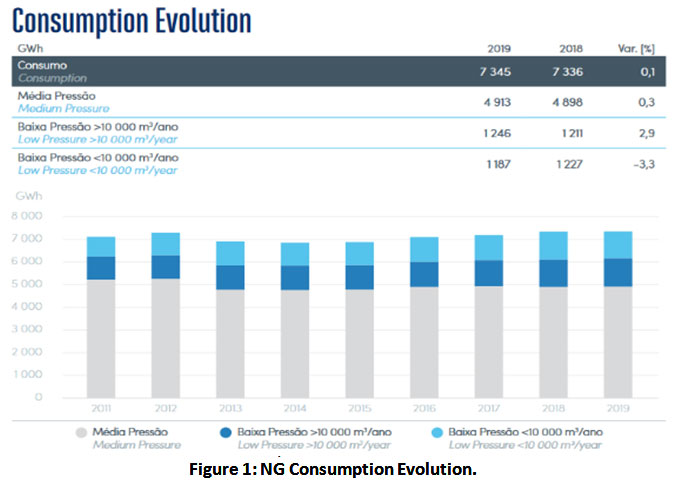 |
Figure 1: NG Consumption Evolution. Click here to view Figure |
It is possible to realize that the constant consumption of NG is more obvious when observing the medium pressure consumers. Without considering the share for electricity production, the medium pressure consumers are manufacturers and industry, and their number are not forecast to increase. On the contrary, they are expected to decrease, instead.
Figure 2 2 illustrates the Electricity mix generation and Figure 3 3 illustrates the Electricity mix supply.
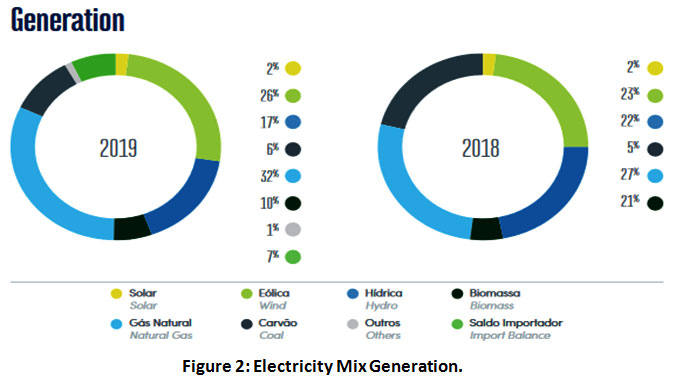 |
Figure 2: Electricity Mix Generation. Click here to view Figure |
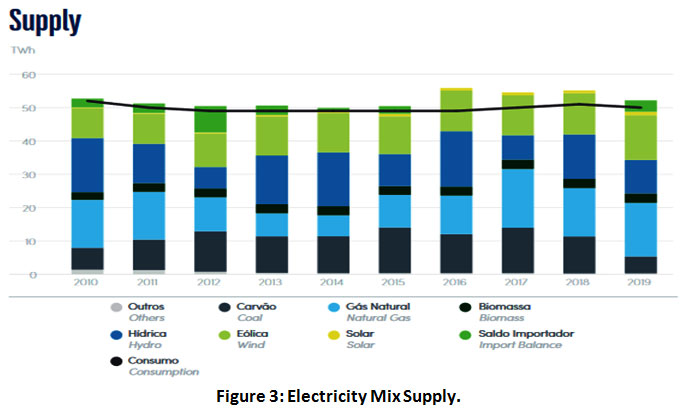 |
Figure 3: Electricity Mix Supply. Click here to view Figure |
It is possible to notice that role of NG is of great importance. Figure 4 4 illustrates the NG consumption evolution for the last decade.
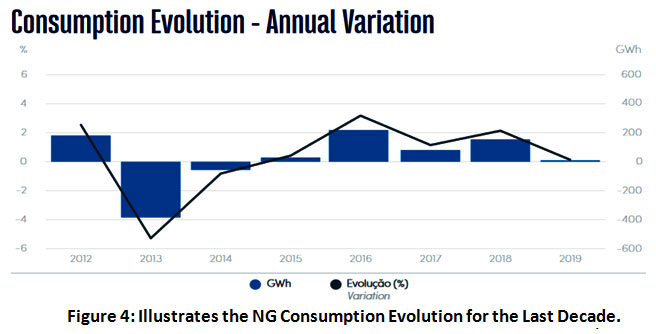 |
Figure 4: Illustrates the NG Consumption Evolution for the Last Decade. Click here to view Figure |
When comparing this data with the Hydroelectric Productivity Index (Índice Produtibilidade Hidroeléctrica 1) it is possible to conclude that the NG has a bigger role in the dry years and therefore the flexibility of the supply grid cannot be based on hydropower plants but rather on its NG counterparts.
The flexibility of the system is guaranteed by the Secondary Band power plants. The Secondary Regulation Band is deemed as the power variation margin, in both directions, in which the secondary regulator can act automatically in less than 5 minutes and starting from the point of operation in which it stands at each moment - multiplied by 1,5. Only the physical units that demonstrate technical and operational capacity to provide this service under the required conditions can make offers of Secondary Regulation Band. In addition, the Global System Manager defines, for each of the programming periods of the following day, the needs of the SEN Secondary Regulation Band. As a result, the market agents that have Physical Units available and are qualified to provide the service will offer a regulation band, normalized by the regulator, in MW, and the respective unit price of the band, in € / MW. Furthermore, Extraordinary Hiring of Secondary Band can occur in case of emergency situations for the System, in the absence of sufficient offers and because of an unavailability of the computer system. In this way, the Global System Manager (GGS) may adopt the decisions considered appropriate for the use of an available secondary reserve.
Figure 5 5 illustrates the satisfaction of second band, by group, in the Iberian electricity market.
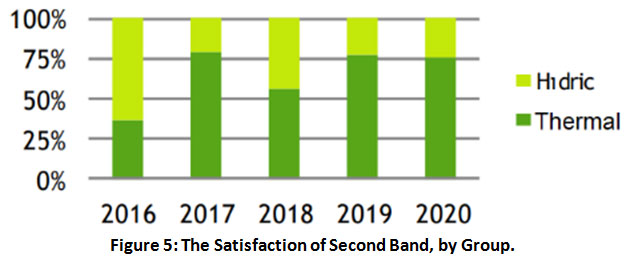 |
Figure 5: The Satisfaction of Second Band, by Group. Click here to view Figure |
It is possible to observe that the importance of thermal power plants is significant. The NG plant is principal among the other thermal power plants.
Figure 6 6 illustrates the interconnection of electricity transfer (Congestion final) between Portugal and Spain.
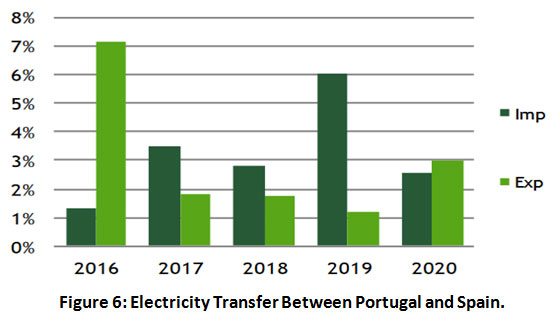 |
Figure 6: Electricity Transfer Between Portugal and Spain. Click here to view Figure |
Shall the share of NG in the electricity mix decreases the interconnection between Portugal and Spain would have to assume the role of flexibility to the system to ensure both continue supply and high service level. This would lead to an increase in the imports, especially in dry years as the low hydraulic index would occur.
Tariff Adjustment Regarding Reduction in the Consumption of NG
The process for calculating regulated tariffs is in Chapter V of Section IM Methodology for calculating Energy tariffs based on the Article 123 Methodology for calculating the Energy tariff, for the purchase and sale of NG for supply to the last resort Traders and the following normative 7.
1 -The Energy tariff for the purchase and sale of NG for supply to the last resort suppliers, is established to provide the income per unit of energy from the purchase and sale of NG activity for supply to the last resort suppliers, provided for in Article 99.
2 -The prices of the Energy tariff for the purchase and sale of NG for supply to the last resort suppliers are calculated to provide income, according to the following instalments: Income from the purchase and sale of NG to supply the last resort suppliers, foreseen for the gas year t, Energy from supplies to the last retailer k retailer, expected for gas year t and Energy price of the Energy tariff applicable to deliveries to last resort suppliers, in gas year t.
The amount of energy to be considered in the computation of the Energy tariff for the purchase and sale of NG, to be provided to the last resort suppliers are the extent supplied to each last resource supplier, foreseen for the gas year t, as referenced at RNTGN.
Continuous Replenishment of Supply and Power Ensure Incentives
Ordinance No. 41/2017 8 establishes a new remuneration regime for the reserve provided to the National Electric System (SEN) through availability services provided by electricity producers and other market agents. Accordingly, the remuneration of the security reserve is established through a competitive auction mechanism that exclusively remunerates the availability services provided, favouring low carbon technologies. Additionally, the following general security principles apply to the security reserve remuneration regime:
- The security reserve provided to SEN constitutes a service remunerated by market criteria, and its cost is borne by all electricity consumers, under the terms established in Decree-Law No. 172/2006, of 23 August.
- The security reserve remuneration regime complies with cost minimization criteria for electricity consumers, ensuring an adequate reserve for supplying the SEN.
- The maximum annual cost to be borne by SEN electricity consumers is established through an Order from the Government member responsible for the energy area, after consulting the Directorate-General for Energy and Geology (DGEG) and the Energy Services Regulatory Authority (ERSE), keeping the respective value valid until the definition of another one that replaces it.
- The security reserve remuneration is established through a competitive auction mechanism that exclusively remunerates the availability services provided, favouring low carbon technologies.
- The auction mechanism referred to in the previous number has in the purchasing entity, representing SEN, the entity responsible for the overall technical management of SEN.
- The participants admitted as potential sellers, in the light of the Article 4 of Ordinance No. 41/2017, include producers using different technologies, nationals or from other Member States if it is feasible through international links and common mechanisms for checking availability, as well as market players using demand management solutions. The auction mechanism is implemented by OMIP, as the auction management entity determined by ERSE.
After the 2017 State Budget Law, approved by Law no. 42/2016, of 28 December, determined the suspension of the above-mentioned guarantee model as incentive to availability, it still remaining the investment incentive mechanism, designed to support new investments in hydroelectric plants, in the case, more capital-intensive than those of thermal power plants and by awarding compensation during the first years of operation. According to ordinance no. 251/2012, of 20 August, this investment incentive mechanism is not compatible with the European rules and guidelines of the internal market, which, in contrast, have chosen open, transparent and non-discriminatory procedures to the detriment of administrative attribution mechanisms - such as the still provided for in the aforementioned ordinance.
Promotion of Efficiency in the Consumption of NG
This focus is present in Article 118 of the Plan for the Promotion of Efficiency in Consumption and has the following motivations:
1 -The Plan for the Promotion of Efficiency in Consumption aims at improving efficiency in the consumption of NG.
2 -The regulation and functioning of the Efficiency Promotion Plan in Consumption are defined in sub regulation, to be exact in the “Rules of the Plan for the Promotion of Efficiency in the Consumption of NG”, approved by ERSE.
3 - Until the approval of the rules referred to in the previous number, network operators and last resort suppliers may submit proposals for measures to promote efficiency in the consumption of NG. In addition, the Article 119 defines the costs with the Plan for the Promotion of Efficiency in Consumption that is considered for tariff purposes, pursuant to Article 83. º. 9
Expansion of NG Grid and Supply Points
The number of supply points have been fairly increasing in the last decade. Figure 7 11 illustrates the evolution of the delivery points.
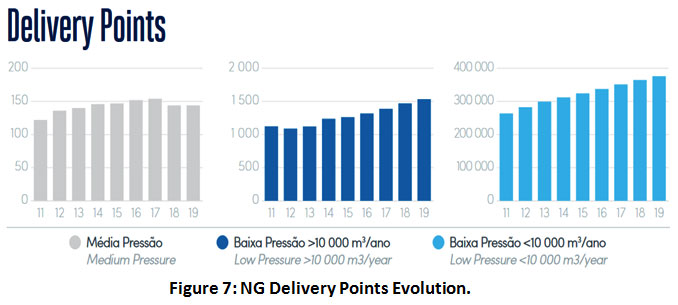 |
Figure 7: NG Delivery Points Evolution. Click here to view Figure |
Once observing the data in Figure 7, one can conclude wrongly that there is a positive and ongoing path on the strategy of NG access. However, as this is centred upon national data and Portugal is an heterogeneous Country, such data should be carefully taken in consideration. Figure 8 10 illustrates the geographic distribution of the Natural grid.
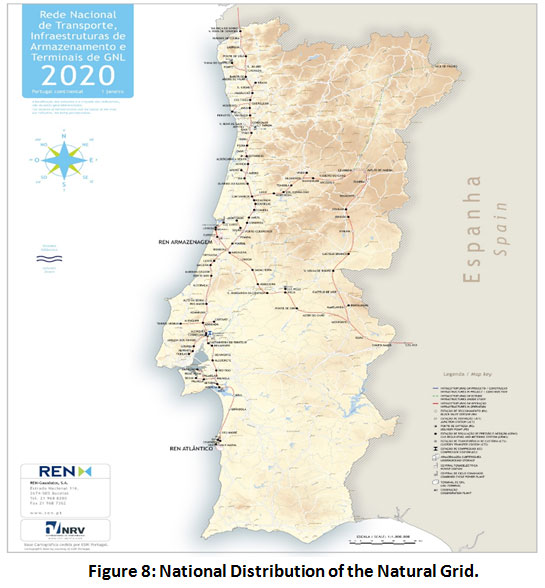 |
Figure 8: National Distribution of the Natural Grid. Click here to view Figure |
It is possible to observe that, except for the interior south area (Alentejo), in which the consumption is low while the solar power plants capacity is high, the rest of the Country is hardly supplied by NG in a realistic way, both economically and technically. For these areas, the electricity is a more appropriate energy source, together with the sparse energy capacity in terms of biomass and wind. The reason for the low possibility of NG grid expansion is the mountains and the disperse consumer distribution of those areas.
Energy Substitutes of NG
There is no domestic production of NG. There is some shale gas prospecting in central Portugal. In September 2015, the Government and the Austral is Oil and Gas Company signed the contract for research and production of oil in the triangle formed by Figueroa da Foz, Peniche and Fatima Shrine 12,13 The report submitted by the Austral is to Entidade Nacional para o Mercado de Combustive is (ENMC) 14, the National body for the Fuel Market, claims that there are large gas accumulations. Although the operation may be limited, the tests show there is an active hydrocarbon system. There is gas in volume and there is a gas pipeline with installed capacity to receive more production. In addition, there is a modern road system for distribution. The domestic market depends exclusively on imported oil and gas and there are no restrictions on exports, but a beneficial tax regime. 15,16 However, Portugal has initiated the first steps for production of green-hydrogen, notably by previewing the basis of such activity in the applicable legal framework. In this phase of energy transition, a careful analysis of the various emerging technologies is needed, contributing therefore to the decarbonisation of the energy system, through a balanced and sustainable way. In addition to the measures in each technology is their important integration in the entire energy system, to benefit from both the synergies between the various technologies and the different end uses, thus adding value overall. The current energy scenario in Portugal, which includes renewable, started at the end of the 20th century and caused a profound change in the energy system, principally in the electricity sector, due to the increasing weight of wind power plants. The PNEC's perspective is that there will be a large investment in the large-scale use of photovoltaic solar energy, while other technologies become promising and competitive, as in the case of concentrated solar energy, or even wind energy offshore.
Gaseous fuels, Hydrogen, bio methane and biogas, including electro fuels have a high potential for improving national energy security, contributing therefore to reducing imports of oil, coal and NG. They also allow for the achievement of carbon neutrality as they can have their production renewable through different integrated technologies, as for example the technologies to produce non-biological renewable gases (RFNBO or electro fuels. These technologies, known as Power-to-Gas (PtG) and Power-to-Liquids (PtL), utilize water instead of biomass, as a renewable source. Additionally, since the production of H2 is carried out from the electrolysis of water, which requires high amounts of energy, it is considered that the best way to achieve an adequate cost-efficiency will be through the surplus of renewable energy production. These fuels can therefore compete indirectly with NG in the scenario of massive mobility electrification. 17,18,19
The evolution of electric mobility will only be effective for decarbonisation after the addition of new capacity for electric energy (from renewable sources and corresponding production), exceeds the increase in electricity consumption for mobility. It is recognized that the investment in the creation of production, storage and cement supply infrastructures will be time consuming, which means that the importance of electric mobility for the effective decarbonisation of the transport sector will only be noteworthy in the post-2030/2035 period. Moreover, there are weight / space limitations and autonomy for long-distance road transport, as well as for sea and air. In contrast, it will be in the light passenger road sector and even in the urban distribution goods sector that its penetration is most clearly predicted until 2030. It is noteworthy to mention that another way to increase the share of these gaseous fuels, namely Hydrogen, is to mix with NG and introduce them into the system. Yet, this requires further investments in the NG grid and supply points.
The Contribution of NG to the Welfare
Portugal bases its activity of producing electricity through the exploration of a diversified portfolio of sources of renewable energy and NG, which reliability and performance to the system and aims to produce electricity in a safe and efficient way, with due respect for the environment and at a competitive price. To this end, it manages a diversified set of assets that combines the benefits of renewable energies with the flexibility and efficiency of NG.
NG is an important primary energy source for the balance between the three main pillars of sustainable development (environmental protection, economic competitiveness and social well-being) and Portugal is a reference country on this premise. The country is now able to increase the competitiveness of its industry, mainly the one with the highest energy intensity, to facilitate social development and the well-being of the populations and to improve the security of energy supply.
The interrelation between energy and the economy, which has long influenced public policies, is well known. The availability and price of energy have a decisive influence on social welfare and the performance of the economy. Conversely, the development of economic activity, through demand, affects energy prices4, which is well understood because energy is an essential base service. From the outset, the entire transport sector depends on energy (both to supply conventional vehicles with combustion engines and to charge electric vehicles). In addition, energy animates financial markets (such as the creation of organized markets, the generation of emissions and securitization operations), it promotes the agricultural sector (through, for example, the production of biogas and biofuels), as well as the construction and maintenance of large infrastructures (e.g., interconnections, networks, energy efficiency of the housing stock).
However, at the level of public policies, it is with the environment that the energy relationship has become increasingly strong. Public policies in ??energy are designed in a way that is strongly aligned with environmental issues and, in turn, environmental policies depend to a large extent on the implementation of energy policy measures. The interrelationships between the energy sector, the environment and the economy come from afar and tend to deepen. This results not only from national policy options but must be seen in the framework of public policies defined at European level and international law - United Nations Framework Convention on Climate Change (UNFCCC) -, to which the country is bound, and which end up guiding the field of action of the different Member States. 20
Conclusions
First, the promotion of Efficiency in the Consumption of NG has a similar impact in the tariffs as the phase out of NG in the electricity mix. However, since efficiency measures are cost free or of lower investment both for consumers and for the market operators, the economic advantage of consumption efficiency presents a surplus.
Second, the transport of NG requires an investment in pipelines that is expensive, especially given that the Phasing out the NG power plants has a social and environmental impact that is high and segregates consumers, as rural consumers do not have access to other types of energy with similar calorific power, as electricity.
Finally, the removal of an energy that introduces flexibility to the electricity system and the removal of the incentives to power guaranty, while it is expected that the quality of service will decrease, regarding the number, the duration and the frequency of interruptions.
Acknowledgments
The present paper is the author’s knowledge based on several years of research and point of view based on his experience.
Funding Source
There is no external funding. All expenses were self-supported by the author.
Conflict of Interest
Author declares no conflict of interest.
References
- REN- Redes Energéticas Nacionais, Natural Gas consumption evolution, https://www.ren.pt/files/2020-03/2020-03-18150056_f7664ca7-3a1a-4b25-9f46-2056eef44c33$$72f445d4-8e31-416a-bd01-d7b980134d0f$$3da61867-1929-4f34-88fa-43dac04e6cf3$$storage_image$$pt$$1.pdf
- REN- Redes Energéticas Nacionais, Electricity mix generation, https://www.ren.pt/files/2020-03/2020-03-18150056_f7664ca7-3a1a-4b25-9f46-2056eef44c33$$72f445d4-8e31-416a-bd01-d7b980134d0f$$3da61867-1929-4f34-88fa-43dac04e6cf3$$storage_image$$pt$$1.pdf
- REN- Redes Energéticas Nacionais, Electricity mix supply, https://www.ren.pt/files/2020-03/2020-03-18150056_f7664ca7-3a1a-4b25-9f46-2056eef44c33$$72f445d4-8e31-416a-bd01-d7b980134d0f$$3da61867-1929-4f34-88fa-43dac04e6cf3$$storage_image$$pt$$1.pdf
- REN- Redes Energéticas Nacionais, Natural Gas consumption evolution, https://www.ren.pt/files/2020-03/2020-03-18150056_f7664ca7-3a1a-4b25-9f46-2056eef44c33$$72f445d4-8e31-416a-bd01-d7b980134d0f$$3da61867-1929-4f34-88fa-43dac04e6cf3$$storage_image$$pt$$1.pdf
- MIBEL- Mercado Ibérico de Eletricidade, Second band satisfaction, in the electricity market, by group, https://www.mercado.ren.pt/PT/Electr/InfoMercado/PressReleases/BibInfAnual/MercadoEletricidadeSinteseAnual2016_202011.pdf
- MIBEL- Mercado Ibérico de Eletricidade, Electricity transfer between Portugal and Spain, in the electricity market, by group, https://www.mercado.ren.pt/PT/Electr/InfoMercado/PressReleases/BibInfAnual/MercadoEletricidadeSinteseAnual2016_202011.pdf
- ERSE- Entidade Reguladora dos Serviços Energéticos, Regulamento Tarifário do setor do gás natural, Regulamento n.º 361/2019, publicado no Diário da República, 2.ª Série, n.º 79, de 23 de abril de 2019.
- Portaria n.º 41/2017, Diário da República n.º 20/2017, Série I de 2017-01-27, , Pages: 527 – 533, ELI:https://data.dre.pt/eli/port/41/2017/01/27/p/dre/pt/html
- Regulamento Tarifário do setor do gás natural, ERSE- Entidade Reguladora dos Serviços Energéticos, Regulamento n.º 361/2019, publicado no Diário da República, 2.ª Série, n.º 79, de 23 de abril de 2019.
- REN- Redes Energéticas Nacionais, Natural Gas delivery points evolution, https://www.ren.pt/files/2020-03/2020-03-18150056_f7664ca7-3a1a-4b25-9f46-2056eef44c33$$72f445d4-8e31-416a-bd01-d7b980134d0f$$3da61867-1929-4f34-88fa-43dac04e6cf3$$storage_image$$pt$$1.pdf
- REN- Redes Energéticas Nacionais, National distribution of the Natural grid, https://www.ren.pt/files/2020-03/2020-03-31151639_f7664ca7-3a1a-4b25-9f46-2056eef44c33$$72f445d4-8e31-416a-bd01-d7b980134d0f$$cfe76813-0212-4746-9cd8-92083fe2500e$$storage_image$$pt$$1.jpg
- ENMC- Entidade Nacional para o Mercado de Combustíveis, Annual Report on Simple Fuels 2020, https://www.ense-epe.pt/wp-content/uploads/2021/04/Relatorio-sobre-Combustiveis-Simples-2020_site.pdf, last accessed 23th of April of 2021
- ANAREC - Associação Nacional de Revendedores de Combustível, National Association of Fuel Dealers, National report 2020, PT/SGMAI/GCLSB/H-B/001/14800
- APETRO - Associação Portuguesa de Empresas Petrolíferas, Portuguese Association of Oil Companies, Economic contribution of the Portuguese oil sector, https://www.apetro.pt/folder/galerianoticia/ficheiro/961_AF_Apetro_Brochura_digital_poj3uawtlk.pdf , last accessed 23th of April of 2021
- APED - Associação Portuguesa de Empresas de Distribuição, Portuguese Association of Distribution Companies, Evolution of the concentration of industry and distribution in Portugal, LIS-9970-08459-002-03
- Fuels Europe, Clean Fuels for all - EU refining industry proposes a possible way to achieve climate neutrality by 2050, 2020, John Cooper
- KPMG Espanha e Apetro - A road to emission reductions in Portugal 2030 – The role of oil products, 2020, https://www.apetro.pt/folder/galerianoticia/ficheiro/848_Executive%20Summary%20APETRO%20-%20PT_vf_e881tz393n.pdf , last accessed 23th of April of 2021
- Fuels Europe, EU Consumer Survey on Future Mobility Options, https://www.fuelseurope.eu/wp-content/uploads/DEF_EU_ConsumerSurvey_digital.pdf , last accessed 23th of April of 2021
- APPB - Associação Portuguesa de Produtores de Biocombustíveis, Portuguese Association of Biofuel Producers; foreseen objectives in the PNEC 2030 for biofuels, https://appb.pt/wp-content/uploads/2020/05/biocombustiveis-objetivos-previstos-pnec2030.pdf , last accessed 23th of April of 2021
- APA- Agência Portuguesa do Ambiente, https://www.apambiente.pt , last accessed at 10th of December of 2018.

This work is licensed under a Creative Commons Attribution 4.0 International License.