
Human Resource Management: Impact of Employees Relations and Training Practices of Listed Deposit Money Banks LDMB Performance in Adamawa State, Nigeria
Anthonia Ngozi Ibelegbu  and Friday Ekahe Abanyam*
1Department of Business Education, University of Nigeria, Nsukka Enugu State, Nigeria .
2Department of Business Education, Ambross Alli University, Ekpoma, Edo State, Nigeria .
http://dx.doi.org/10.12944/JBSFM.04.01.13
Copy the following to cite this article:
Ibelegbu A. N, Abanyam F. E. (2022) "Human Resource Management: Impact of Employees’ Relations and Training Practices of Listed Deposit Money Banks’ (LDMB) Performance in Adamawa State, Nigeria". Journal of Business Strategy Finance and Management, 4(1). DOI:http://dx.doi.org/10.12944/JBSFM.04.01.13
Copy the following to cite this URL:
Ibelegbu A. N, Abanyam F. E. (2022) "Human Resource Management: Impact of Employees’ Relations and Training Practices of Listed Deposit Money Banks’ (LDMB) Performance in Adamawa State, Nigeria". Journal of Business Strategy Finance and Management, 4(1). Available From: https://bit.ly/3qDq0ow
Download article (pdf) Citation Manager Publish History



Introduction
Adamawa State is one of the 36 States in Nigeria. Banking industries in this State play a vital role in growing the State’s economy. The economy of the State is based primarily on agriculture, but recently the economic structure in the state has begun to shift towards the manufacturing and service sectors. In order to accelerate economic growth, the State government is focused on developmental strategies through competitiveness, productivity, innovativeness and entrepreneurship which could be achieved with the aid of banking sectors. Though the economy of the state is relying on the banking sectors to meet their financial needs, but their poor management of customers and staff-related complaints have been largely criticized.it has therefore become a major concern for any company that intends to succeed in the face of stiff competition.
The generic name “Listed Deposit Money Bank (LDMB)” was adopted for all banks (Commercial and Merchant) operating in Nigeria since the commencement of universal banking in 2001. Bank, as a financial institution, is permitted to receive deposits, conduct monetary policy, and make loans1. Banks may also provide financial services such as wealth management, currency exchange and safe deposit boxes. Banks create liquidity for the public on the balance sheet by transforming relatively illiquid assets for example loan commitments and similar claims to liquid funds2. Other tasks of banks are to ensure reduction in the rate of interest, foreign exchange, credits and liquidity risk. According to3, the catalyst for the growth and development of any economy lies majorly in the productivity and effectiveness of the banking sectors.4 stated that the banking sector is generally considered a key channel for financial intermediation in every economy. 5 confirmed that a well-functioning banking system fast-tracks economic growth by providing services. These include deposit collection, providing business and auto loans, mortgage lending, and providing basic investment transactions, such as maintenance of various accounts as well as certificates of deposit activities. There are many deposit money banks listed in the stock exchange with their branches spread across all over the country.
One of the most important resources in banks is the people. These are individuals working independently in their formal tasks towards accomplishing organizational goals and objectives. In banking sectors, there are boards of directors, chief executive officers (CEO), department heads, operation managers, human resource managers, supervisors, team workers, accountants, cleaners among others. These groups of personnel perform different functions in the bank. While some are involved in decision-making, others attain to customers. All of these activities put together to determine the performance of the banks in Adamawa State, Nigeria.6 stated that human resource management (HRM) amongst others, involves careful planning of the staffing to meet t organization’s operational goals, and ensuring the right people are placed at their appropriate tasks of expertise. Human resources of an organization are those who carry out the day-day activities of the organization.7 pointed out that in the past, human resources are also referred to as members of staff, workers, team members, or employees. They are further termed personnel, manpower, operators, or workmen. 8 stressed that banking sectors in Nigeria have received a lot of complaints on their human resource practices in recent times. This has therefore led to the call for the reform in the practices of managing human resources in banks in Adamawa State.
Human resource management practices (HRMP) is very vital in an organization. It involves a blend of people management practices that see members of staff as assets who are skillful and committed to achieving organizational goals. Furthermore, HRMP are principles and applications guarding the functionality of top management. These practices are seen as a series of interrelated activities to attract, develop and maintain the organization’s human resources. The HRM concept has been widely adopted in organizational practices and is proven to be able to provide organizational opportunities to get the right employees9.
Performance is a measure that reveals the position of an organization. It provides information on the progress as well as the level of productivity of the firm.5 inferred that organization performance accentuates the plans organization tons need to adopt in order to excel both in the immediate and long term bases. According to 10organizational performance comprises of the actual an organizational output measured against the expected goals and objectives of the organizational goals and objectives. 11argues that, with better human resources philosophy, staff performance can improve significantly. 12 stated that organizational performance is a function of the mutual efforts of engaged employees who experience more attachment and do things that enhance organizational effectiveness. 13 believed that human resource management practices will lead an organization to better performance in any situation.
But, frequent complaints by bank managers on the shortage of skilled manpower have led to poor staff performance, hence affecting the functionality of the organization. The fact is if the poor banking performance as a result of poor employee relations continues unchecked, the negative impact would be much on the banking industry and the society at large. This, therefore, calls for the overhauling or better still, the training of staff for better productivity in the banks. The human resource practices adapted by an organization, to a large extent, plays a crucial role in determining the success or otherwise of such a firm. The core function of HR in LDMBs is, but not limited to aiding the performance improvement index of her people. Thus,14 suggest that the management team of LDMBs need to evolve functional strategies to ensure the optimal utilization of staff members through competitive capacity building such as training; participatory decision making, and adequate motivational practices.
Employee relations entail providing and sustaining positive working relationships between an organization (banks) and the people (employees). Employee relation is achieved based on the culture instilled in such organization. The CEOs and other management teams are responsible for creating the right atmosphere for all employees by developing processes that encourage the application of the rules in a practical, transparent and fair manner, hence, the need for employees to be trained. Employees training, according to9, is a practice that focuses on developing workers’ skills, knowledge, and attitudes in order to accomplish organizational goals. Providing regular exercises such as workshops, seminars n dot more on how to cultivate positive work and organizational culture can improve the performances of LMDBs.
Conversely, the observations notwithstanding, most studies linking the relationship between HRM practices and organizational performance have been carried out mainly in other climes, but not in Adamawa State, and also more commonly seen in the manufacturing sectors of the economy15, 16;17, 18, 19, 20. Their studies have shown a relationship that is positive between personnel management practices and the organization performances. Empirical reviews have revealed dearth in similar studies carried out in developing nations2, 21. Additionally, Scholars in developing nations like Nigeria have not possibly authenticated the effectiveness of banking practices for which useful propositions can be made to stakeholders. An opening has been created for more evidential research to improve performances of banking institutions. Hence, the thrust of this study is to provide more empirical findings to support research findings in Nigerian as well as ascertain the impact employees’ relations and training practices have on performances of LDMBs in Adamawa State, Nigeria.
Based on the major aim of this study, the following hypotheses were formulated:
Ho1: Employees’ training practices do not significantly impact the performance of LDMBs in Adamawa State.
Ho2: Employees working experience have no significant impact on the performance of LDMBs in Adamawa State.
Ho3: Significant difference does not exist in the opinions of employees on the rate of performance of LDMBs in Adamawa State.
22 carried out an empirical study to ascertain the impact training and development have on the performance of officers in some selected banks in India. Survey method was used. Data was collected from the websites of the Ministry of Finance of the Government of India, the Reserve Bank of India and the respondent PSBs themselves. Statistical tools like averages were used to analyze and interpret the data, duly supplemented by graphical and tabular representation. Appropriate interpretations were added to the tabulated and charted data. It was found that majority of the respondents believe that the quality of the T&D programmes arranged by the banking terms of improving the productivity of the officers has been average.
23 studies take a look at Training and Development as a vital tool for organizational effectiveness. The result of the study revealed that staff training and development has a significant effect on organizational effectiveness and that staff training and development has enhanced employees‘ performance in Sterling bank Nigeria Plc. 24 determine the effect of HRM strategies on commercial banks performances in Kenya. Survey research method was employed. The population was 2,738 employees from 46 banks. Stratified and purposive sampling techniques were used in selecting 349 respondents for the study. Analyses of data were done using tables, graphs and charts.. It was found that HRM practices have significant positive effect on performances of commercial banks in Kenya. 25 did a study on the impact of human resource accounting on the profitability of a firm. Findings revealed a positive relationship between training/development cost and the profit of the organization. Their submissions also showed organizational performance relies on the performance of the individuals that make up the organization. This finding implies that organizations do not exist in vacuity. Rather, employees and management team must work together to achieve its goal.
26 carried out a study on HR development as a correlate of performance of the banking industry in Ogun state, Nigeria. The study found that more than 50% of the total variation in the performance in each of the financial indicators except retained earnings with 49% was explained by human capital expenditure. Their result further submitted that training programmes have effect on the output of commercial bank staff. 27 conjectured that the most modern generation banks expend more on development of human resource more than their older counterpart. The authors observed that the quantum of employees trained and the length of trainings were low, in-house, and not related to their tasks.
28 carried out a study to examine the effect of HR outsourcing on organizational performance in Deposit Money Banks. The findings showed that there is a significant positive relationship between the variables of human resource outsourcing and organizational performance. The implication is that its effect on cost savings and productivity was as a result of outsourcing activities. The study therefore concludes that recruitment process outsourcing has significant relationship with organizational performance by moving the recruitment process to a recruitment agency, time is saved by the managers for more efficient planning. There is a need to adopt effective strategies when outsourcing recruitment process because human resource is the most vital asset of any organization.
Another study was conducted by 29on strategic role of human resource training and development on organizational effectiveness in Nigerian banking industries. The study ascertained best training tools needed to reduce employee waste, never-ending industrial accidents, fatigue, and absenteeism. The findings revealed that employees training significantly influenced organizational effectiveness not considering the fact that some of the observed banks failed because they send their employees on a training programme when they do not have the necessary equipment to practice when they return from such training programmes.
30 investigated the effect of human resource management on the performance of banks in Nigeria. The study used descriptive survey design. Questionnaire was administered on 397 staff of eight deposit money banks in Nigeria. Data was analyzed using ordinary least square. The result showed that human resource management significantly affects banks’ performance. The study likewise findings revealed that reward and staff performance management have significant effect on the performance of banks, while staff resourcing has no significant effect on the performance of banks in Nigeria.
31 conducted a study to ascertain strategic human resource management and public employee performance in National Bank of Egypt. Descriptive and quantitative research designs were used in data collection. The research found that selection procedures of the banks had a significant impact on employee performance. In the research carried out by20 to determine the strategic human resource management practices (SHRNP) and their effect on perceived organizational performance at the National Insurance Corporation of Eritrea, using a population of 73 employees at the corporation’s headquarters, the study found that the corporation had embraced a number of SHRMPs, however, their systematic implementation was hindered by poor structural policies or guidelines across the corporation. In addition, the findings discorded the challenges of inadequate and highly qualified personnel – only one employee in the entire corporation had a master’s degree and none had undertaken a course in actuarial science, which is insurance-specific. Furthermore, it was showed an evidence of very low staff mobility, due largely to few staff enrolment with working experiences of between 5-15 years at the corporation. The study also observed that the corporation needed improvement in the areas of motivation and performance management.
32 carried out an investigative study on how human resource management practices influence organizational performance in Bahrain Private Universities. Data were gathered using a set of questionnaire items to measure staff perceptions. 280 usable responses were received and the results were analyzed to determine the relationship between variables in the model using PLS (Partial Least Squares). The findings indicated that there was a direct relationship between HR practices and staff perceptions of organizational performance and. This relationship was mediated by effective use of strategic variables such as organizational culture, employee retention and employee commitment.
Similarly,33 did research to determine the impact of the business process outsourcing sector in Sri Lanka. A structured questionnaire was administered to 237 executive-level employees. Their findings showed a significant relationship between employee recruitment, selection strategies, and employee performance.
The review revealed that there have been attempts by different researchers at investigating the practices in various institutions and organizations. Some of the empirical studies reviewed indicated that there is a need for adoption and consistent implementation of appropriate human resource recruitment and selection, training and development as well as compensation in order to deliver on organizations’ mandates. Other researchers observed several challenges hindering effective recruitment and selection of workers, which include but not limited to: poor human resource planning, ineffective job analysis, employee competence level, cost of employee selection, poor or lack of fictional human resource department, and working conditions of workers. Some of the literature insisted that inadequate provisions were made for personnel motivation while other studies contradicted it. Again others suggested a significant number of employees were not receiving adequate performance motivation. It, therefore, becomes pertinent to find out the impact of human resource management practices on the performance of LDMBs in Adamawa State, Nigeria. This is, therefore, the gap this study seeks to fill.
Materials and Methods
Survey research design was employed. According to34, a research survey is one in which the totality of the population or representative sample is studied by gathering and analyzing data from the group through observation, focus group discussion, or a structured questionnaire. This design was considered appropriate to this study for the reason that this article aimed at collecting data and describing it in a systematic manner, on how to ascertain the impact of human resource management practices on the performance of LDMBs in Adamawa State, Nigeria.
The population of the study consists of 120 employees of the entire 14 branches of LDMBs (DMB) listed in the Nigerian Stock Exchange for the year 2019. Prior to the study, a sample size that provided a high effect size was ascertained through the use of G?>Power 3.1 software based on effect size d = 0.8, power (1–b = .95), Allocation ratio N2/N1 = 1 and statistical test (t-tests—mean: Difference between two independent means (two groups) 35. Based on the analysis, a sample of above 102 participants will be enough to give the required power to carry out the study. Hence, the entire 120 employees were studied since the population was of a manageable size.
A 28-item structured questionnaire developed by the researcher and titled, “Questionnaire on the Impact of Human Resource Management Practices on LDMB performances (QIHRMPLDMB)” was used to collect data for the study. The questionnaire was had two parts: I and II. Part I of the questionnaire elicited personal information about the respondents. Part II, which was further divided into three clusters (A-C) in line with the questions that guided the research. The questionnaire was structured on a 5-point scale with response options of strongly agree (5); agree (4); neutral (3); disagree (2), and strongly disagree (1). The performance questionnaire was rated on a 4-point scale of very high rate (4); high rate (3); low rate (2); and very low rate (1).
The researchers carried out a pilot study to the reliability of the questionnaire, survey techniques and pretesting of the instrument36, 37, 38 to ensure that the item statements clearly measure what it intends to achieve37. Pilot testing aided the researchers to ascertain the validity or otherwise of the instrument. The predictor powers and moderation effect of other extraneous HRM variables on employees’ performance was tested using descriptive and inferential statistics such as mean, standard deviation, and analysis of variance. This was done with the use of Statistical Packages for Social Science software.
The real limit of the mean values was used to take decisions on the entire items in each cluster as follows: items whose mean values fell within 4.50 – 5.00 were regarded as strongly agreed; those with mean values within 3.50 – 4.49 were regarded as agreed; those with mean values within 2.50 – 3.49 were regarded as neutral while those with mean values within 1.50 – 2.49 were interpreted as disagreeing and those with mean values within 1.00 - 1.49 were interpreted as strongly disagreed.
Result
Analyses of Descriptive Statistics
Table 1: Demographic Distribution of Respondents According to their Status.
|
S.No. |
Status |
Frequency |
Percent |
Valid Percent |
Cumulative Percent |
|
1 |
CEOs |
14 |
12.5 |
12.5 |
12.5 |
|
2 |
Operations managers |
14 |
12.5 |
12.5 |
25.0 |
|
3 |
Human resource managers |
14 |
11.6 |
11.6 |
36.6 |
|
4 |
Supervisors |
78 |
63.4 |
63.4 |
100.0 |
|
|
Total |
120 |
100.0 |
100.0 |
|
Source; Human Resource Department of respective Banks, 2019
Table 1 shows the result of the demographic distribution of respondents according to their status. The employees comprised of 14 CEOs, 13 HR managers, 14 operation managers and 71 supervisors of the LDMBs in Adamawa State. The choice of the population was because these individuals perform different functions in the organization but are directly involved in human resource management in the banks. For instance, while the CEOs make the rules and take decisions on issues concerning employees, the supervisors are to ensure the employees implement the policies towards chiding organizational goals. Their respective opinions and expertise was needed to add credence to the findings of this study. This information is further presented in the chart in figure 1:
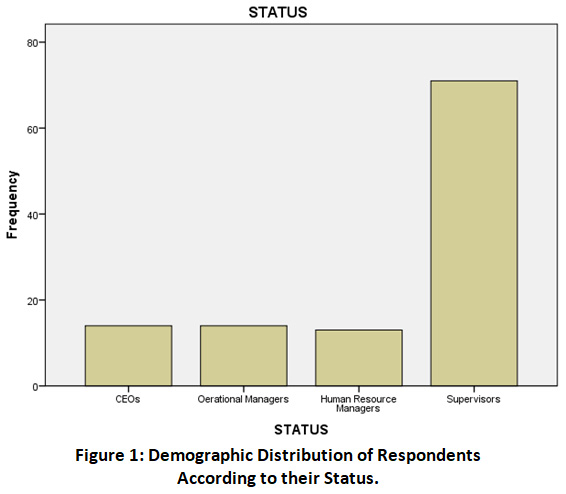 |
Figure 1: Demographic Distribution of Respondents According to their Status. Click here to view Figure |
Table 2: Demographic Distribution of Respondents According to their Gender.
|
S/No |
Status |
Frequency |
Percent |
Valid Percent |
Cumulative Percent |
|
1 |
Female |
61 |
54.5 |
54.5 |
54.5 |
|
2 |
Male |
51 |
45.5 |
45.5 |
100.0 |
|
|
Total |
112 |
100.0 |
100.0 |
|
Source; Human Resource Department of respective Banks, 2019
Table 2 presents the distribution of respondents according to employees gender. The distribution shows that 61 female and 51 male employees were used in this study. The reason for this comparism was to determine the opinions of both gender on the impact of employees relations and training practices on LDMBs in Adamawa. This information is further presented in figure 2:
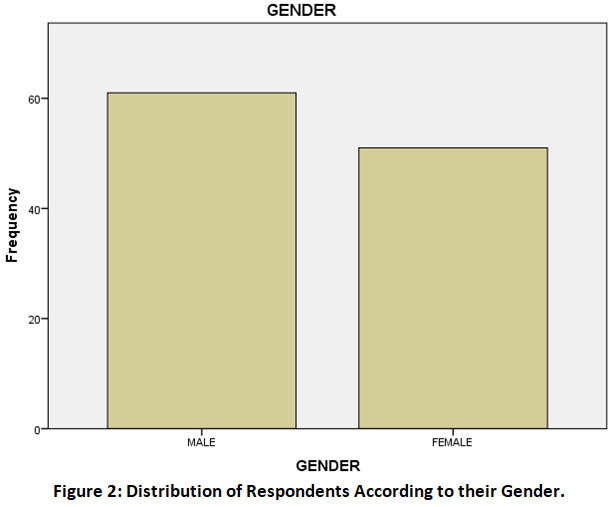 |
Figure 2: Distribution of Respondents According to their Gender. Click here to view Figure |
Table 3: Demographic Distribution of Respondents According to their Years of Experience.
|
S/No |
Years of Experience |
Frequency |
Percent |
Valid Percent |
Cumulative Percent |
|
1 |
Below 5 |
16 |
14.3 |
14.3 |
14.3 |
|
2 |
5 to 10 |
35 |
31.3 |
31.3 |
45.5 |
|
3 |
11 to 15 |
28 |
25.0 |
25.0 |
70.5 |
|
4 |
16 to 20 |
21 |
18.8 |
18.8 |
89.3 |
|
5 |
21 and above |
12 |
10.7 |
10.7 |
100.0 |
|
|
Total |
112 |
100.0 |
100.0 |
|
The distribution in Table 3 shows that employees with working experience below 5, 5-10, 11-15, 16-20, and above 21 had population distributions of 16, 35, 28, 21, and 12 respectively. The essence of this comparison was to ascertain if employees’ years of experience influence their relationship as well as determine their level of performance in LDMBs in Adamawa state. This information is further presented in the chart in figure 3:
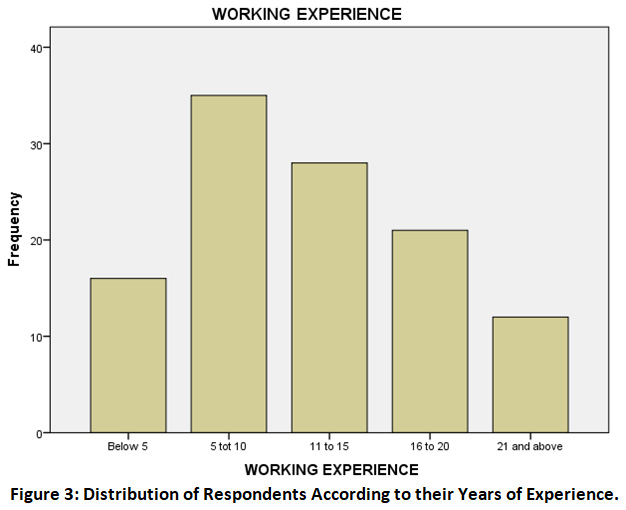 |
Figure 3: Distribution of Respondents According to their Years of Experience. Click here to view Figure |
Testing of Hypothesis
Hypothesis one was done to compare opinions of CEOs, operation managers, human resource managers, and supervisors to ascertain whether or not employees’ training practices significantly impact the performance of LDMBs in Adamawa State. The analyzed result is presented in Table 4:
Table 4: Analysis of Variance Test on the Impacts of Employees’ Training Practices on LDMBs’ Performance.
|
Source of difference |
Sum of Square |
df |
Mean Square |
F-ratio |
P-Value (sig) |
Rmk |
|
Between groups |
2.010 |
3 |
.670 |
2.476 |
.065 |
|
|
Within groups |
29.221 |
108 |
.271 |
|
|
NS |
|
Total |
31.231 |
111 |
|
|
|
|
The result in Table 4 reveals a p-value of 0.65 as well as an F-ratio of 2.476 implying that no is significant difference exist among the opinions of employees on the impacts of training practices on LDMBs’ performance in Adamawa State. Therefore, hypothesis one was accepted.
Hypothesis two was done to compare opinions of CEOs, operation managers, human resource managers, and supervisors to ascertain whether or not employees working experience have significant impact on the performance of LDMBs in Adamawa State. The data collected was analyzed and presented in Table 5:
Table 5: Analysis of Variance Test Comparing Opinions of Employees on the Impact of Working Experience on LDMBs’ Performance in Adamawa State.
|
Source of difference |
Sum of Square |
Df |
Mean Square |
F-ratio |
P-Value (sig) |
Rmk |
|
Between groups |
49.316 |
4 |
12.329 |
72.427 |
.066 |
|
|
Within groups |
18.214 |
107 |
.170 |
|
|
NS |
|
Total |
67.530 |
111 |
|
|
|
|
Table 5 presents the summary of the responses of employees on the impacts working experience practices have on the performance of LDMBs in Adamawa State. Table 5 shows an F-value of 72.43 as well as a Probability value of 0.66, revealing that no significant difference existed in the opinions of employees on the impacts of working experience on LDMBs’ performance in Adamawa State. Thus, the hypothesis of no significant difference was upheld.
Hypothesis three was carried out to ascertain whether or not a significant difference existed in the opinions of CEOs, operation managers, human resource managers, and supervisors on the rate of performance of LDMBs in Adamawa State. The data collected was analyzed and presented in Table 6:
Table 6: Analysis of Variance Test for Comparing the Mean Ratings of Employees on the Rate of Performance of LDMBs.
|
Source of difference |
Sum of Square |
Df |
Mean Square |
F-ratio |
P-Value (sig) |
Rmk |
|
Between groups |
8.526 |
3 |
2.842 |
22.762 |
.001 |
|
|
Within groups |
13.485 |
108 |
.125 |
|
|
S |
|
Total |
22.011 |
111 |
|
|
|
|
Table 6 presents the summary of the Analysis of Variance test of the responses of employees on the rate of performance of LDMBs in Adamawa State. The Table indicates an F-value of 22.76, also with a probability value of 0.01, revealing a significant difference in the opinions of employees on the rate of performance of listed deposit money banks in Adamawa State. As a result, the hypothesis of no significant difference was rejected. Post-hoc test using Bonferroni multiple comparisons analysis method as presented in Table 7.
Table 7: Post-hoc Test Comparing the Opinions of Employees on the Rate of Performance of LDMBs in Adamawa State.
|
S/No. |
(I) Employees’ Status |
(J) Employees (compared) |
Mean Difference (I-J) |
Std. Error |
Sig Value |
Remarks |
|
|
|
Operation Managers |
-.44898* |
.13356 |
.006 |
S |
|
1 |
CEOs |
Human Resource Managers |
-.46939* |
.13610 |
.005 |
S |
|
|
|
Supervisors |
-.80540* |
.10333 |
.000 |
S |
|
|
|
Human Resource Managers |
-.02041 |
.13610 |
1.000 |
NS |
|
2 |
Operation Managers |
|
|
|
|
|
|
|
|
Supervisors |
-.35642* |
.10333 |
.005 |
S |
|
|
|
|
|
|
|
|
|
3 |
Human Resource Managers |
|
|
|
|
|
|
|
|
Supervisors |
-.33602* |
.10660 |
.013 |
S |
As presented in Table 7, the post hoc analysis result revealed that the Human resource managers differ significantly in their opinions from that of the CEOs, Operation managers and Supervisors on the rate of performance of LDMBs in Adamawa State. This implies that the CEOs, Operation managers and Supervisors were in agreement on the rate of performance of LDMBs in Adamawa State. In contrast, the Human resource managers disagree with the CEOs, Operation Managers and Supervisors on the rate of performance of LDMBs in Adamawa State.
Discussion of the Findings
No significant difference was found on the impact of training practices on LDMBs’ performances in Adamawa State. The findings of this study on training and development were in consonance with the report of 20 who reported that training and development have become the most important factor in the business world today, because training increases the efficiency and the effectiveness of both employees and the organization. 39 indicated that training have a clear effect on the performance of employees.
The findings of this study are inconsonant with 40 who found that on-the-job training, training design and delivery style significantly have a positive effect on a firm’s performance. The findings of this study were in consonance with the report of 3 who reported that training and development have become the most important factor in the business world today, because training increases the efficiency and the effectiveness of both employees and the organization. 40 in a study also reported that the following issues are relevant to employees training and development effectiveness: organization The findings of this study were in consonance with the report of 3 who reported that training and development have become the most important factor in the business world today because training increases the efficiency and the effectiveness of both employees and the organization. 41 in a study also reported that the following issues are relevant to employees' training and development effectiveness: organizations.
Likewise, the findings conformed with the findings of 42 who investigated evaluation of human resource talent management practices in Nigerian universities taking cognizance of the impact of ownership type and age and found that conducting regular training need assessment, ensuring employees are involved in making decisions regarding their training and providing employees with learning opportunities designed to help them grow for future use among others. The findings of the study equally supported that of 43 who investigated the roles of talent management and industry image on attracting and retaining staff in telecommunication industries in South-East, Nigeria and found that the talent management tasks such as attracting, recruiting, training and development, compensation positively influenced employee’s attraction and retention on the job. 44 assessed the impact of training on organizational effectiveness using the case of selected public sector organizations in Nigeria and found a positive correlation between training and organizational effectiveness. It is worthy to note that the best-performing institutions are those who invest a lot in their employees by equipping them with the relevant skills.
Furthermore, the study found no significant differences in the responses of banks’ employees on the impact of workers relations on the performance of listed banks in Adamawa State. Similarly, the study revealed that listed money banks with good employee relations have better performance in terms of return on investment, undertaking transactions in bonds, currencies, equities options, asset management, hedge fund management, relationship management, identification, assessment and management of risk. These findings support40, 45,46 who stated that workers who are better motivated tend to have higher productive ratings than those who are less motivated. Also, this study discovered that employees’ motivation can be achieved by adopting effective human management practices. These findings lay credence to11, 47,4, 49.
Conclusion
In the banking sector, skilled manpower is in short supply; this scenario led to the scarcity of human resources both in quality and quantity, thus, diminishing the quality of operations of most banks- a situation which led to poor performance of staff. The study, therefore, concluded that no significant differences in the opinions of CEOs, operation managers, human resource managers, and supervisors on the impacts of training practices, and working experience on the performance of LDMBs in Adamawa State. However, a significant difference was noticed in the opinions of employees on the rate of performance of LDMBs in Adamawa State.
Based on the findings and conclusion of the study, the researchers recommend that listed deposit banks in Adamawa State should: align their human resources management philosophy with a societal culture so as to achieve required corporate results as well as bottom-line performance; develop and document strategies for training and determine what each employee needs at a time.
Acknowledgment
The researchers did not receive any grant or support from any funding agency. However, the authors appreciate our respective bank Administrators for giving us enabling platforms to successfully carry out this research work.
Funding Source
There is no funding or financial support for this research work.
Conflict of Interest
There is no conflict of interest.
References
- Ameche, B.C, & Ibe, E. R.C. (2014). Impact of bank credit on economic growth in Nigeria: Application of reduced vector auto regressive (var) technique. European Journal of Accounting, Auditing and Finance Research, 2(9) 11-21.
- Berger, A., Molyneux, P., & Wilson, J. (2015). The oxford handbook of Banking. Oxford university press.
CrossRef - Ejem, C. A., Jombo, C.O. & Oriko, B.O. (2017). Foundations of Banking, Finance and Insurance in Nigeria: An Eclectic Approach. Aba: M&N Computer Graphics
- Olukayode R, & Somoye C. (2018). The impact of finance on entrepreneurship growth in Nigeria: A co-integration framework. ACRN Journal of Entrepreneurship Perspectives, 2(2) 21-45.
- Dada, R. M. (2014). Commercial banks’ credit and SMEs development in Nigeria: An empirical review. International Journal of Research (IJR), 1(8) 305-320.
- Lucidchart, C.T. (2019). Introduction to strategic human resources planning. https://www.lucidchart.com/blog/what-is-the-human-resources-planning-process.
- Susan, M.H. (2019). Everything you need to know about human resources. Retrieved May 12, 2020, from https://www.thebalance.com/human-resources-4074009
- Aldaibat, B. F. & Irtaimeh, H. (2019). The role of strategic human resource management at Jordanian Banking Sector through implementation total quality management (TQM). Albalqa Applied University European Scientific Journal, 24(1), 35-51.
- Abanyamm, F. E. & Abanyam, V. A. (2021). Green Marketing in South-South Nigeria Consumer Sustainability: The Distribution and Physical Practice on Polythene Manufacturing Companies. Journal of Contemporary Issues and Thought, 11(1), 126-140. https://ojs.upsi.edu.my/index.php/JCIT/article/view/
CrossRef - Bohlander, G., & Snell, S. (2017). Managing human resources (13th Ed.). London: Academic Internet Publishers (AIPI).
- Armstrong, M. (2010). Strategic human resource management. (1st ed). London: Kogan Page Limited.
- Bakker, A. B., Albrecht, S. L. & Leiter, M. P. (2019). Key questions regarding work engagement. European Journal of Work and Organizational Psychology, 20(1), 4-28.
CrossRef - Darwish, T. K. (2018). Strategic HRM and Performance: Theory and Practice, Cambridge Scholars Publishing. ProQuest E-book Central, https://ebookcentral proquestcom ezproxy.centria.fi/lib/cop-ebooks/detail.action?docID=1220971. Accessed on 13 September 2019.
- Lankeu. M. & Maket, J. (2018). Towards a result oriented public service in Kenya: The modern human resource management perspective. International Journal of Business and Social Science, 3(21).
- Dimba, B. A. (2010). Strategic human resource management practices: Effect on performance. African journal of economic management studies, 1(2), 128-137.
CrossRef - Georgiadis, A., & Pitelis, C. N. (2012). Human resources and SME performance in services: Empirical evidence from the UK. The International Journal of Human Resource Management, 23(4), 808– 825. http://doi.org/10.1080/09585192.2011.561236.
CrossRef - Ogunyomi, P. & Bruning, N. (2015). Human resource management and organizational performance in small and medium scale enterprises in Nigeria. The International Journal of Human Resource Management, 27(6), 612-634.
CrossRef - Dahie, A. M. & Mohamed, R. A. (2017). Human resource management practice and organizational performance: Case study from Hormuud telecom in Mogadishu, Somalia. European Researcher, 8(2), 78-83.
CrossRef - El-Ghalayini, Y. (2017). Human resource management practices and organizational performance in public sector organization. Journal of Business Studies, 8(3), 65-80.
- Gituma, M. & Beyene, T. (2018). Strategic human resource management practices and organizational performance: A case of National Insurance Corporation of Eritrea. Global Journal of Management and Business Research, 18(1), 1-15.
- Kiiru, D. M. (2015). Strategic human resource management practices and performance of parastatals in Kenya. Unpublished doctoral thesis. Kenyatta University.
- Gonchkar, K. P. (2012). The impact of training and development on performance of officers of select public sector banks for sustainable human development: A Study‘OIDA International Journal of Sustainable Development, 5(7), 87-96.
- Samuel, O.O., Awotungase, A., Suleiman, & Emmanuel, C.O. (2012). Training and Development, A Vital Tool for Organizational Effectiveness.? (A Case Study of Sterling Bank Nigeria Place) IOSR Journal of Business and Management (IOSR-JBM). 6(2), 48-57.
CrossRef - Ngui, T.K. (2014). Effect of human resource management strategies on the performance of commercial banks in Kenya. A research project submitted in partial fulfillment of the requirements for the award of master of business administration (MBA), school of business, Jomo Kenyatta University of Agriculture and Technology Kenya.
- Olannye, A. P. & Okoro O. M. (2017). The effect of human resources outsourcing on organizational performance in Deposit Money Banks. Journal of Management and Strategy 8(4), 1923-1939.
- Oni-Ojo E.A., Salau, O.P., Oludayo, O.A. & Abasilim, U.D. (2019). Strategic role of human resource training and development on organizational effectiveness in Nigerian banking industries, Global Journal of Human Resource Management 2(4), 24-39.
- Storey, J. (2014). Human resource management: A Critical Text’. London: Routledge.
- Edom, G. O., Inah, E. U. & Adanma, E. S. (2015). The impact of human resource accounting on the profitability of a firm: empirical evidence from access bank of Nigeria plc. European Journal of Accounting, Auditing and Finance Research 3(7), 76-94.
- Sowunmi, S. O., Eleyowo, I. O., Salako, M. A. & Oketokun, F. O. (2015). Human resource development as a correlate of performance of the banking industry in Ogun state, Nigeria. Journal of Economics and International Finance, 7(5), 112-126.
CrossRef - Hansson, B. (2016). Company-based determinants of training and the impact of training on company performance: Results from an international HRM survey. Personnel Review, 36(2), 311-331.
CrossRef - Julius, A. A., Benneth U. E. & Motunrayo F.S. (2018). Human resource management practices and Banks’ performance in Nigeria. Izvestiya, Varna University of Economics, 2(1), 117-130.
- Marwa, G.A.F (2018). Strategic human resource management and public employee performance. Review of Economics and Political Science 3(2):20-39.
CrossRef - Mohammed, Y.A. (2019). Staff perceptions of how human resource management practices influence organizational performance: mediating roles of organizational culture, employees’ commitment and employee retention in Bahrain Private Universities. Retrieved May 31, 2020, from https://repository.cardiffmet.ac.uk/handle/10369/8003.
- Abanyam, F. E. & Terkuma, G. E. (2021). Utilization of Computer Assisted Instruction (CAI) for Effective Teaching and Learning of Financial Accounting in Senior Secondary Schools in Benue State, Nigeria. Asian Journal of Assessment in Teaching and Learning, 11(2), 42-55. https://doi.org/10.37134/ajatel.vol11.2.5.2021.
- Abanyam, F. E. Ozioma, P. N. & Agbomi, J. B. 2021). Upshot of Uses and Gratifications of Social Media on the Moral Conducts of Business Education Students in Nigerian Universities: A Post Covid-19 Lockdown Effect. Journal of Contemporary Issues and Thought, 12(1), 55-64.
- Jimoh, A. G., Abanyam, F. E. & Uloko, C. I. (2021). Effect of One-Minute-Paper Cooperative Learning Strategy on Junior Secondary School Students’ Academic Achievement in Business Studies in Ogun State, Nigeria. international Business Education Jouurnal, 14(1), 59-64.
- Mugenda, A. & Mugenda, O. (2013). Research Methods Quantitative and Qualitative Approaches. (3rd Ed.). Nairobi: Acts Press Publishers.
- Kothari, C.R. (2014). Research Methodology: Methods and Techniques, (2nd Ed.). New Dehli: New Age International Publishers Ltd.
- Aidah, N. (2019). Effects of training on employee performance. Evidence from Uganda Business Economics and Tourism. Retrieved November, 2019, from https://www.theseus.fi/bitstream/handle/10024/67401/THESIS.pdf?sequence=1.
- Khan, M. I. (2012).Impact of training and motivation on performance of employees, Business Review, 7(2): 84-95.
CrossRef - Obisi, C. (2018). Employee performance appraisal and its implication for individual and organizational growth. Australian Journal of Business and Management Research, 1(9), 92 – 97.
CrossRef - Oladipo, J.A. & Abdulkadiri, D.S. (2018). An evaluation of strategic human resource management practices in Nigerian Universities: the impact of ownership type and age. European Journal of Economics, Finance and Administrative Sciences, 32: 8-25.
- Okafor, C.E & Eze, I.S. (2019). The roles of talent management and industry image on attracting and retaining staff in telecommunication industries in South-East Nigeria. International Journal of Business Management, 3(8), 234-248.
- Obi-Anike, H.O. and Ekwe, M.C. (2018). Impact of training and development on organizational effectiveness: evidence from selected Public sector organizations in Nigeria. European Journal of Business and Management, 6 (29), 66 – 75.
- Chaudhary, G., & Sharma, L. (2017). Link between HRM practices and organizational performance: evidence from retail banking. Industrial and labour relations review, 57(2), 12-23.
- Chaudhry, M.S., Sohail, F. & Riaz, N. (2019). Impact of employee relation on employee performance in Hospitality Industry of Pakistan. Entrepreneurship and Innovation Management Journal, 1(1), 34-56.
- Gunu, U., Oni, E. Tsado, E. & Ajayi, O. (2018). Empirical study of training and development as a tool for Organizational Performance: Case Study of Selected Banks in Nigeria, Kuwait Chapter of Arabian Journal of Business and Management Review, 2(1), 78-Kinicki (2018);
CrossRef - Wijesiri, N.R., Paranagama, G.S. Sirirwardhana, M.M, Thilakarathna, D.L., Weerarathna, R.S., & Pathirana, U.P. (2019). The impact of human resource practices on employee retention: A Case of BPO Sector, Sri Lanka. International Journal of Human Resource Studies 9(1), 1-21.
CrossRef - Dessler, G. (2015). Human resource management. 14th Edition. Pearson Education Limited.

This work is licensed under a Creative Commons Attribution 4.0 International License.