Green Human Resources Management Practices and Pro-Environmental Behavior of Knowledge Workers in Selected Private Organisations in Ogun State, Nigeria
Olatunji Eniola Sule1*  and Joseph Akhigbe Omoankhanlen1
1Department of Management, University of Port Harcourt, Port Harcourt, Nigeria .
http://dx.doi.org/10.12944/JBSFM.04.01.09
Copy the following to cite this article:
Sule O. E, Omoankhanlen J. A. (2022) "Green Human Resources Management Practices and Pro-Environmental Behavior of Knowledge Workers in Selected Private Organisations in Ogun State, Nigeria". Journal of Business Strategy Finance and Management, 4(1). DOI:http://dx.doi.org/10.12944/JBSFM.04.01.09
Copy the following to cite this URL:
Sule O. E, Omoankhanlen J. A. (2022) "Green Human Resources Management Practices and Pro-Environmental Behavior of Knowledge Workers in Selected Private Organisations in Ogun State, Nigeria". Journal of Business Strategy Finance and Management, 4(1). Available From: https://bit.ly/3LTj0fE
Download article (pdf) Citation Manager Publish History



Introduction
Global advent of industrialization regime increases the use of heavy machineries and equipment both industrially and domestically. The use of these machineries and equipment aid easy and voluminous production capability of individual and organisation; but it actually comes with adverse effect among which is environmental pollution. As a result of immense environmental pollution, it was observed that the weather and atmospheric condition was not as it was before the advent of industrialization. This change in weather and atmospheric condition was the genesis of the phrase ozone layer depletion and solving this problem globally had given rise to greening situations and processes of virtually everything around the globe. 1 opined that different environmental challenges increase threat to sustainability of environment in form of loss in biodiversity, shortages of water, global warming, noise pollution and pollution of urban air.
Greening simply refers to being environmentally friendly in all processes and endeavours. This is why today we hear of green everything like human resource management practices, revolution, behaviour/pro-environmental behaviour, marketing, general management, technology, accounting, et cetera 2. Oreskas (2004) as quoted in [3] opined that carbon emissions reduction has long been adopted as necessity for the limitation of the climate change damaging extent. In 2003, also, there was United Kingdom Energy white paper aimed at carbon dioxide emissions reduction by 60 percent by the year 2050 and 80 percent reduction of six important greenhouse gases emission which was authorized by the Climate Change Act of 2008. There was also UN Framework Convention about climate change which came up in Rio Janeiro attended by about 154 nations and reduction of legally-binding emission target was set by the Kyoto Protocol Metz, et al. (2007) as quoted in 3.
It is, therefore, imperative to be environment conscious at the point of bringing in those workers into the organisation which is the sole responsibility of the HR Management department. 4 opined that corporate environmental management integration into HR management is termed green human resource management. Such GHRMP entail the HR management functions like recruitment/selection, training/development, performance management, pay/reward, involvement, induction and others in greening form. With the inculcation of environmental friendly orientation into the employment process of the organisation, there is every possibility that such can impact on the need for employee private and/or public PEB.
It was submitted in 5 that positive attitudes like GHRMP will directly influence pro-environmental behaviour. Pro-environmental behaviours are those behaviours that are environmental friendly which is why it is sometimes referred to as environment friendly behaviour, ecological behaviour, environmentally related behaviour, environmentally significant behaviour, responsible environmental behaviour according to Kurisu (2015) as quoted in [6]. Pro-environmental behaviour was described as those behaviours that could result to reduction of the negative effect of people on our physical environment (Kollmuss & Agyeman, 2002 as quoted in 6. It could also be described as every voluntary action taken by individuals in protecting our natural and physical environment Borail, Paille and Raineri (2015) as quoted in 6. Pro-environmental behaviours are not only practiced at workplace (public pro-environmental behaviour) but it could as well be practiced at home (private pro-environmental behaviour) according to Ture and Ganesh (2018) as quoted in 6.
However, since the advent of coronavirus tagged COVID-19 in Wuham, China, certain actions has been made popular globally like “avoid MEN, embrace WOMEN” meaning avoid touching your Mouth, Eyes and Nose; embrace Washing your hands regularly, Obey social distancing, Mask up, Exercise regularly and Never ignore warning signals. As such, workers that are not essential service provider are to work from home.
This work expeditiously trying to see how pro-environmental behaviour could be attained with green human resource management practices among knowledge workers in private manufacturing firms. It seems more like a new area of interest where no scholar had venture into, so the issue of referencing what others have done in this area is almost nil. Nevertheless, scholars have researched into both green human resource management practices and pro-environmental behaviour independently. Studies had shown how pro-environmental behaviour had influenced different phenomenon but no study had been able to examine what might trigger environmental friendly behaviour especially from workplace to the individual workers’ environment. Again, it appears that no study had been able to determine whether GHRMP relates to or with pro-environmental behaviour (PEB). Considering essentially, therefore, the effect of such relationship on knowledge workers in some selected incorporated privately owned organisations in Ogun State, Nigeria.
AIM
Our intention is to expose if there exist relationship amongst the green human resource management practices and pro-environmental behaviour of knowledge workers in selected private organisations in Ogun State, Nigeria.
Objectives
The specific objectives are to:
- Establish the relationship between green recruitment/selection and private pro-environmental behaviour of knowledge workers in selected private organisations in Ogun State, Nigeria.
- Know the relationship between green recruitment/selection and public pro-environmental behaviour of knowledge workers in selected private organisations in Ogun State, Nigeria.
- Assess the relationship between green performance management and private pro-environmental behaviour of knowledge workers in selected private organisations in Ogun State, Nigeria.
- Examine the relationship between green performance management and public pro-environmental behaviour of knowledge workers in selected private organisations in Ogun State, Nigeria.
Research Questions
- What is the relationship between green recruitment/selection and private pro-environmental behaviour of knowledge workers in selected private organisations in Ogun State, Nigeria?
- What is the relationship between green recruitment/selection and public pro-environmental behaviour of knowledge workers in selected private organisations in Ogun State, Nigeria?
- What is the relationship between green performance management and private pro-environmental behaviour of knowledge workers in selected private organisations in Ogun State, Nigeria?
- What is the relationship between green performance management and public pro-environmental behaviour of knowledge workers in selected private organisations in Ogun State, Nigeria?
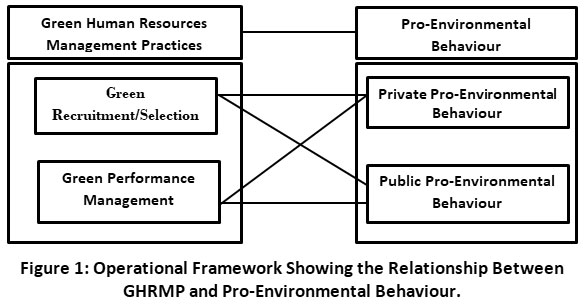 |
Figure 1: Operational Framework Showing the Relationship Between GHRMP and Pro-Environmental Behaviour. Click here to view Figure |
Dimensions: Redman and Maguire (2013); Opatha (2013); Renwick, Tang, Chen, Jiang, Paille and Jia (2018).
Measures: Stern (2000); Fu, Zhang, Xiong and Bai (2018).
Theoretical Framework
Norm Activation Model/Theory
Three elements stimulate behaviour occurrence process. They are individual norms, consequence awareness and responsibility ascription 5. Norm activation theory was described as “one of the theories commonly used to explain pro-environmental behaviour …” De Groot, and Steg (2009) as quoted in 11. This is sequel to the chain reaction of three elements mentioned earlier for stimulating behaviour occurrence process – Ascribed Responsibility (AR), Adverse Consequence (AC) and Personal Norm (PN).
Ascribed responsibility was described as nous of obligation to those consequences that are negative. Adverse consequence was also described as the ability to know the likely negative impact of those actions that are not pro-environmentally. Again, personal norm is an individual moral obligation to transmit out or refraining from transmitting out definite behaviour11. 12 added that personal norm is the central construct of the norm activation theory because it is the major determinant of behaviour and that it should be activated before it is found relevant like the use of GHRMP for employment process in an organisation to achieve pro-environmental behaviour.
This theory explains how norm is normally activated and thereby shapes values, attitudes, and beliefs affecting environmentally ethical behaviours through the development of knowledge and skills that enhanced participation in social and ecological matters. If adverse consequences, therefore, increase, ascribed responsibility will likewise increase. These two elements can be described as the set of belief to achieve a particular behaviour. It is process for making decision through which individual personal and social norms facilitate the stimuli of broad value on self-sacrificing and/or supporting behaviour (Schwartz & Howard, 1981:193 as quoted in 12.
Concept of Green Human Resource Management Practices
GHRM was defined by 4 as the human resource management (HRM) that deals with the management of the environment by hiring those employees that are willing to create and sustain organisation that is environmental friendly by implementing environmental management activities. This is based on the premise that “…environmental reputation is important” [4]. Renwick, et al. (2013) as quoted in 13 affirmed that GHRM reflects HR management married with environmental management. Also, Ahuja (2015) as quoted in 14 described green HR management as the use of HR management policies for supporting the use of resources and actively encouraging environmentalism.
To protect the environment especially by organisations, the human resource management unit according to Daily and Huang (2001) quoted in 13 should be doing something concrete by formulating and implementing employment policies that are environmentally friendly. Apart from assisting the organisation in improving the organisation’s performance as well as improving the internal manufacturing processes, 13 GHRM just like HR management could be beneficial directly to external stakeholders, encouraging workers’ commitment, and environmental practices involvement, that is, a source of increasing their motivation, pride and belongingness. 13 added that from GHRMP, organisation will enjoy goodwill, reduction in stakeholders’ pressure and in the long run be beneficial to next generations. It was deposited by 4 that most employees that work in environmental friendly workplace tend to be innovative and that they are problem solving individuals. 4 went further to assert that the turnover rate of employees working in organisation that are green oriented are usually minimal and are also low cost budget flexible.
oncept of Pro-Environmental Behavior
Employee pro-environmental behaviour (PEB) was described by Bissin-Olson, et al. (2013) as quoted in 6 as the level at which work was being done by employee in an environmentally friendly manner which is most times influenced by employee’s volitional choice and supported by the structure put in place by either the society or the organisation. 5 asserted that pro-environmental behaviour is an effort by individual aimed at reducing the negative effect as a result of destruction of natural phenomenon around us by simply preserving, protecting and improving the environment. 9 gave a broad definition of PEB as any behaviour that convert available energy and or materials or energy offered by the environment as well as altering the dynamics and or structure of atmosphere or environments.
It was asserted by 5 that attitudes and behaviours are gotten from education and life experience. When employees are within an organisation that domesticates green process, they are likely to be influenced by their working environment to have environmental friendly behaviour. It was also asserted in 15 that pro-environmental behaviour could be observed as that pro-social behaviour of people within a particular community, group/team and/or organisation. They went further to stress it that pro-social behaviour ought to have impact that is enduring on the employees’ well-being. However, pro-environmental behaviour will be looked at from two angle in reliance on the submission of 9 and 10, that is, private pro-environmental behaviour – purchasing, using and disposing personal products; and public pro-environmental behaviour – policies on pro-environmental, sharing of knowledge on environmental issues and encouragement of people to be involved in pro-environmental activities. It must be noted that when discussing either private or public pro-environmental behaviour, any of those mentioned examples can be the focus.
Green Recruitment/Selection and Private Pro-Environmental Behaviour
An expert in Human Resource (John Sullivan) described green recruitment as commitment to the environment by applicant that may be likely hired by an organisation and the hirer (the organisation) who believe strongly in respecting the environment 4. This was referred to by 8 as “war for talent” and this is because to attract high-quality job seeker to the organisation is a big challenge to human resource department. One of the best ways of reducing the anxiety is by applying a non-stop employment process mostly through online recruitment. This can only be facilitated by constantly updating the human resource part of the organisation.
In 16; Jackson, et al. (2011) and others as quoted in 13, it was asserted that green recruitment is an essential component in green human resource management practices because employees that value environmental will actively enhance their operational process their (private) environmental knowledge. The issue now is does green recruitment truly enhance private pro-environmental behaviour?
Selection is the second stage in the employment process anywhere which could just be described as weeding exercise of unwanted or unqualified applicants in the employment process. That is, removing those that did not meet the employment requirement and select those that meet up with the set criteria. Green selection was described by Ullah (2017) as quoted in 17 as candidates hiring based on their attitudes, skill, knowledge, and behaviors in conformity with organisational systems of environmental management. Organisations must not only attract job seekers that have green awareness alone but they should as well select them for employment in the organisation after allowing them to pass through series of environmental related and other fundamental tests so as to be sure about how positive they are on environmental and other fundamental matters 13.
It has been established in a study reported in 8 that one of the main predictors of the overall selection attractiveness of any organisation is positive environmental image of the organisation which in turn affect the public pro-environmental behaviour of employees of such organisation. Again, green selection leads to high commitment by the employees selected which could be otherwise referred to as practices which have impact on performance through the creation of organisational commitment environment which will help in the stimulation of employee’s private pro-environmental behaviour as well as increasing the competitive advantage of organisation Collins and Smith (2006) as quoted in 13. We, therefore, hypothesized it as hypothesis one.
Hypothesis 1:
No relationship between green recruitment/selection and private pro-environmental behaviour of knowledge workers in selected private organisations in Ogun State, Nigeria.
Green Recruitment/Selection and Public Pro-Environmental Behaviour
Recruitment is attracting reliable and best candidate to the organisation for employment purpose. But in the same vein, green recruitment is attracting candidates to work for the organisation with serious consideration of environmental friendliness Jabbour, Santos and Nagano (2008) as quoted in 13. A study was said to have been conducted for comparing two corporate social performances and it revealed that firms implementing good environmental policies need to emphasize it during recruitment processes focusing more on the characteristics of the job like remuneration during interview of candidates. Again, organisations should endeavour to provide details about their environmental policies on their recruitment websites to attract job seekers just like it is commonly done by many organisations in Europe, so that job seekers could make use of the organisation’s attributes like using environmental image and reputation in finding clues concerning imminent actions and intents 8.
Job seekers are also attracted to organisation with green branding that is positive on images and issues relating to environmental friendliness 13. But recruiters using green recruitment should evaluate based on green principles to give a sense of public pro-environmental behaviour after recruitment. Environmental inclined management might possess competitive advantage in hiring potentially high-performing employees 8. Chartered Institute of Personnel and Development (CIPD) in 2007 as quoted in [8] opined that high performing graduates of tertiary institutions will decide to work in an organisation after looking at the reputation and performance environmentally. Obaid and Alias (2015) as quoted in 18 where it was revealed that recruiting staff with green oriented is a dire feature to promote green HM practices that enhance innovative behaviors not leaving right attitude. By right attitude, they are referring to public PEB. Employees PEB depends strongly in employing staff that may be willing to engage in activities of environmental management which require awareness and knowledge of employees hired 8.
In addition to the normal selection criteria, green selection requires selection of environmental friendly job seekers 19. This is done by considering the environmental interest and concern of the candidates as part of the criteria for selecting them. To authors like Wehrmeyer (1996) and Revill (2000) as quoted in 19 opined that as candidates are being interviewed or evaluated them for selection, question relating to environment should be asked by the firm’s recruiters.
It was asserted in 17 that upon the completion of recruitment process, those candidates selected should be availed with green orientation programme covering organisational commitment and environmental sustainability information that will enhance their public pro-environmental behaviour to the organisation and the other stakeholders. We again, need to examine authenticity of this assumption in this study, thus we have the second hypothesis.
Research Hypothesis 2
There is no relationship between green recruitment/selection and public pro-environmental behaviour of knowledge workers in selected private organisations in Ogun State, Nigeria.
Green Performance Management GPM and Private Pro-Environmental Behaviour (PEB)
PM was described by 16 as the process employees are compelled to improve their professional skills that assist in achieving the corporate aims and intentions. But Jabbour, et al. (2008) as quoted in 13 described GPM as the evaluating method of events of an organisation staffs’ performance in terms of green and other fundamental focus. In addition, green performance management will be tailored towards green target and green initiatives that will achieve environmental friendly result. 20 opined that “one of the initial important steps that can be taken by HR towards the development of a comprehensive green approach is persuading managers towards adding environment related goals to the job descriptions and job goals of employees”. Renwick, Redman and Maguire (2013) as quoted in 13 argued that negative measures could be used to have a check on the individual employee green performance and definitely, these negative measures will have impact on the private pro-environmental behaviour of the employee by striving towards green goals in the future endeavours. Though, 2 argued that such adverse methods do not have effect on their private pro-environmental behaviour.
It was also contended that performance is always shaped by contextual factors and that employee/staff green behaviour (EGB) performance is influenced by personal factors 21. The sole aim of green performance management which starts with appraisal is strictly to evaluate each employee’s performance pointing to the fact that the evaluation will be directed towards each employee’s private pro-environmental behaviour. To be sure of these assertions, we came up with another hypothesis.
Research Hypothesis 3
There is no relationship amongst green performance management and private pro-environmental behaviour of knowledge workers in selected private organisations in Ogun State, Nigeria.
Green Performance Management (GPM) and Public Pro-Environmental Behaviour
Green performance could as well be referred to as green performance appraisal though appraisal is an integral part of performance management. 16 opined that the most vital aspect of green performance management is appraisal of performance. Appraisal of performance require setting green standard and Milliman and Clair (1996) as cited in 13 emphasized that green standard setting translate into environmental objectives action plans used for subsequent effective compensation and reward of employees. This is by ensuring that employees reduce carbon emissions, involve in environmental concern communication and environmental responsibility.
Furthermore, apart from achieving reliability, fairness and possibly, validity, proper performance appraisals give employees necessary feedback which in turn enhances pro-environmental behaviour of employees 4 maintained that to motivate employees at all levels directing attention at the organisation’s green strategy, there must be scheme for green reward.
Apart from tangible benefits highlighted by Ahmad (2015) as cited in 21 resulting from green performance management, organisations can also be proactive by opting for ISO 14001 certification track if they are sure and convinced of their employees’ public pro-environmental behaviour. Again, 8 asserted that transformational leadership behaviours positively encourage the public pro-environmental behaviour. To ascertain the credibility of these assertions, we came up with another hypothesis.
Research Hypothesis 4: There is no relationship between green performance management and public pro-environmental behaviour of knowledge workers in selected private organisations in Ogun State, Nigeria.
METHOD
Population studied includes all knowledge workers in all incorporated private organisations in Ogun State, Nigeria. But for convenience and accessibility especially in this COVID-19 pandemic period, few private organisations that could be assessed electronically were selected. This study made use of e-survey research design with administration of questionnaire on the knowledge workers of some selected organisations within Ogun State, Nigeria and they are Nestle Flower-gate Factory, Sagamu; Nigerian Breweries PLC, Ijebu-Ode plant; Rite-Foods Limited, Ijebu-Ode plant; Sonia Foods Industries Limited, Ibafo; Intercontinental Breweries PLC, Sagamu; and Coleman Wires and Cables Limited, Sagamu.
The use of e-survey was made possible by identifying a reliable source within each of the organisations and sending the questionnaire to their email address for forwarding to at least twenty-five (25) knowledge-workers in their respective organisation. This necessitated the use of Random sampling method in administering the research instrument in those selected organisations. The administered questionnaire were more than one hundred and fifty (150) copies administered electronically, though, the first reliable set of one hundred and fifty (150) received were worked with and again, there is no need in determining the sample size as the target population can be covered by the researchers. E-survey method of questionnaire administration is proposed for this study because of the COVID-19 pandemic instead of one-on-one (physical contact) method based on national order of social distance. The statement items on green recruitment/selection and green performance was adapted from 13; and statement items on private and public pro-environmental behaviour were adapted from 10.
Pearson Product Moment Correlation (PPMC) used in testing the hypotheses. PPMC analysis is for determining the relationship existing among the study variables. This is simply to determine if there is any relationship – positive or negative and the capability of such relationship. PPMC was used basically to determine the strength or level of linear association or rather, association among the predictor and criterion variables if there exist any positive, negative or no linear association among the variables. PPMC was also considered for the fact that it can accommodate values from minus one (-1) to plus one (+1).
Hypotheses TestingDecision Rule
Null hypotheses will be rejected if p < 0.05 level of significant and accepted if p > 0.05. All hypotheses stated and verified in the null method.
HO1 Testing
HO1: There is no relationship between green recruitment/selection GR/S and private pro-environmental behaviour of knowledge workers in selected private organisations in Ogun State, Nigeria.
HA1: There is relationship between green recruitment/selection GR/S and private pro-environmental behaviour of knowledge workers in selected private organisations in Ogun State, Nigeria.
Table 1: Green Recruitment/Selection and Private Pro-Environmental Behaviour.
|
Correlations |
Green Recruitment/Selection |
Private Pro-Environmental Behaviour |
|
|
Green Recruitment/Selection |
Pearson Correlation |
1 |
.592** |
|
Sig. (2-tailed) |
|
.000 |
|
|
N |
150 |
150 |
|
|
Private Pro-Environmental Behaviour |
Pearson Correlation |
.592** |
1 |
|
Sig. (2-tailed) |
.000 |
|
|
|
N |
150 |
150 |
|
|
**. Correlation is significant at the 0.01 level (2-tailed). |
|||
Table 1 analysis result established p< 0.05 (0.000< 0.05) significant level, this pointed out that significant relationship exist between green recruitment/selection and private pro-environmental behaviour. r = 0.592 shows positive relationship between green recruitment/selection and private pro-environmental behaviour. This indicates that private pro-environmental behaviour will increase once there is an increase in green recruitment/selection. Null hypothesis is rejected and alternate hypothesis accepted; that there is a relationship amongst green recruitment/selection and private pro-environmental behaviour of knowledge workers in selected manufacturing organisations in Ogun State, Nigeria.
HO2 Testing
HO2: There is no relationship between green recruitment/selection and public pro-environmental behaviour of knowledge workers in selected private organisations in Ogun State, Nigeria.
HA2: There is relationship between green recruitment/selection and public pro-environmental behaviour of knowledge workers in selected private organisations in Ogun State, Nigeria.
Table 2: Green Recruitment/Selection and Public Pro-Environmental Behaviour.
|
Correlations |
Green Recruitment/Selection |
Public Pro-Environmental Behaviour |
|
|
Green Recruitment/Selection |
Pearson Correlation |
1 |
.277** |
|
Sig. (2-tailed) |
|
.000 |
|
|
N |
150 |
150 |
|
|
Public Pro-Environmental Behaviour |
Pearson Correlation |
.277** |
1 |
|
Sig. (2-tailed) |
.000 |
|
|
|
N |
150 |
150 |
|
|
**. Correlation is significant at the 0.01 level (2-tailed). |
|||
Source: SPSS Version 25.0 Output, 2021
Table 2 analysis result reveals p< 0.05 (0.000< 0.05) level of significant, that is, relationship exist between green recruitment/selection and public pro-environmental behaviour. r = 0.227 implies denotes positive relationship existing between recruitment/selection and public pro-environmental behaviour. Hence, null hypothesis is rejected and accepts alternate hypothesis that significant relationship exist amongst green recruitment/selection and public pro-environmental behaviour of knowledge workers in selected private organisations in Ogun State, Nigeria.
HO3 Testing
HO3: There is no relationship between green performance management and private pro-environmental behaviour of knowledge workers in selected private organisations in Ogun State, Nigeria.
HA3: There is relationship between green performance management and private pro-environmental behaviour of knowledge workers in selected private organisations in Ogun State, Nigeria.
Table 3: Green Performance Management and Private Pro-Environmental Behaviour.
|
Correlations |
Green Performance Management |
Private Pro-Environmental |
|
|
Green Performance Management |
Pearson Correlation |
1 |
.464** |
|
Sig. (2-tailed) |
|
.000 |
|
|
N |
150 |
150 |
|
|
Private Pro-Environmental Behaviour |
Pearson Correlation |
.464** |
1 |
|
Sig. (2-tailed) |
.000 |
|
|
|
N |
150 |
150 |
|
|
**. Correlation is significant at the 0.01 level (2-tailed). |
|||
Source: SPSS Version 25.0 Output, 2021
Table 3 analysis result implies p< 0.05 (0.000< 0.05) level of significant, this denotes significant interconnection amongst green performance management and private pro-environmental behaviour. r = 0.464 exposes positive relationship existing amongst green performance management and private pro-environmental behaviour that indicate that one variable increases the other variable will increase. Null hypothesis rejected and alternate hypothesis accepted signifying significant relationship existing between green performance management and private pro-environmental behaviour of knowledge workers in selected private organisations in Ogun State, Nigeria.
HO4 Testing
HO4: There is no relationship between green performance management and public pro-environmental behaviour of knowledge workers in selected private organisations in Ogun State, Nigeria.
HA4: There is relationship between green performance management and public pro-environmental behaviour of knowledge workers in selected private organisations in Ogun State, Nigeria.
Table 4: Green Performance Management and Public Pro-Environmental Behaviour.
|
Correlations |
Green Performance Management |
Public Pro-Environmental Behaviour |
|
|
Green Performance Management |
Pearson Correlation |
1 |
.500** |
|
Sig. (2-tailed) |
|
.000 |
|
|
N |
150 |
150 |
|
|
Public Pro-Environmental Behaviour |
Pearson Correlation |
.500** |
1 |
|
Sig. (2-tailed) |
.000 |
|
|
|
N |
150 |
150 |
|
|
**. Correlation is significant at the 0.01 level (2-tailed). |
|||
Source: SPSS Version 25.0 Output, 2021
Table 4 analysis result indicates p< 0.05 (0.000< 0.05) level of significant suggesting relationship existing between green performance management and public pro-environmental behaviour. r = 0.500 signifies positive relationship amongst green performance management and public pro-environmental behaviour. This means that as green performance management increases public pro-environmental behaviour will increase. Hence, null hypothesis rejected and alternate hypothesis accepted showing that significant relationship exist between green performance management and public pro-environmental behaviour of knowledge workers in selected private organisations in Ogun State, Nigeria.
Findings
Green Recruitment/Selection and Private PEB
Hypothesis testing on how green recruitment/selection relates with private pro-environmental behaviour showed that the p-value was 0.000 that is less than 0.05. This connotes that green recruitment/selection relates with private pro-environmental behaviour among the employees of knowledge workers in selected private organisations in Ogun State, Nigeria. Null hypothesis rejected in accordance with the decision rule and accept the alternate hypothesis. When the green recruitment/selection is high, such enhances employees’ private pro-environmental behaviour in the organisation. The correlational value (r) was 0.590. This is indicating that green recruitment/selection has a high positive relationship with private pro-environmental behaviour among knowledge workers in selected private organisations. Furthermore, the coefficient of determination between green recruitment/selection and private pro-environmental behaviour was 0.350. By implication, a unit change in green recruitment/selection will account for 35% total variation in private pro-environmental among the knowledge workers in selected private organisations. Thus, one can assert that higher green recruitment/selection is a contributory factor to higher level of private pro-environmental behaviour displayed in organisation by the knowledge workers. This finding is in-line with that of [16]; Jackson, et al. (2011) and others as quoted in [13] asserted that green recruitment is an essential component in green human resource management practices because employees that value environmental will actively enhance their operational process their (private) environmental knowledge. Also, green selection leads to high commitment by the employees selected which could be otherwise referred to as practices which have impact on performance through the creation of organisational commitment environment which will help in the stimulation of employee’s private pro-environmental behaviour as well as increasing the competitive advantage of organisation Collins and Smith (2006) as quoted in13.
Green Recruitment/Selection and Public PEB
The analysis outcome on how green recruitment/selection relates with public pro-environmental behaviour revealed that there is a substantial relationship between them, given 0.000 p-value and below 0.05 (p=0.000 < 0.05) significant level. The hypothesis which was given in null form rejected and accepts the alternate hypothesis. r was .277. This indicates medium relationship existing between green recruitment/selection and public pro-environmental behaviour among knowledge workers of selected private manufacturing organisations in Ogun State, Nigeria. The positive relationship implies that the public pro-environmental behaviour increases when there is an increase in green recruitment/ selection. Furthermore, the coefficient of determination (r2) was 0.077 which denotes that a unit change in green recruitment/selection in selected private organisations will account for up to 7.7% total variation in public pro-environmental behaviour among the knowledge workers. Hence, green recruitment/selection is an essential factor in organisations that help increase public pro-environmental behaviour. This finding concurred with that of Obaid and Alias (2015) as quoted in 18 where it was recruiting staff with green oriented is a dire feature to promote green HM practices that enhance innovative behaviors not leaving right attitude. By right attitude, they are referring to public pro-environmental behaviour. Furthermore, [8] opined that one of the main predictors of the overall selection attractiveness of any organisation is positive environmental image of the organisation which in turn affects the public pro-environmental behaviour of employees of such organisation.
Green Performance Management and Private Pro-Environmental Behaviour
The third hypothesis on how green performance management relates with private pro-environmental behaviour showed that the p-value was 0.000 below 0.05. This connotes that green performance management relates significantly with private pro-environmental behaviour among the knowledge workers in selected private organisations in Ogun State, Nigeria. The null hypothesis accepted in accordance with the decision rule and accepts the alternate hypothesis. r value was 0.464 which points to green performance management having a moderate positive relationship with private pro-environmental behaviour among knowledge workers in selected private organisations. Any rise in GPM will thus result in upsurge in private pro-environmental behaviour. Furthermore, the coefficient of determination between GPM and private PEB was 0.215. By implication, a unit change in green performance management will account for 21.5% total variation in private pro-environmental behaviour among knowledge workers in selected private organisations. Thus, one can assert that higher green performance management is a contributory factor to higher level of private pro-environmental behaviour displayed in organisation. This finding agrees with that of Renwick, Redman and Maguire (2013) as quoted in 13 argued that negative measures could be used to have a check on the individual employee green performance and definitely, these negative measures will have impact on the private pro-environmental behaviour of the employee by striving towards green goals in the future endeavours. In addition,
Green Performance Management and Public Pro-Environmental Behaviour
The findings in the fourth hypothesis revealed that green performance management relates with public pro-environmental behaviour with 0.000 as p-value below 0.05. The correlation value (r) was 0.500 which shows a high level of correlation among green performance management and public pro-environmental behaviour. The positive link implies that the higher green performance management in the selected private organisations, the more the public pro-environmental behaviour among the knowledge workers. Similarly, the coefficient of determination (r2) was 0.250. By implication, a unit change in green performance management will result in 25% variation in public pro-environmental behaviour. This study is in tandem with 8 that asserted that transformational leadership behaviours (talking of green performance management) positively encourage the public pro-environmental behaviour. Also, Ahmad (2015) as quoted in 21 opined that resulting from green performance management, organisations can also be proactive by opting for ISO 14001 certification tracks if they are sure and convinced of their employees’ public pro-environmental behaviour.
Conclusion
Based on the study findings, it is imperative to emphasize that GHRMP are stimulus that can assist in having increased PEB in private organisations in Ogun State and by implication, the entire Nigeria. The study, therefore, align with the submission of 5 that attitudes and behaviours are gotten from education and life experience. When employees are within an organisation that domesticates green process, they are likely to be influenced by their working environment to have environmental friendly behaviour.
Recommendation
It should be noted that the deadly virus (COVID-19) started in China as confirmed by World Health Organisation (WHO) where there was emphasis on two key policies of developing the economy and protecting the environment after declaring in 2014 by China’s President that economic development should be slowed down and “green, low-carbon, and sustainable type of development” should be promoted 10. If such could happen in such country, then, it is imperative to recommend for all organisations around the globe to embrace pro-environmental behaviour both in private and public domain and as charity, they said begins at home, organisations needs to inculcate environmental friendly policies into their employment process.
Acknowledgement
This is purely an academic exercise done to better ourselves and the body of knowledge.
Conflict of Interest
There is no conflict of interest.
Funding sources
Nobody gave us grants/funds or any form of support for the research.
References
- Steg, L. & Viek, C. (2009). Encouraging pro-environmental behaviour: An integrative review and research agenda, Journal of Environmental Psychology, 29, 309-317. https://doi.org/j.jenvp.2008.10.004
CrossRef - Renwick, D. E., Redman, T. & Maguire, S. (2013). Green human resource management: A review and research agenda, International Journal of \management Reviews, 15(1), 1-14. https://doi.org/10.1111/j.1468-2370.2011.00328.x
CrossRef - Lynn, P. (2014). Distinguishing dimensions of pro-environmental behavior, Economic & Social Research Council, 2014-19. http://hdl.handle.net/10419/123804
- El-Sakka, S. E. (2018). Impact of green human resource management (GHRM) practices on enhancing supply chain image and performance, European Centre for Research Training and Development UK. 6(3), 70-78.
- Palupi, T. & Sawitri, D. R. (2018). The importance of pro-environmental behavior in adolescent, Psychology, E3S Web of Conferences, 31, 1-4. https://doi.org/10.1051/e3sconf/20183109031
CrossRef - Fatoki, O. (2019). Hotel employees’ pro-environmental behavior: Effects of leadership behavior, institutional support and workplace spirituality, Sustainability, 11, 4135. https://doi.org/10.3390/sci/1154135
CrossRef - Opatha, H. H. D. N. P. (2013). Human resource management and competitive advantage, Charana Academic Journal, Association of \monks, University of Sri Jayewardenepura, Sri Lanka, 5, 521-538.
- Renwick, G. W. S., Jabbour, C. J. C., Muller-Camen, M., Redman, T. & Wilkonson, A. (2016).Contemporary developments in Green (environmental) HRM scholarship, International Journal of Human Resource Management, 27(1-2), 114-128. https://doi.org/10.1080/09585192.2015.1105844
CrossRef - Stern, P. (2000).Toward a coherent theory of environmentally significant behavior, Journal of Social Issue, 56(3), 407-424. https://doi.org/10.1111/0022.4537.00175
CrossRef - Fu, L., Zhang, Y., Xiong, X., & Bai, Y. (2018). Pro-environmental awareness and behaviors on campus: Evidence from Tianjin, China, EURASIA Journal of Mathematics, Science and Technology Education, 14(1), 427-445. https://doi.org/10.12793/ejmste/77953
CrossRef - Benyamin, A., Djuwita, R. & Ariyanto, A. A. (2018). Norm activation theory in the plastic age: Explaining children’s pro-environmental behaviour, E3S Web of Conferences, 74, 08008, ICSoLCA https://doi.org/10.1051e3sconf/20187408008.
CrossRef - Lauper, E., Moser, S., Fischer, M. & Matthies, E. (2016). Explaining car drivers’ intention to prevent road-traffic noise: An application of the norm activation model, Environment and Behavior, 48(6), 826-853. https://doi.org/10.1177/0013916515570476
CrossRef - Tang, G., Chen, Y., Jiang, Y., Paille, P., & Jia, J. (2018). Green human resource management practices: Scale development and validity, Asia Pacific Journal of Human Resources, 56(1), 31-55. https://doi.org/10.1111/1744-7941.12147
CrossRef - Vahdati, S. & Vahdati, S. (2018). Identifying the obstacles of green human resource management practices in Iran, International Journal of Human Capital Urban Management, 3(1), 9- 18. https://doi.org/10.22034/ijhcum.2018.03.01.002
- Prati, G., Albanesi, C. & Pietrantoni, L. (2017). Social well-being and pro-environmental behavior: A cross-lagged panel design, Human Ecology Review, 23(1), 123-139. https://doi.org/10.22459/HER.23.01.2017.07
CrossRef - Ahmad, S. (2015). Green human resource management: Policies and practices, Cogent Business & Management, 2, 1-13. https://doi.org/10.1080/23311975.2015.1030817
CrossRef - Mashala, Y. L. (2019). Green human resource management and environmental sustainability in Tanzania: A review and research agenda, International Journal of Academic Multidisciplinary Research, 2(12), 60-68.
- Kuria, M. W. & Mose, T. (2019). Effect of green human resource management practices on organisational effectiveness of universities in Kenya, Human Resource and Leadership Journal, 4(2), 1-20. https://doi.org/10.47941/hrlj.319
CrossRef - Arulrajah, A. A., Opatha, H. H. D. N. P. & Nawaratne, N. N. J. (2015). Green human resource management practices: A review, Sri Lanka Journal of Human Resources Management,5(1), 1-16. https://doi.org/10.4038/sljhrm.v5i1.5624
CrossRef - Shahriari, B. & Hassanpoor, A. (2019). Green human resource management in the east and west.Revista Gestao Techologia, Pedro Leopoldo, 19(2), 27-57. https://doi.org/10.20397/2177-6652/2019.v19i2.1546
CrossRef - Zubair, S. S. & Khan, M. A. (2019). Sustainable development: The role of green HRM, International Journal of Research in Human Resource Management, 1(2), 01-06. https://www.researchgate.net/publication/334317586

This work is licensed under a Creative Commons Attribution 4.0 International License.